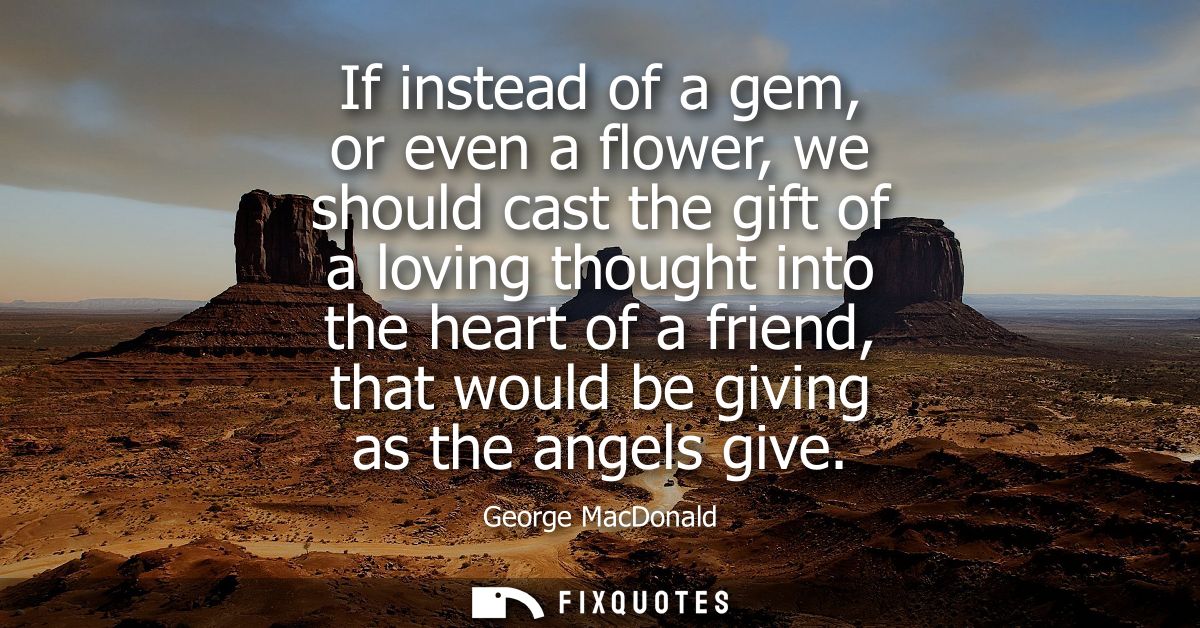
"If instead of a gem, or even a flower, we should cast the gift of a loving thought into the heart of a friend, that would be giving as the angels give"
About this Quote
The angel line is classic MacDonald: Christianity without the bookkeeping. “As the angels give” doesn’t mean grand miracles; it means giving without leverage. Angels, in his imagination, don’t give to be remembered, to be repaid, or to curate a social identity. They give because love moves outward by nature. The subtext is a critique of performative generosity - the kind that pads reputations and tightens social bonds through obligation.
Context sharpens the point. MacDonald wrote in a century that turned sentiment into an industry: bouquets with coded meanings, jewelry as status, gift-giving as ritualized proof of respectability. Against that, he elevates the small, interior act: the note, the attention, the true seeing of another person. It’s anti-consumerist before consumerism had a name, and it’s also psychologically astute: what actually nourishes friendship isn’t sparkle, it’s recognition.
Quote Details
| Topic | Friendship |
|---|---|
| Source | Unverified source: Annals of a Quiet Neighbourhood (George MacDonald, 1867)
Evidence: It must be something imperishable,, something which in its own nature IS. If instead of a gem, or even of a flower, we could cast the gift of a lovely thought into the heart of a friend, that would be giving, as the angels, I suppose, must give. (Chapter 26; exact page varies by edition). This qu... Other candidates (1) Walking the Path of Love (Joseph J. Mazzella, 2010) compilation97.5% ... If instead of a gem or even a flower , we should cast the gift of a loving thought into the heart of a friend , t... |
| Cite |
Citation Formats
APA Style (7th ed.)
MacDonald, George. (2026, March 14). If instead of a gem, or even a flower, we should cast the gift of a loving thought into the heart of a friend, that would be giving as the angels give. FixQuotes. https://fixquotes.com/quotes/if-instead-of-a-gem-or-even-a-flower-we-should-125649/
Chicago Style
MacDonald, George. "If instead of a gem, or even a flower, we should cast the gift of a loving thought into the heart of a friend, that would be giving as the angels give." FixQuotes. March 14, 2026. https://fixquotes.com/quotes/if-instead-of-a-gem-or-even-a-flower-we-should-125649/.
MLA Style (9th ed.)
"If instead of a gem, or even a flower, we should cast the gift of a loving thought into the heart of a friend, that would be giving as the angels give." FixQuotes, 14 Mar. 2026, https://fixquotes.com/quotes/if-instead-of-a-gem-or-even-a-flower-we-should-125649/. Accessed 7 Apr. 2026.