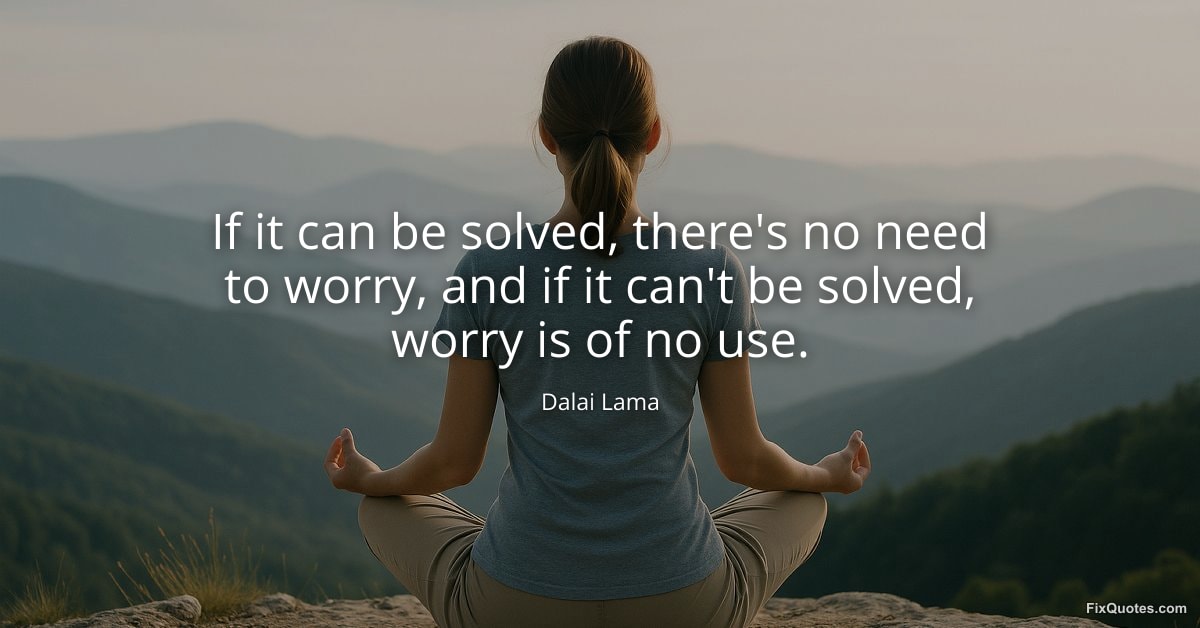
"If it can be solved, there's no need to worry, and if it can't be solved, worry is of no use"
About this Quote
As a spiritual and political leader, his intent isn’t merely therapeutic; it’s disciplinary. The line doesn’t romanticize calm. It argues for agency when agency is available and acceptance when it isn’t, and it refuses the modern habit of treating anxiety as evidence of seriousness. In that sense, it works like a koan dressed in plain language: it corners the mind. If you keep worrying, you’ve implicitly claimed one of two irrational positions - either you’re ignoring a solution you could pursue, or you’re demanding control over what cannot be controlled.
The subtext is Buddhist but also deeply political in its implications. Worry is ego’s way of insisting the world should be negotiable. For someone whose life has been marked by exile and the immense unsolved problem of Tibet, the quote reads less like a self-help mantra and more like a survival ethic: don’t let fear become your identity. It grants permission to stop rehearsing catastrophe, not because catastrophe isn’t real, but because suffering doesn’t need your additional sponsorship.
Its rhetorical power comes from clean structure and moral clarity: two clauses, no loopholes, no drama - a leader’s way of turning serenity into practice.
Quote Details
| Topic | Wisdom |
|---|---|
| Source | Later attribution: Grow! (Trevor Silvester, 2017) modern compilationISBN: 9781444740912 · ID: EHcADAAAQBAJ
Evidence:
... Dalai Lama wisely pointed out , ' If it can be solved , there's no need to worry , and if it can't be solved , worry is of no use . ' When the going gets tough ... The purpose of self - development isn't to smooth the seas of life ... |
| Video | Watch Video Quote |
| Featured | This quote was our Quote of the Day on December 18, 2025 |
| Cite |
Citation Formats
APA Style (7th ed.)
Lama, Dalai. (2026, January 11). If it can be solved, there's no need to worry, and if it can't be solved, worry is of no use. FixQuotes. https://fixquotes.com/quotes/if-it-can-be-solved-theres-no-need-to-worry-and-172836/
Chicago Style
Lama, Dalai. "If it can be solved, there's no need to worry, and if it can't be solved, worry is of no use." FixQuotes. January 11, 2026. https://fixquotes.com/quotes/if-it-can-be-solved-theres-no-need-to-worry-and-172836/.
MLA Style (9th ed.)
"If it can be solved, there's no need to worry, and if it can't be solved, worry is of no use." FixQuotes, 11 Jan. 2026, https://fixquotes.com/quotes/if-it-can-be-solved-theres-no-need-to-worry-and-172836/. Accessed 15 Mar. 2026.