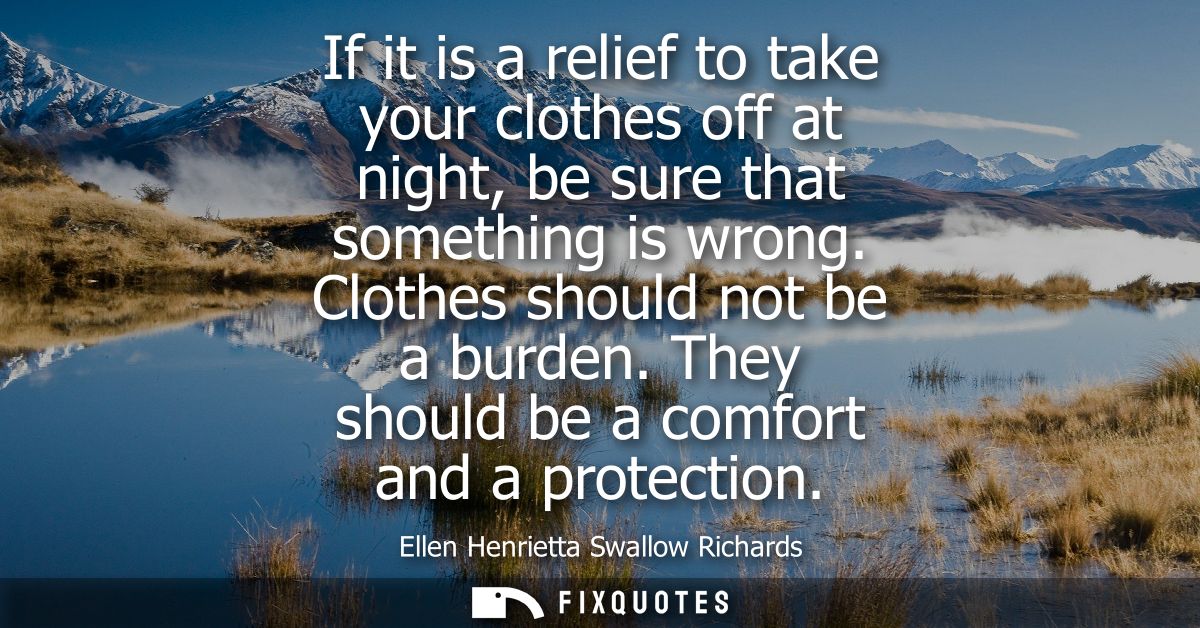
"If it is a relief to take your clothes off at night, be sure that something is wrong. Clothes should not be a burden. They should be a comfort and a protection"
About this Quote
Richards wrote in an era when women’s bodies were routinely negotiated through corsets, heavy skirts, tight collars, and the moral theater of “proper” appearance. The relief she’s talking about isn’t merely physical; it’s the release from constraint-as-respectability. Her sentence “be sure that something is wrong” refuses to romanticize discomfort as virtue. It reads like an early consumer-safety warning, aimed at a culture that praised endurance and treated pain as proof of refinement.
The subtext is a rebuke to design that prioritizes display over human function. By insisting clothes should be “comfort and protection,” she reclaims the purpose of material culture: to serve the wearer, not the onlooker. There’s also a class-and-labor undertone. Clothing that burdens you is harder to work in, harder to breathe in, harder to move through the world in. Richards, associated with the emerging science of home economics and public health, is effectively arguing that the everyday environment - down to fabric and fit - is a health issue, not a vanity issue.
It works because it’s practical, almost disarmingly so. She doesn’t sermonize; she gives you a bodily metric. Your own relief becomes evidence.
Quote Details
| Topic | Life |
|---|---|
| Source | Help us find the source |
| Cite |
Citation Formats
APA Style (7th ed.)
Richards, Ellen Henrietta Swallow. (2026, January 16). If it is a relief to take your clothes off at night, be sure that something is wrong. Clothes should not be a burden. They should be a comfort and a protection. FixQuotes. https://fixquotes.com/quotes/if-it-is-a-relief-to-take-your-clothes-off-at-119759/
Chicago Style
Richards, Ellen Henrietta Swallow. "If it is a relief to take your clothes off at night, be sure that something is wrong. Clothes should not be a burden. They should be a comfort and a protection." FixQuotes. January 16, 2026. https://fixquotes.com/quotes/if-it-is-a-relief-to-take-your-clothes-off-at-119759/.
MLA Style (9th ed.)
"If it is a relief to take your clothes off at night, be sure that something is wrong. Clothes should not be a burden. They should be a comfort and a protection." FixQuotes, 16 Jan. 2026, https://fixquotes.com/quotes/if-it-is-a-relief-to-take-your-clothes-off-at-119759/. Accessed 27 Mar. 2026.