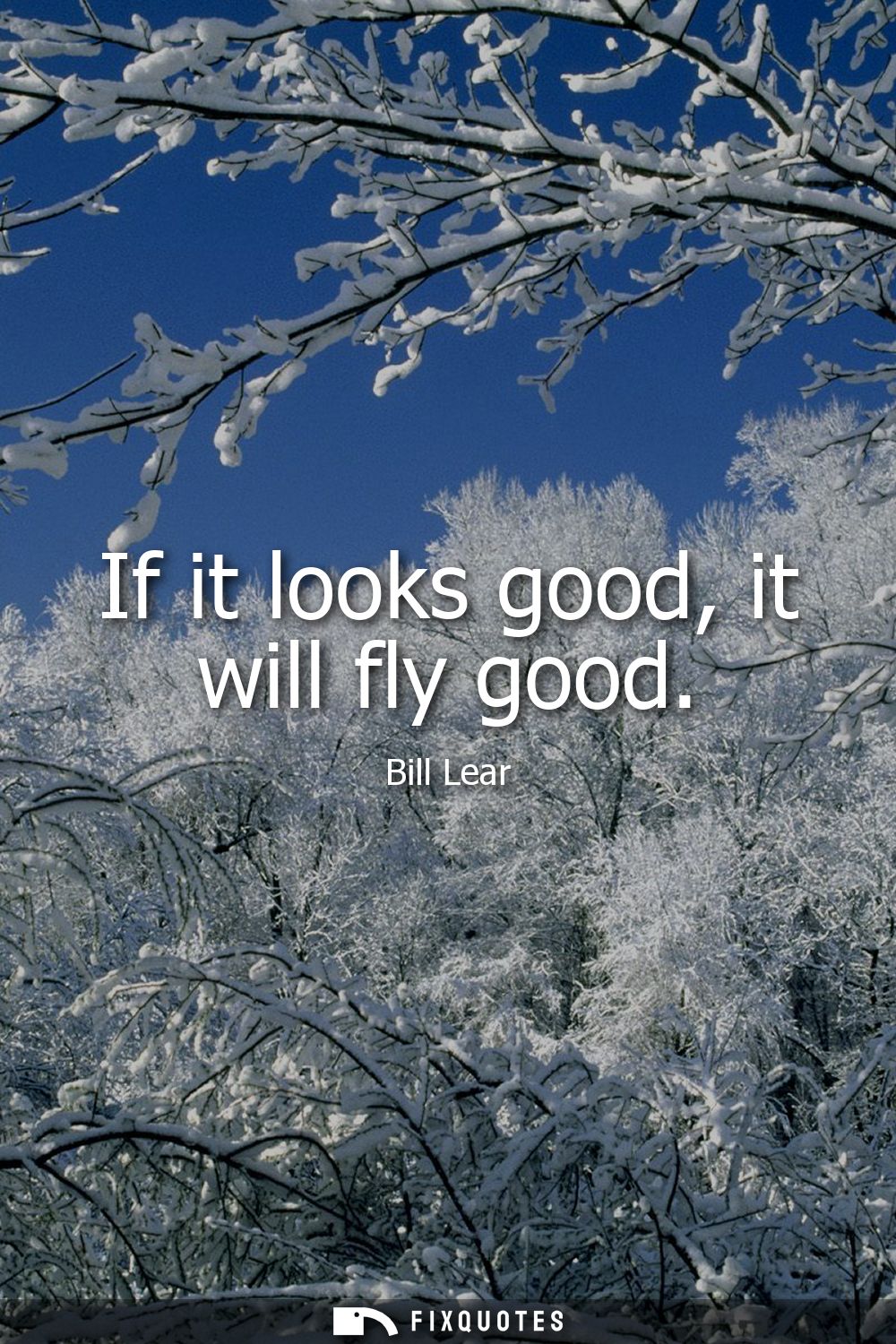
"If it looks good, it will fly good"
About this Quote
"If it looks good, it will fly good" is engineering heresy dressed up as common sense, and that’s why it lands. Bill Lear wasn’t a poet; he was an inventor and industrial operator who lived in the brutal feedback loop of prototypes, budgets, and deadlines. The line reads like a shop-floor proverb, but it’s really a management philosophy: trust the eye as a proxy for sound design, and don’t let analysis outrun judgment.
The intent is partly motivational. Lear is giving permission to stop fetishizing equations and start building. In aviation, where every mistake gets audited by gravity, “looks good” isn’t about styling for its own sake. It’s shorthand for aerodynamic coherence: smooth lines, clean junctions, symmetry, lack of draggy clutter. Humans evolved to read patterns fast; experienced builders often spot inefficiencies before the instruments do. Lear compresses that tacit knowledge into a sentence anyone can repeat.
The subtext has a swaggering American optimism: elegance equals performance, and a well-made thing should advertise its correctness. That belief has deep roots in modern design culture, from streamlining to Silicon Valley’s “it just feels right” product ethos. It’s also a warning: ugly solutions are frequently the result of compromise, committee churn, or bolted-on fixes. Lear is arguing for integrated thinking.
Of course, it’s not a law of physics. Plenty of beautiful aircraft were dogs, and plenty of ungainly ones were miracles. The quote endures because it’s less a claim about airfoils than a claim about craft: when form and function are genuinely aligned, your eyes can tell.
The intent is partly motivational. Lear is giving permission to stop fetishizing equations and start building. In aviation, where every mistake gets audited by gravity, “looks good” isn’t about styling for its own sake. It’s shorthand for aerodynamic coherence: smooth lines, clean junctions, symmetry, lack of draggy clutter. Humans evolved to read patterns fast; experienced builders often spot inefficiencies before the instruments do. Lear compresses that tacit knowledge into a sentence anyone can repeat.
The subtext has a swaggering American optimism: elegance equals performance, and a well-made thing should advertise its correctness. That belief has deep roots in modern design culture, from streamlining to Silicon Valley’s “it just feels right” product ethos. It’s also a warning: ugly solutions are frequently the result of compromise, committee churn, or bolted-on fixes. Lear is arguing for integrated thinking.
Of course, it’s not a law of physics. Plenty of beautiful aircraft were dogs, and plenty of ungainly ones were miracles. The quote endures because it’s less a claim about airfoils than a claim about craft: when form and function are genuinely aligned, your eyes can tell.
Quote Details
| Topic | Technology |
|---|---|
| Source | Help us find the source |
| Cite |
Citation Formats
APA Style (7th ed.)
Lear, Bill. (2026, January 13). If it looks good, it will fly good. FixQuotes. https://fixquotes.com/quotes/if-it-looks-good-it-will-fly-good-172444/
Chicago Style
Lear, Bill. "If it looks good, it will fly good." FixQuotes. January 13, 2026. https://fixquotes.com/quotes/if-it-looks-good-it-will-fly-good-172444/.
MLA Style (9th ed.)
"If it looks good, it will fly good." FixQuotes, 13 Jan. 2026, https://fixquotes.com/quotes/if-it-looks-good-it-will-fly-good-172444/. Accessed 12 Feb. 2026.
More Quotes by Bill
Add to List