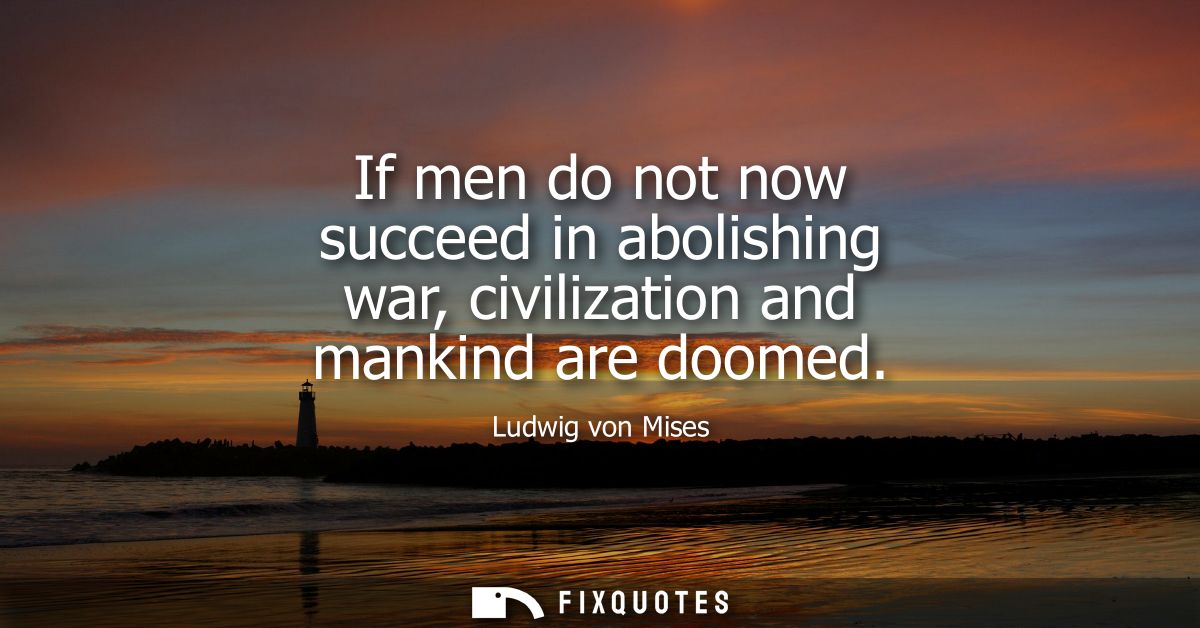
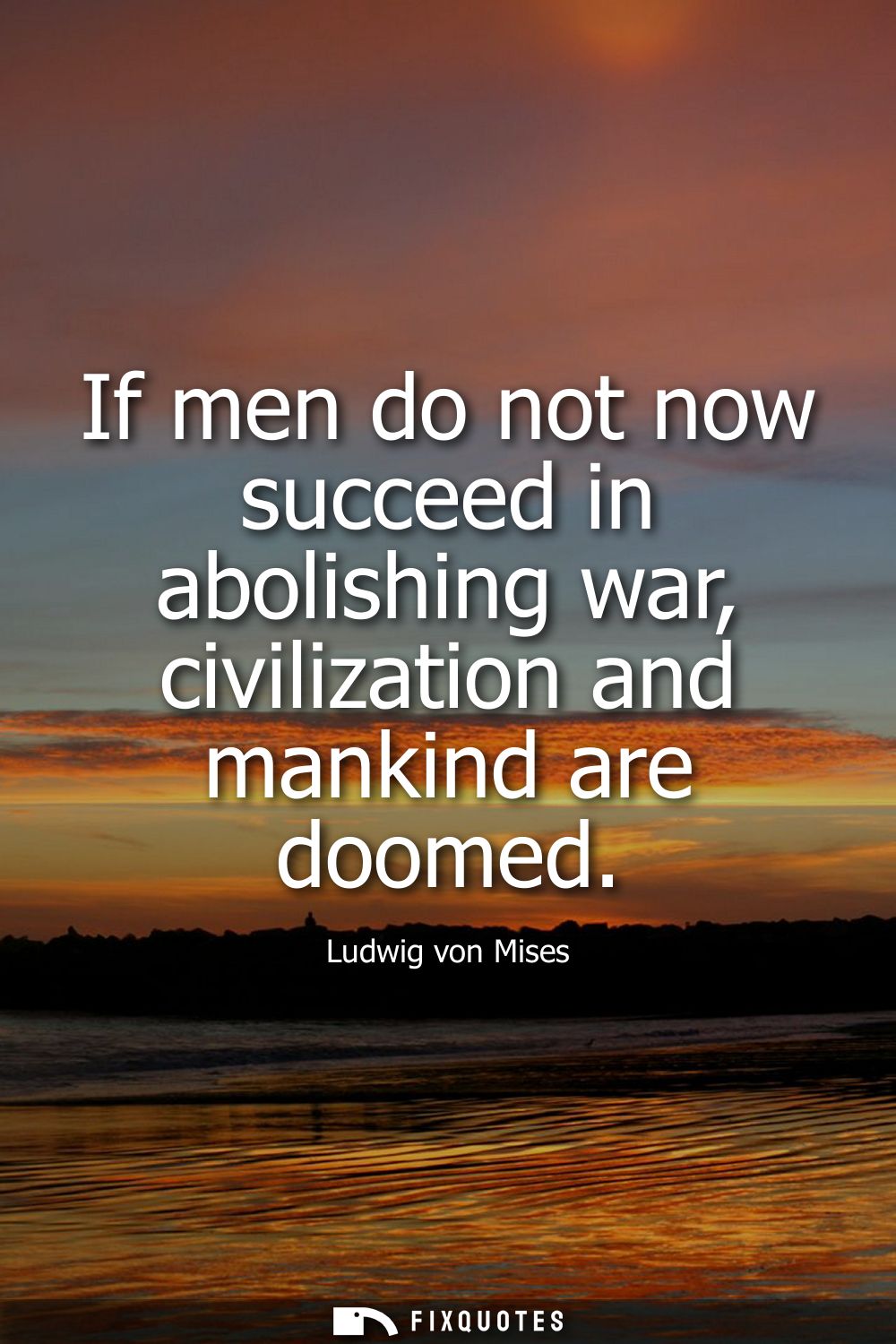
"If men do not now succeed in abolishing war, civilization and mankind are doomed"
About this Quote
There is nothing abstract about Mises's warning; it’s an economist’s doomsday scenario disguised as a moral appeal. “If men do not now succeed” compresses urgency and agency into one clause: war isn’t a natural disaster, it’s a policy choice, and the deadline is political, not geological. The sting is in the conditional. Mises isn’t forecasting doom as fate; he’s indicting a civilization that treats organized violence as a recurring expense line item rather than a solvency crisis.
The subtext is classic liberalism under siege. For Mises, “civilization” isn’t a vague ideal; it’s a fragile infrastructure of trade, division of labor, property rights, and the everyday trust that lets strangers cooperate. War doesn’t just kill people. It liquefies the institutional glue - currencies get commandeered, markets get rationed, dissent becomes treason, planning replaces prices, borders harden into identities. The phrase “civilization and mankind” pairs the refined and the biological: lose the former and the latter follows, because modern survival is no longer pastoral; it’s networked.
Context matters: Mises lived through the collapse of empires, hyperinflation, mass nationalism, and two world wars. He watched “temporary” wartime controls become peacetime habits. His intent isn’t pacifism as piety; it’s abolition as survival strategy, a demand that modernity outgrow its antique habit of settling disputes with artillery. The line works because it refuses comforting middle ground: either humanity innovates morally and institutionally, or it will innovate technically in ways that make annihilation efficient.
The subtext is classic liberalism under siege. For Mises, “civilization” isn’t a vague ideal; it’s a fragile infrastructure of trade, division of labor, property rights, and the everyday trust that lets strangers cooperate. War doesn’t just kill people. It liquefies the institutional glue - currencies get commandeered, markets get rationed, dissent becomes treason, planning replaces prices, borders harden into identities. The phrase “civilization and mankind” pairs the refined and the biological: lose the former and the latter follows, because modern survival is no longer pastoral; it’s networked.
Context matters: Mises lived through the collapse of empires, hyperinflation, mass nationalism, and two world wars. He watched “temporary” wartime controls become peacetime habits. His intent isn’t pacifism as piety; it’s abolition as survival strategy, a demand that modernity outgrow its antique habit of settling disputes with artillery. The line works because it refuses comforting middle ground: either humanity innovates morally and institutionally, or it will innovate technically in ways that make annihilation efficient.
Quote Details
| Topic | War |
|---|---|
| Source | Help us find the source |
More Quotes by Ludwig
Add to List