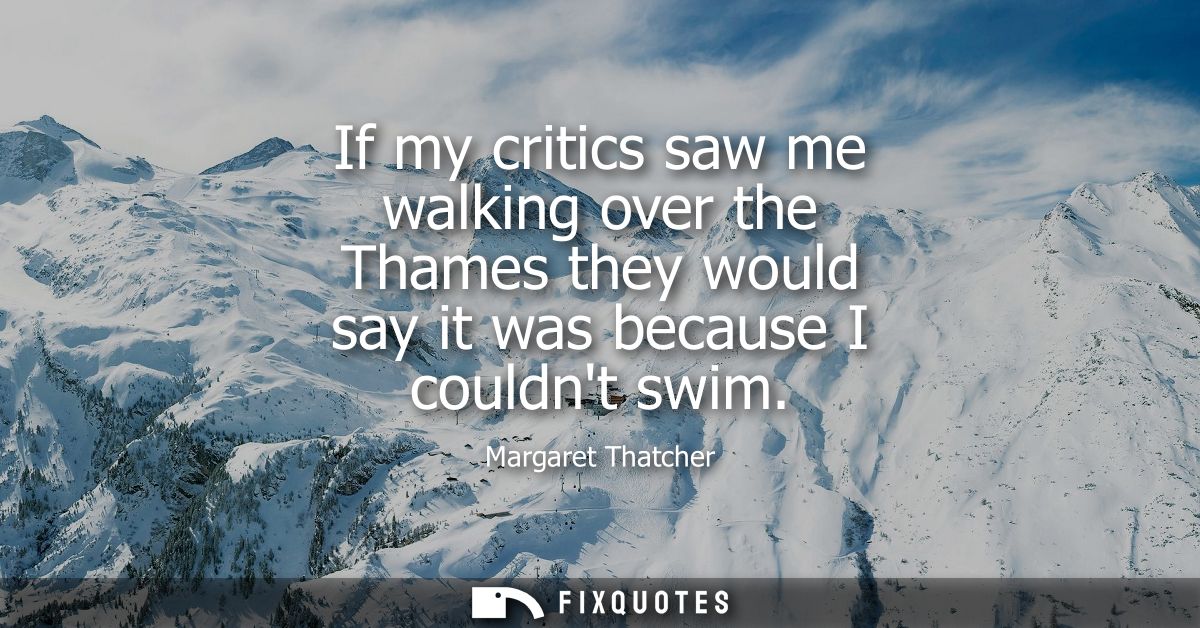
"If my critics saw me walking over the Thames, they would say it was because I couldn't swim"
About this Quote
The intent is twofold. It hardens her own side by treating opposition as reflexive and unserious, the kind of mindset you can’t persuade, only outlast. It also projects Thatcher’s preferred self-portrait: embattled, misunderstood, but unbowed. The subtext is almost devotional: I can’t be judged on outcomes because my enemies are committed to misreading outcomes. In that way it anticipates the modern grievance playbook, where the leader’s legitimacy comes from being perpetually “unfairly” attacked.
Context matters because Thatcher governed by confrontation. Her economic program and her stance toward unions, the welfare state, and the postwar consensus created a nation that felt - depending on your postcode - either liberated or broken. The quip converts that moral argument into a question of tone and motives: the problem isn’t what I’m doing, it’s that they’ll never give credit. It’s witty, yes, but also strategic: a shield against accountability that doubles as a rallying cry for faithful supporters.
Quote Details
| Topic | Witty One-Liners |
|---|---|
| Source | Help us find the source |
| Cite |
Citation Formats
APA Style (7th ed.)
Thatcher, Margaret. (2026, February 19). If my critics saw me walking over the Thames, they would say it was because I couldn't swim. FixQuotes. https://fixquotes.com/quotes/if-my-critics-saw-me-walking-over-the-thames-they-28167/
Chicago Style
Thatcher, Margaret. "If my critics saw me walking over the Thames, they would say it was because I couldn't swim." FixQuotes. February 19, 2026. https://fixquotes.com/quotes/if-my-critics-saw-me-walking-over-the-thames-they-28167/.
MLA Style (9th ed.)
"If my critics saw me walking over the Thames, they would say it was because I couldn't swim." FixQuotes, 19 Feb. 2026, https://fixquotes.com/quotes/if-my-critics-saw-me-walking-over-the-thames-they-28167/. Accessed 1 Apr. 2026.