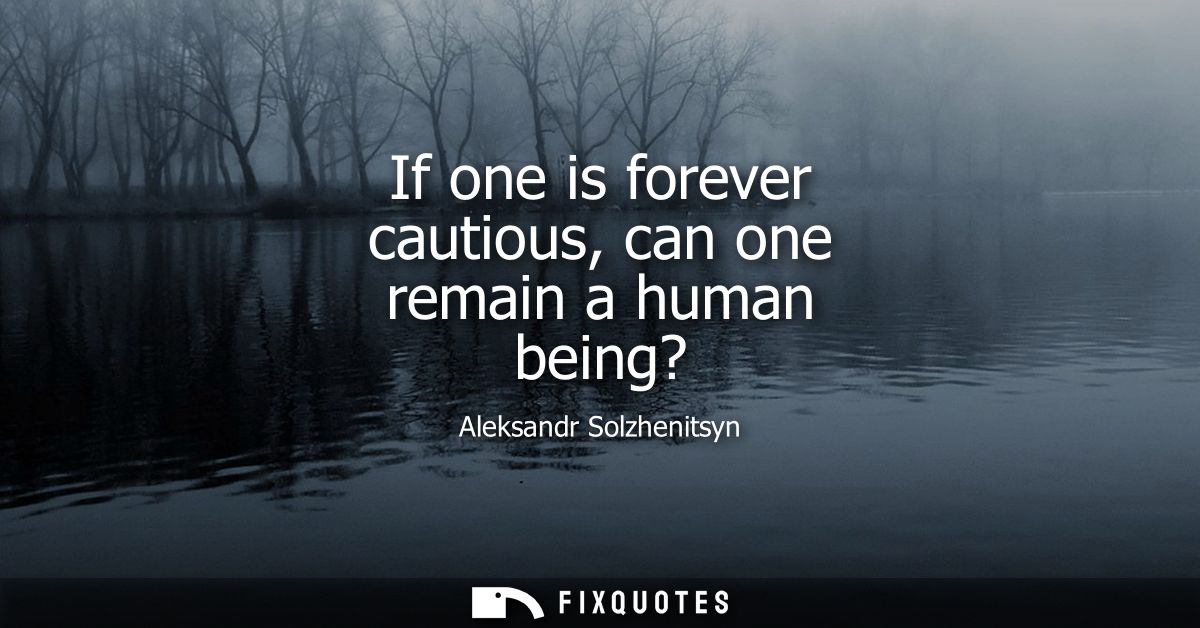
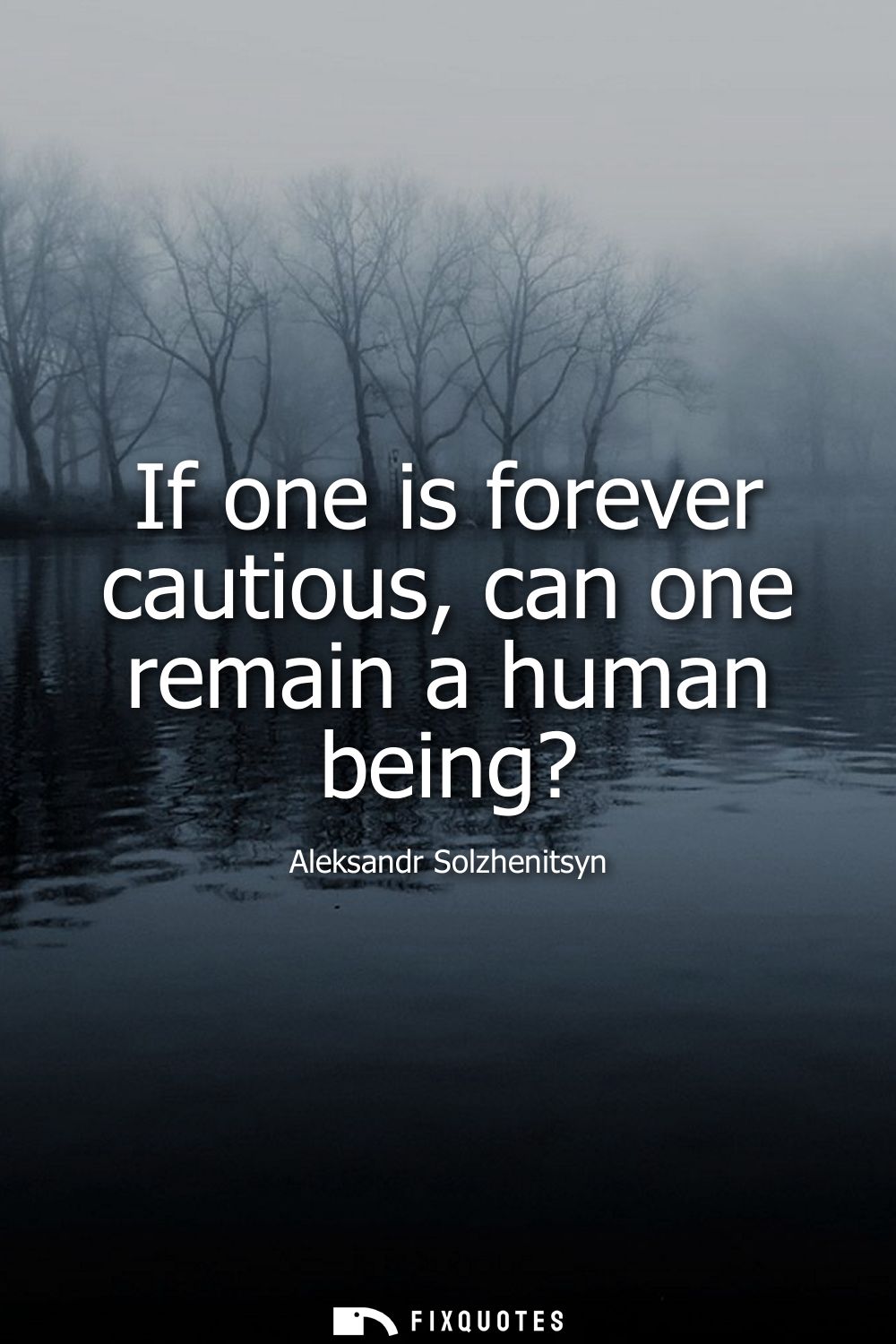
"If one is forever cautious, can one remain a human being?"
About this Quote
Solzhenitsyn makes caution sound less like prudence and more like self-erasure. The line is framed as a question, but it’s really an accusation: a life organized around perpetual risk management will eventually sand down the jagged, troublesome edges that make someone fully human - conviction, spontaneity, moral choice, the willingness to be seen. “Forever” is the trapdoor word. Temporary caution is sensible; permanent caution becomes a personality, then a prison.
The subtext is Soviet, but it travels. In a society where the state trains you to anticipate punishment, caution isn’t just an individual habit; it’s a public ethic. You learn to speak in safe sentences, to keep your head low, to treat truth as contraband. Over time, that survival strategy curdles into complicity: if you are always careful, you start pre-censoring your own conscience. The question pokes at that quiet bargain - the one where you trade moral agency for the comforting illusion of safety.
What makes it work is how it redefines “human being” as an active verb rather than a biological status. Being human here requires exposure: to danger, to other people, to the possibility of being wrong, punished, or rejected. Solzhenitsyn, writing out of a world of informers and camps, isn’t romanticizing recklessness; he’s warning that fear can colonize the soul so thoroughly that you survive your life without actually living it.
The subtext is Soviet, but it travels. In a society where the state trains you to anticipate punishment, caution isn’t just an individual habit; it’s a public ethic. You learn to speak in safe sentences, to keep your head low, to treat truth as contraband. Over time, that survival strategy curdles into complicity: if you are always careful, you start pre-censoring your own conscience. The question pokes at that quiet bargain - the one where you trade moral agency for the comforting illusion of safety.
What makes it work is how it redefines “human being” as an active verb rather than a biological status. Being human here requires exposure: to danger, to other people, to the possibility of being wrong, punished, or rejected. Solzhenitsyn, writing out of a world of informers and camps, isn’t romanticizing recklessness; he’s warning that fear can colonize the soul so thoroughly that you survive your life without actually living it.
Quote Details
| Topic | Wisdom |
|---|---|
| Source | Later attribution: The Positive Hero in Russian Literature (Rufus W. Mathewson, 2000) modern compilationISBN: 9780810117167 · ID: OFuZMcpNttYC
Evidence:
... Solzhenitsyn's account , which marks the first time the inside of a concentration camp has been shown in a ... If one is forever cautious , can one remain a human being ? " - states a choice many of the characters must confront ... |
| Cite |
Citation Formats
APA Style (7th ed.)
Solzhenitsyn, Aleksandr. (2026, March 26). If one is forever cautious, can one remain a human being? FixQuotes. https://fixquotes.com/quotes/if-one-is-forever-cautious-can-one-remain-a-human-43341/
Chicago Style
Solzhenitsyn, Aleksandr. "If one is forever cautious, can one remain a human being?" FixQuotes. March 26, 2026. https://fixquotes.com/quotes/if-one-is-forever-cautious-can-one-remain-a-human-43341/.
MLA Style (9th ed.)
"If one is forever cautious, can one remain a human being?" FixQuotes, 26 Mar. 2026, https://fixquotes.com/quotes/if-one-is-forever-cautious-can-one-remain-a-human-43341/. Accessed 4 Apr. 2026.
More Quotes by Aleksandr
Add to List