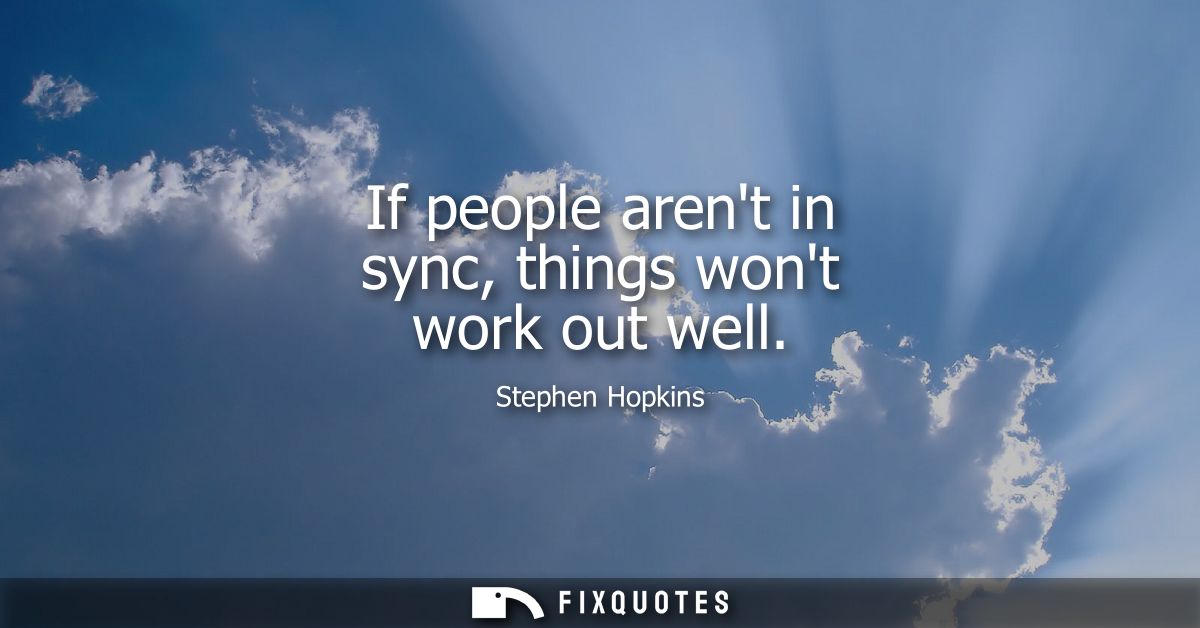
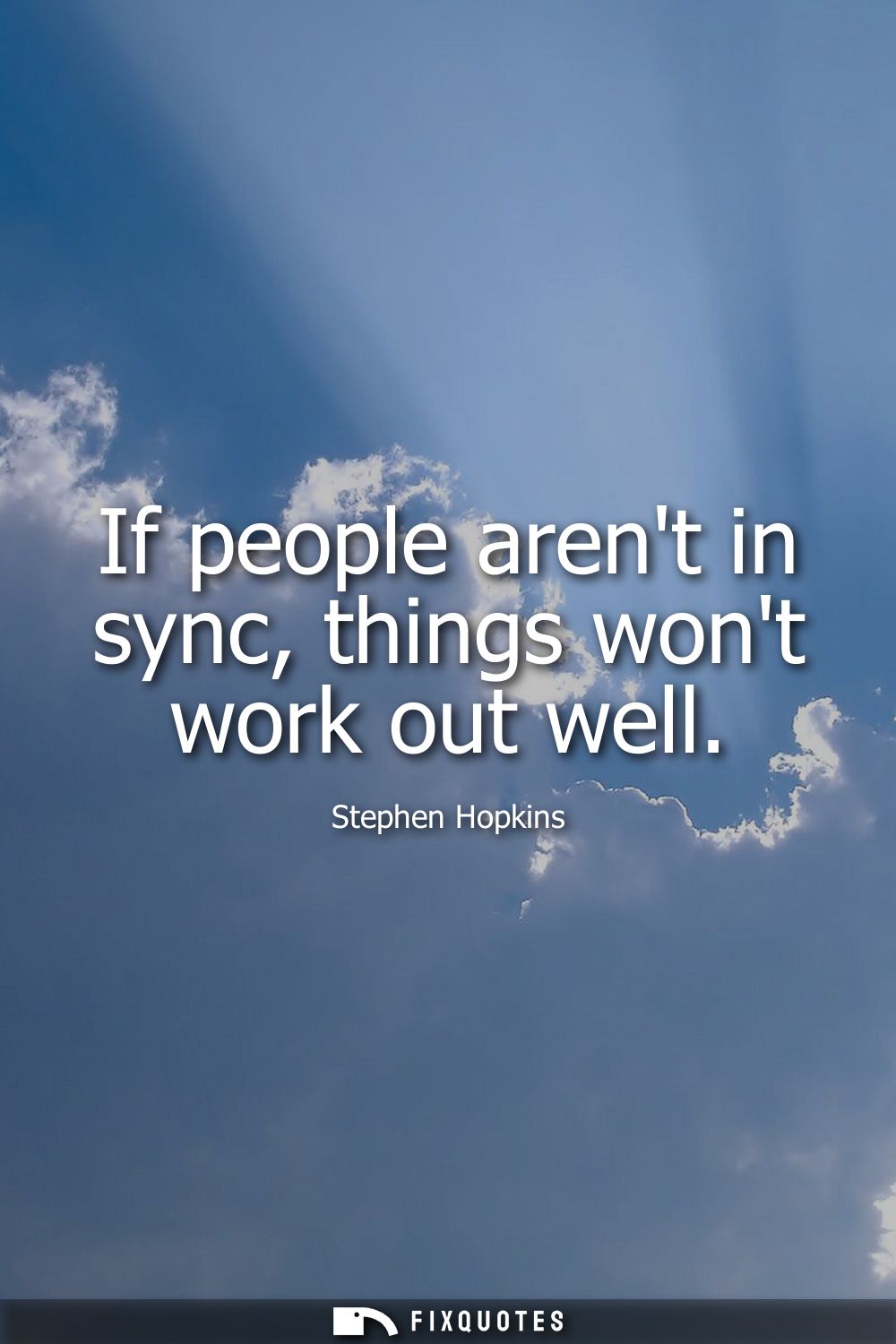
"If people aren't in sync, things won't work out well"
About this Quote
There is a deceptively hard edge to Stephen Hopkins's mild phrasing. "In sync" sounds like a friendly suggestion - get aligned, communicate, vibe. But the sentence is really an ultimatum in a cardigan: coordination isn't a nice-to-have, it's the price of admission. The negative construction ("aren't") and the vague warning ("won't work out well") do what good pragmatic writing often does: it leaves you room to project your own disaster. A relationship that curdles. A writers' room that fractures. A project that dies not with a dramatic blowup, but with a slow leak of mismatched expectations.
Hopkins also chooses the language of rhythm rather than ideology. He doesn't say "agree" or "share values", which would invite arguments about who's right. He says "in sync", a term borrowed from music and machines - metronomes, gears, dancers hitting the same count. That shift matters. It frames conflict less as moral failure than as timing, attunement, and feedback loops. People can be talented, even well-intentioned, and still produce chaos if their internal clocks are off.
The subtext is quietly anti-romantic about individual brilliance. Contemporary culture loves the lone genius and the hot take; Hopkins is reminding you that outcomes are usually collective artifacts. "Things" is broad on purpose: it covers the mundane logistics and the high-stakes decisions. The line reads like advice, but it also functions as a diagnosis of why so much modern collaboration feels exhausting: not a lack of effort, but a lack of shared tempo.
Hopkins also chooses the language of rhythm rather than ideology. He doesn't say "agree" or "share values", which would invite arguments about who's right. He says "in sync", a term borrowed from music and machines - metronomes, gears, dancers hitting the same count. That shift matters. It frames conflict less as moral failure than as timing, attunement, and feedback loops. People can be talented, even well-intentioned, and still produce chaos if their internal clocks are off.
The subtext is quietly anti-romantic about individual brilliance. Contemporary culture loves the lone genius and the hot take; Hopkins is reminding you that outcomes are usually collective artifacts. "Things" is broad on purpose: it covers the mundane logistics and the high-stakes decisions. The line reads like advice, but it also functions as a diagnosis of why so much modern collaboration feels exhausting: not a lack of effort, but a lack of shared tempo.
Quote Details
| Topic | Teamwork |
|---|---|
| Source | Help us find the source |
| Cite |
Citation Formats
APA Style (7th ed.)
Hopkins, Stephen. (2026, January 16). If people aren't in sync, things won't work out well. FixQuotes. https://fixquotes.com/quotes/if-people-arent-in-sync-things-wont-work-out-well-95496/
Chicago Style
Hopkins, Stephen. "If people aren't in sync, things won't work out well." FixQuotes. January 16, 2026. https://fixquotes.com/quotes/if-people-arent-in-sync-things-wont-work-out-well-95496/.
MLA Style (9th ed.)
"If people aren't in sync, things won't work out well." FixQuotes, 16 Jan. 2026, https://fixquotes.com/quotes/if-people-arent-in-sync-things-wont-work-out-well-95496/. Accessed 10 Feb. 2026.
More Quotes by Stephen
Add to List