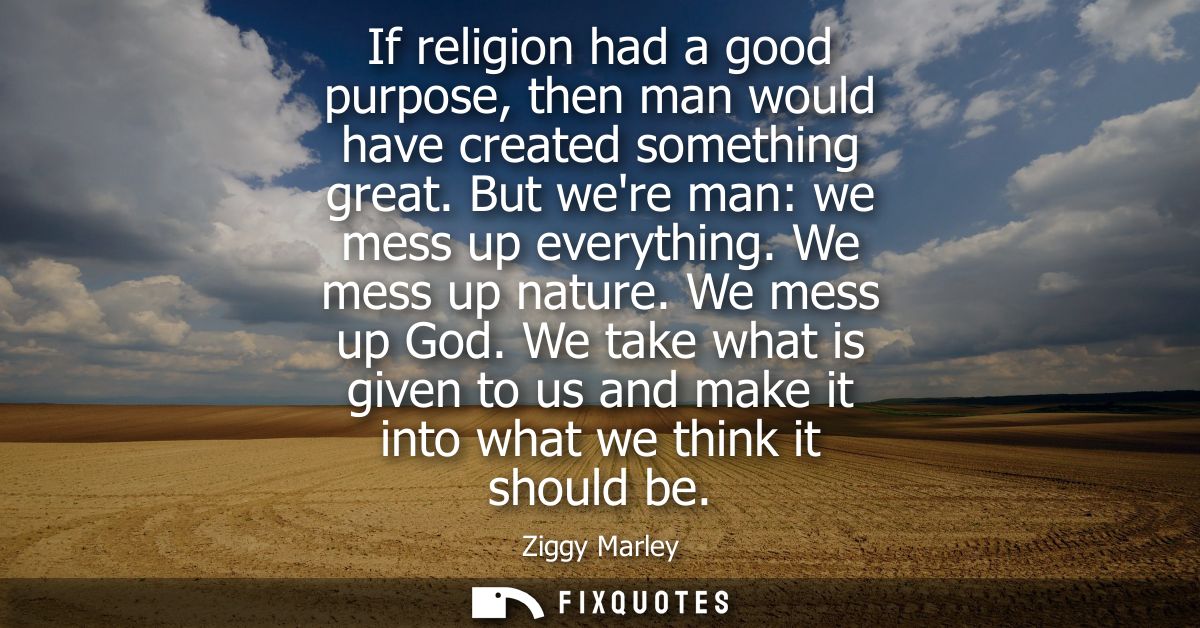
"If religion had a good purpose, then man would have created something great. But we're man: we mess up everything. We mess up nature. We mess up God. We take what is given to us and make it into what we think it should be"
About this Quote
The subtext is less atheist than anti-ownership. Marley isn’t rejecting the spiritual; he’s suspicious of what happens when people treat revelation like raw material for branding, borders, and hierarchy. “We mess up nature. We mess up God” puts ecology and theology on the same continuum of exploitation. In one breath, it links environmental degradation with doctrinal distortion: we don’t just pollute rivers, we pollute meaning, too.
Culturally, the quote sits squarely in the Marley lineage where spirituality is inseparable from liberation politics and respect for creation. Coming from a musician, the language is intentionally plain, almost conversational, which is part of its power: it dodges seminar-room abstraction and aims for moral common sense. The sting is in the final clause: “make it into what we think it should be.” That’s the real accusation - not belief, but the arrogance of editing the sacred to match our ego, our fear, our side.
Quote Details
| Topic | God |
|---|---|
| Source | Help us find the source |
| Cite |
Citation Formats
APA Style (7th ed.)
Marley, Ziggy. (2026, January 16). If religion had a good purpose, then man would have created something great. But we're man: we mess up everything. We mess up nature. We mess up God. We take what is given to us and make it into what we think it should be. FixQuotes. https://fixquotes.com/quotes/if-religion-had-a-good-purpose-then-man-would-117028/
Chicago Style
Marley, Ziggy. "If religion had a good purpose, then man would have created something great. But we're man: we mess up everything. We mess up nature. We mess up God. We take what is given to us and make it into what we think it should be." FixQuotes. January 16, 2026. https://fixquotes.com/quotes/if-religion-had-a-good-purpose-then-man-would-117028/.
MLA Style (9th ed.)
"If religion had a good purpose, then man would have created something great. But we're man: we mess up everything. We mess up nature. We mess up God. We take what is given to us and make it into what we think it should be." FixQuotes, 16 Jan. 2026, https://fixquotes.com/quotes/if-religion-had-a-good-purpose-then-man-would-117028/. Accessed 4 Apr. 2026.