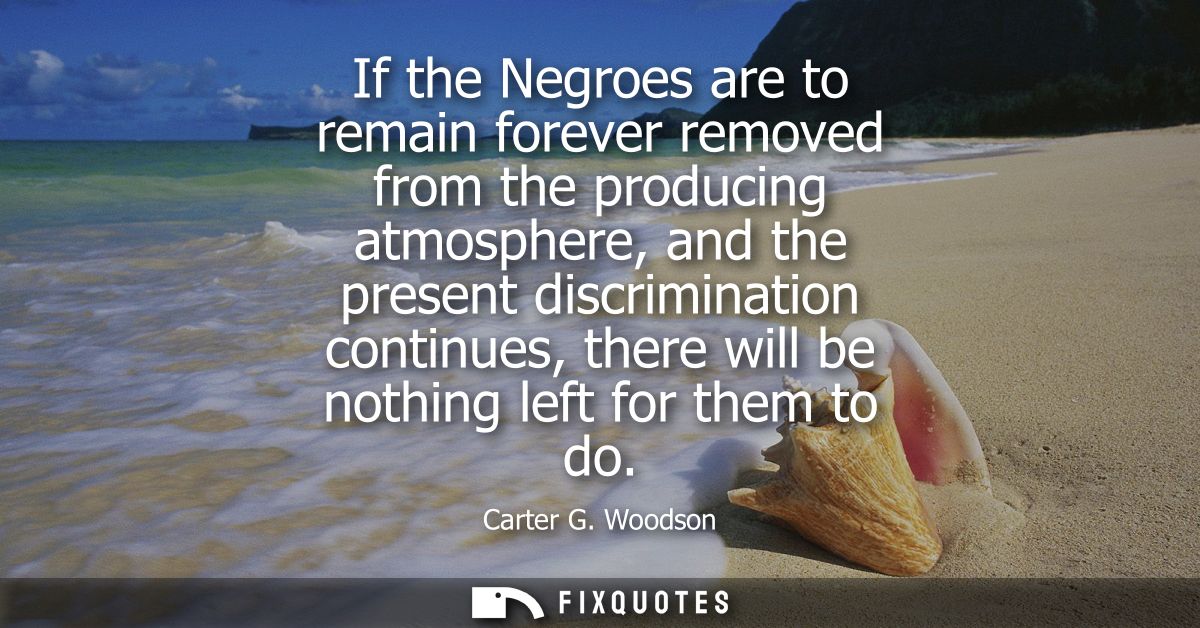
"If the Negroes are to remain forever removed from the producing atmosphere, and the present discrimination continues, there will be nothing left for them to do"
About this Quote
The conditional structure matters. “If... and... there will be” reads less like moral pleading than cause-and-effect forecasting. Woodson is speaking as a historian: he’s seen what happens when a society blocks a group from legitimate routes to survival and status. The line implies the next step without naming it. If there’s “nothing left... to do,” the options turn ugly: dependency, informal economies, migration, protest, or revolt. The ellipsis is intentional; he forces the listener to complete the sentence with their own fear or conscience.
Contextually, this emerges from Woodson’s larger project: exposing how Jim Crow wasn’t merely social insult but economic design. He argues that discrimination doesn’t just harm Black people; it corrodes the nation by wasting talent and manufacturing instability. The bite is in the premise that productivity is a social gatekeeping mechanism. Deny entry long enough and you create the very “problem” segregationists claim to be managing.
Quote Details
| Topic | Equality |
|---|---|
| Source | Help us find the source |
| Cite |
Citation Formats
APA Style (7th ed.)
Woodson, Carter G. (2026, January 15). If the Negroes are to remain forever removed from the producing atmosphere, and the present discrimination continues, there will be nothing left for them to do. FixQuotes. https://fixquotes.com/quotes/if-the-negroes-are-to-remain-forever-removed-from-148589/
Chicago Style
Woodson, Carter G. "If the Negroes are to remain forever removed from the producing atmosphere, and the present discrimination continues, there will be nothing left for them to do." FixQuotes. January 15, 2026. https://fixquotes.com/quotes/if-the-negroes-are-to-remain-forever-removed-from-148589/.
MLA Style (9th ed.)
"If the Negroes are to remain forever removed from the producing atmosphere, and the present discrimination continues, there will be nothing left for them to do." FixQuotes, 15 Jan. 2026, https://fixquotes.com/quotes/if-the-negroes-are-to-remain-forever-removed-from-148589/. Accessed 14 Mar. 2026.