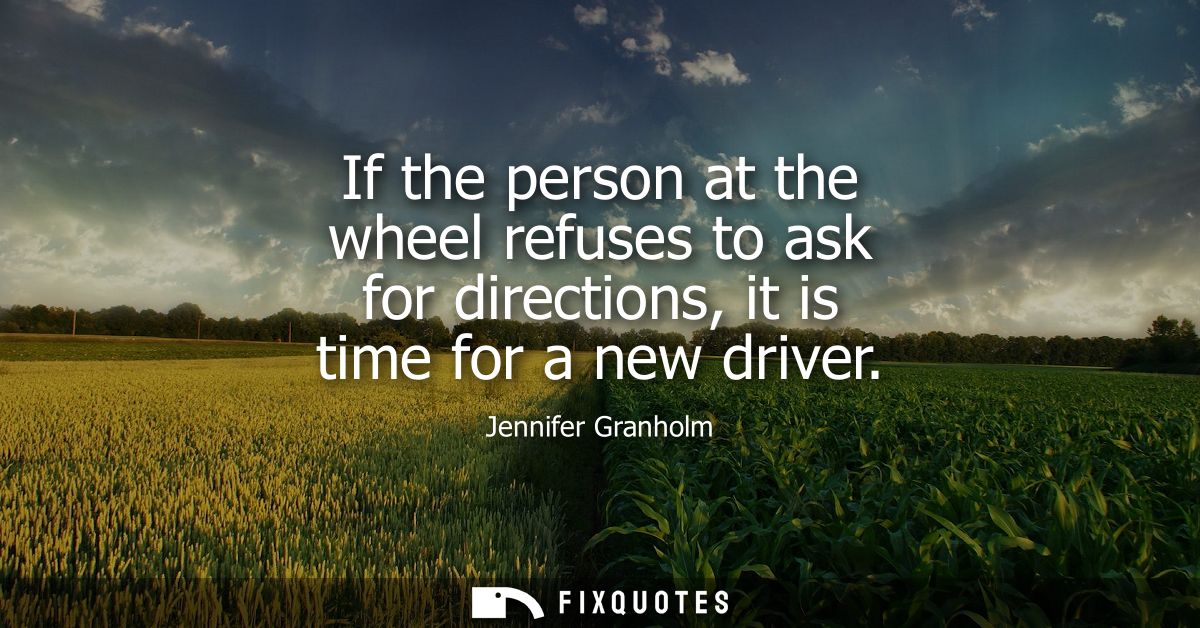
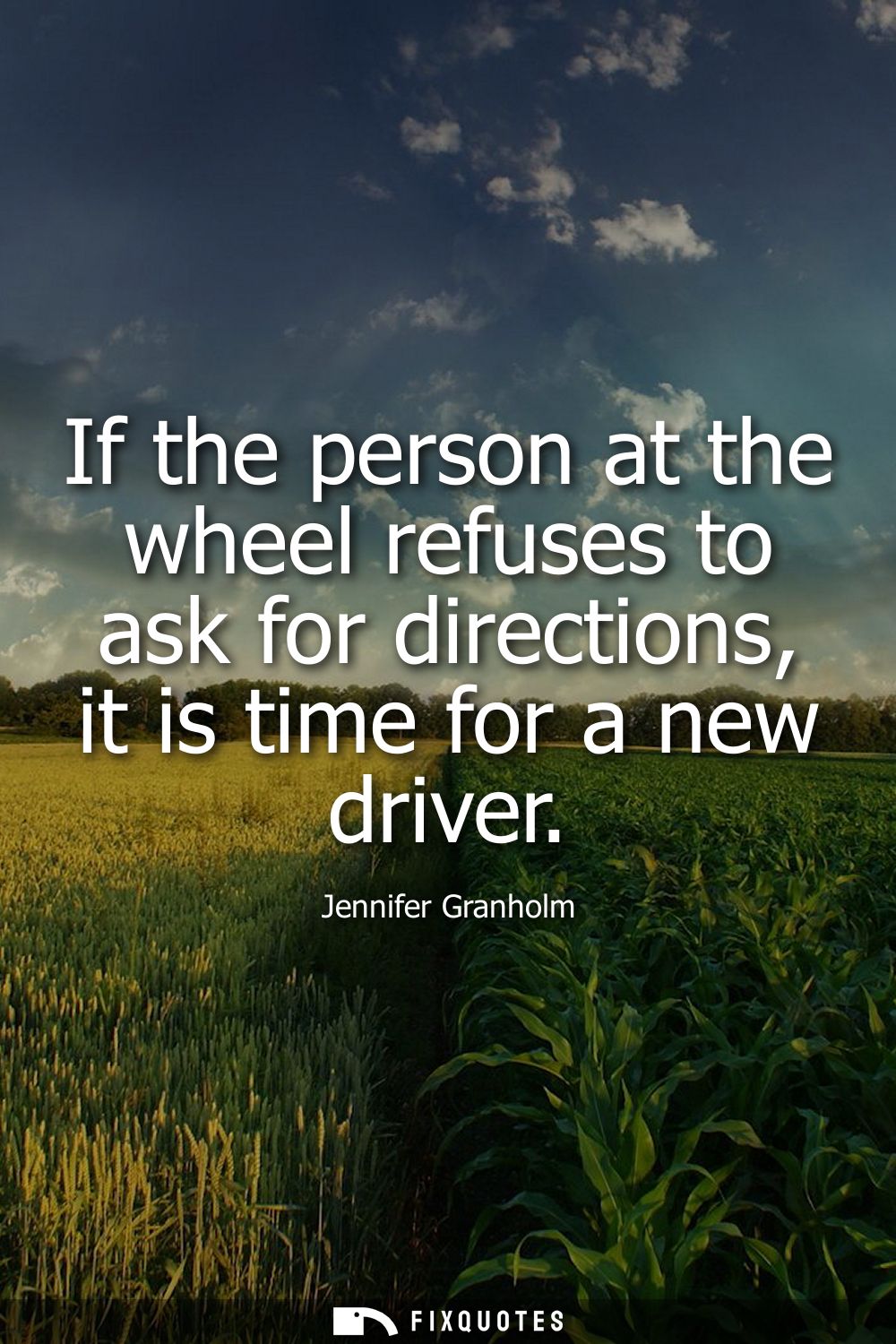
"If the person at the wheel refuses to ask for directions, it is time for a new driver"
About this Quote
Granholm’s line works because it smuggles a hard-edged political ultimatum into the most familiar American argument: the stubborn driver who won’t ask for directions. It’s a kitchen-table metaphor with a blade inside it. Everyone knows the scene, and everyone knows what it implies about pride, control, and the quiet cost of being “sure” while getting nowhere. By choosing the wheel as her image of power, she turns leadership into a practical job, not a sacred identity. Driving is task-based; if you can’t do it well, you don’t deserve the seat.
The specific intent is to legitimize replacement. Not critique, not coaching: transfer authority. “Refuses” is the tell. The problem isn’t ignorance; it’s willful incuriosity. In politics, that maps neatly onto leaders who ignore expertise, dismiss data, or treat advice as weakness. Asking for directions becomes a stand-in for humility and governance-by-information. Refusing to ask becomes negligence.
The subtext is also about accountability in motion. A stalled car can be forgiven; a moving car going the wrong way is dangerous. She implies that bad leadership isn’t merely inefficient, it’s risky to the people in the vehicle - citizens, constituents, an economy. The folksy tone lowers defenses long enough to make the sting land: if your leader won’t consult, won’t correct, won’t admit uncertainty, the responsible move isn’t to keep arguing from the passenger seat. It’s to change drivers.
In context, it reads like a made-for-campaign or crisis-management warning: competence is the brand, arrogance is disqualifying. The metaphor gives voters permission to see leadership as a contract, not a personality test.
The specific intent is to legitimize replacement. Not critique, not coaching: transfer authority. “Refuses” is the tell. The problem isn’t ignorance; it’s willful incuriosity. In politics, that maps neatly onto leaders who ignore expertise, dismiss data, or treat advice as weakness. Asking for directions becomes a stand-in for humility and governance-by-information. Refusing to ask becomes negligence.
The subtext is also about accountability in motion. A stalled car can be forgiven; a moving car going the wrong way is dangerous. She implies that bad leadership isn’t merely inefficient, it’s risky to the people in the vehicle - citizens, constituents, an economy. The folksy tone lowers defenses long enough to make the sting land: if your leader won’t consult, won’t correct, won’t admit uncertainty, the responsible move isn’t to keep arguing from the passenger seat. It’s to change drivers.
In context, it reads like a made-for-campaign or crisis-management warning: competence is the brand, arrogance is disqualifying. The metaphor gives voters permission to see leadership as a contract, not a personality test.
Quote Details
| Topic | Decision-Making |
|---|
More Quotes by Jennifer
Add to List