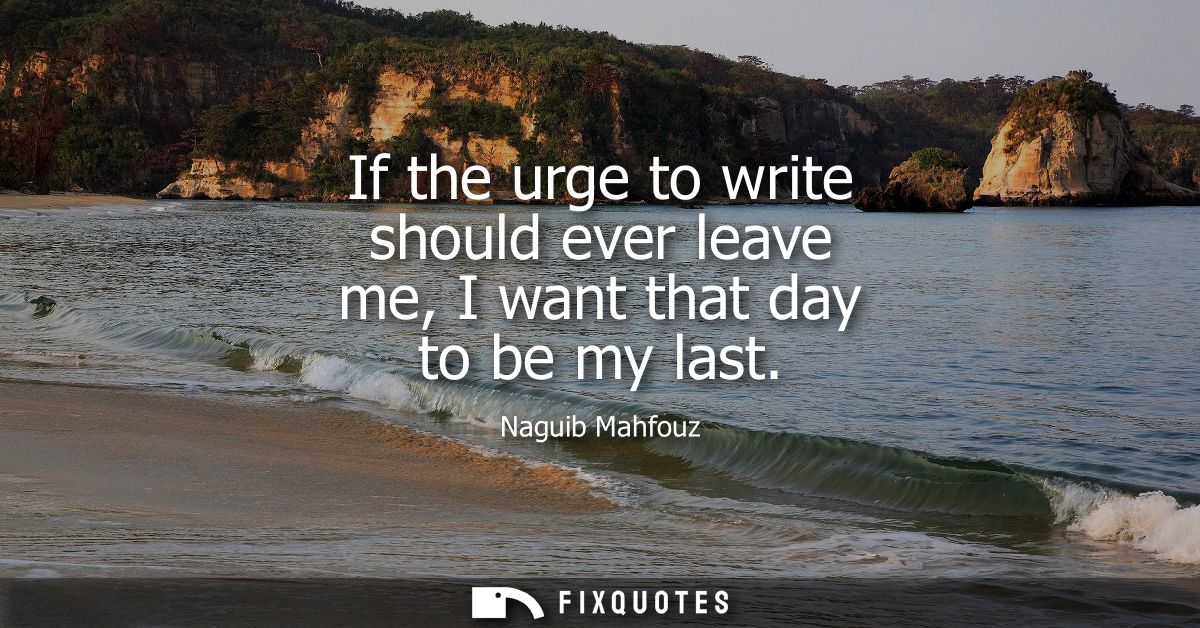
"If the urge to write should ever leave me, I want that day to be my last"
About this Quote
The specific intent is to declare writing as the core of selfhood, not an accessory to it. He doesn't say "if I can't write" but "if the urge... leave me" - the threat is not external censorship or age but internal extinguishing, the terrifying possibility of becoming indifferent. Mahfouz is naming the engine, not the output. Novels can stall; the appetite to make them is what keeps a mind morally and imaginatively awake.
The subtext is also political, in the quiet Mahfouz way. In societies where public speech can be policed, the private insistence on continuing to want to speak is itself defiance. He frames the worst fate as spiritual silence, not death. That inversion gives the line its bite: mortality is manageable; a life without the compulsion to observe, translate, and tell the truth of daily life is the real extinction.
Quote Details
| Topic | Writing |
|---|---|
| Source | Help us find the source |
| Cite |
Citation Formats
APA Style (7th ed.)
Mahfouz, Naguib. (2026, January 16). If the urge to write should ever leave me, I want that day to be my last. FixQuotes. https://fixquotes.com/quotes/if-the-urge-to-write-should-ever-leave-me-i-want-82714/
Chicago Style
Mahfouz, Naguib. "If the urge to write should ever leave me, I want that day to be my last." FixQuotes. January 16, 2026. https://fixquotes.com/quotes/if-the-urge-to-write-should-ever-leave-me-i-want-82714/.
MLA Style (9th ed.)
"If the urge to write should ever leave me, I want that day to be my last." FixQuotes, 16 Jan. 2026, https://fixquotes.com/quotes/if-the-urge-to-write-should-ever-leave-me-i-want-82714/. Accessed 14 Mar. 2026.