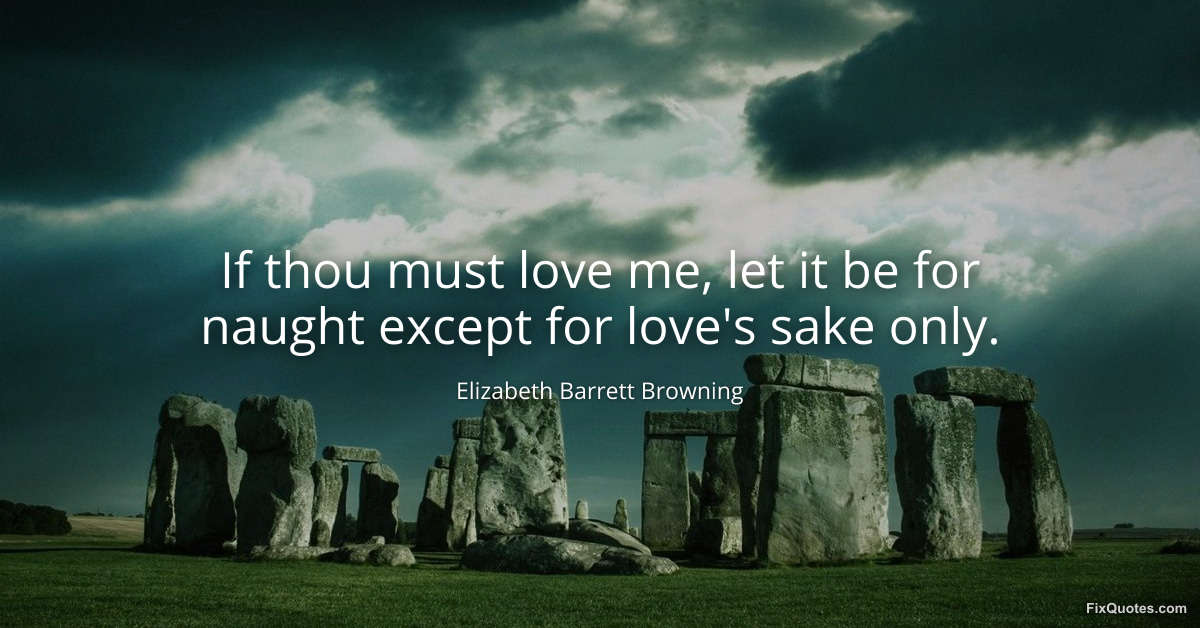
"If thou must love me, let it be for naught except for love's sake only"
About this Quote
The subtext is bodily and biographical. Elizabeth Barrett Browning spent years constrained by illness and by an overbearing father who opposed her marriage. The speaker’s insistence reads like someone negotiating for emotional safety from inside a world that treats women as fragile property. She’s asking not to be turned into a caretaking project, a muse, or a moral improvement plan. Don’t love me for pity; pity curdles into power.
What makes the line work is its paradoxical toughness. It sounds devotional, almost prayerful (“thou”), but it’s also a boundary. Browning frames love as the one motive that can survive time’s vandalism. Everything else is a compliment with an expiration date; love “for love’s sake” is the only promise that doesn’t secretly reserve the right to revoke.
Quote Details
| Topic | Love |
|---|---|
| Source | Elizabeth Barrett Browning, Sonnet XIV, Sonnets from the Portuguese (1850). Opening lines: "If thou must love me, let it be for naught / Except for love's sake only." |
| Cite |
Citation Formats
APA Style (7th ed.)
Browning, Elizabeth Barrett. (2026, January 18). If thou must love me, let it be for naught except for love's sake only. FixQuotes. https://fixquotes.com/quotes/if-thou-must-love-me-let-it-be-for-naught-except-3423/
Chicago Style
Browning, Elizabeth Barrett. "If thou must love me, let it be for naught except for love's sake only." FixQuotes. January 18, 2026. https://fixquotes.com/quotes/if-thou-must-love-me-let-it-be-for-naught-except-3423/.
MLA Style (9th ed.)
"If thou must love me, let it be for naught except for love's sake only." FixQuotes, 18 Jan. 2026, https://fixquotes.com/quotes/if-thou-must-love-me-let-it-be-for-naught-except-3423/. Accessed 1 Apr. 2026.