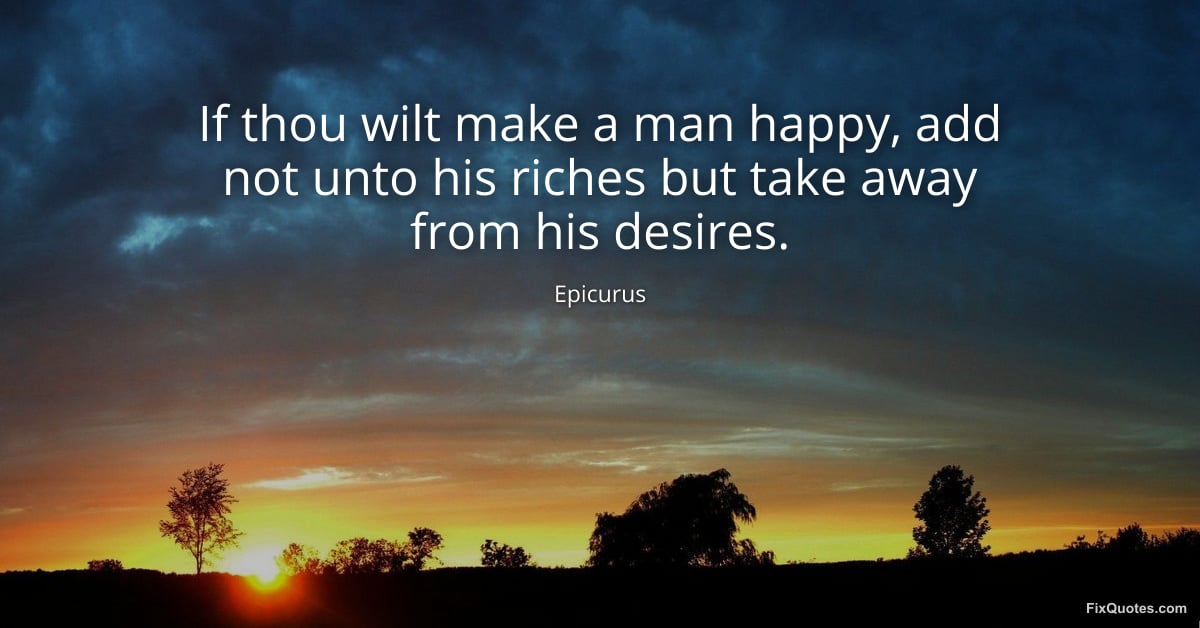
"If thou wilt make a man happy, add not unto his riches but take away from his desires"
About this Quote
The intent is practical, almost clinical. Epicurus is writing against the grain of status-driven Greek life, where honor, luxury, and public appetite were endlessly escalated. His philosophy of ataraxia (untroubledness) isn’t a mood; it’s a strategy: reduce the number of things that can hurt you by reducing the number of things you feel you must have. The subtext is quietly radical: the happiest person is the one least governable by circumstance. If your peace depends on external supply chains - money, admiration, novelty - you’re always one shortage away from misery.
The phrasing “take away” matters. It suggests desire isn’t a sacred inner truth to be obeyed but a removable burden, like a fever you can lower. Epicurus isn’t selling deprivation for its own sake; he’s advocating a reorientation toward simple pleasures and necessary needs. In a culture - and an economy - built on stoking wants, his advice reads less like ancient wisdom and more like a form of resistance.
Quote Details
| Topic | Happiness |
|---|---|
| Source | Later attribution: Know Thyself: My Homage to Montaigne (Charlie Burzing) modern compilationISBN: 9780244391546 · ID: Ng1gDwAAQBAJ
Evidence:
... Epicurus drank water rather than wine, and was happy with a dinner of bread, vegetables and a palmful of olives ... If thou wilt make a man happy, add not unto his riches, but take away from his desires.' Those last couple of ... |
| Cite |
Citation Formats
APA Style (7th ed.)
Epicurus. (2026, March 28). If thou wilt make a man happy, add not unto his riches but take away from his desires. FixQuotes. https://fixquotes.com/quotes/if-thou-wilt-make-a-man-happy-add-not-unto-his-27201/
Chicago Style
Epicurus. "If thou wilt make a man happy, add not unto his riches but take away from his desires." FixQuotes. March 28, 2026. https://fixquotes.com/quotes/if-thou-wilt-make-a-man-happy-add-not-unto-his-27201/.
MLA Style (9th ed.)
"If thou wilt make a man happy, add not unto his riches but take away from his desires." FixQuotes, 28 Mar. 2026, https://fixquotes.com/quotes/if-thou-wilt-make-a-man-happy-add-not-unto-his-27201/. Accessed 5 Apr. 2026.