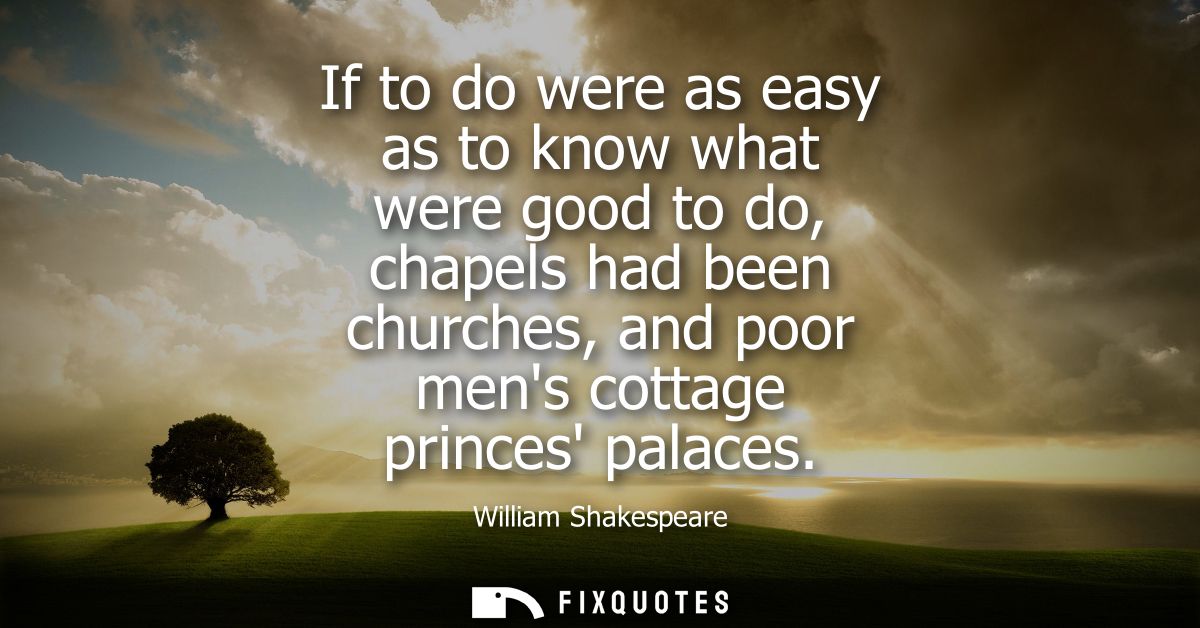
"If to do were as easy as to know what were good to do, chapels had been churches, and poor men's cottage princes' palaces"
About this Quote
The subtext is a jab at armchair righteousness and the comforting gap between intention and action. “To know what were good to do” flatters the conscience; it lets people feel morally solvent without paying in inconvenience, risk, or sacrifice. Shakespeare frames that gap as systemic, not merely personal. If individual willpower were the only barrier, the transformation would be ubiquitous. The fact that it isn’t suggests sturdier constraints: appetite, fear, status, habit, the friction of real life.
Context matters: this comes from The Merchant of Venice, spoken by Portia, a character who watches men wrap their choices in piety and principle while pursuing advantage. The line anticipates the play’s larger critique of moral bookkeeping - who gets to call themselves righteous, and at what cost to others. It also lands as Renaissance skepticism about human perfectibility: reason can map the good, but it can’t guarantee the doing. Shakespeare’s brilliance is making that philosophical point feel like a streetwise observation, delivered with a dry, almost impatient clarity.
Quote Details
| Topic | Ethics & Morality |
|---|---|
| Source | William Shakespeare, The Merchant of Venice, Act 1, Scene 2 (spoken by Portia). |
| Cite |
Citation Formats
APA Style (7th ed.)
Shakespeare, William. (2026, January 17). If to do were as easy as to know what were good to do, chapels had been churches, and poor men's cottage princes' palaces. FixQuotes. https://fixquotes.com/quotes/if-to-do-were-as-easy-as-to-know-what-were-good-42183/
Chicago Style
Shakespeare, William. "If to do were as easy as to know what were good to do, chapels had been churches, and poor men's cottage princes' palaces." FixQuotes. January 17, 2026. https://fixquotes.com/quotes/if-to-do-were-as-easy-as-to-know-what-were-good-42183/.
MLA Style (9th ed.)
"If to do were as easy as to know what were good to do, chapels had been churches, and poor men's cottage princes' palaces." FixQuotes, 17 Jan. 2026, https://fixquotes.com/quotes/if-to-do-were-as-easy-as-to-know-what-were-good-42183/. Accessed 7 Apr. 2026.