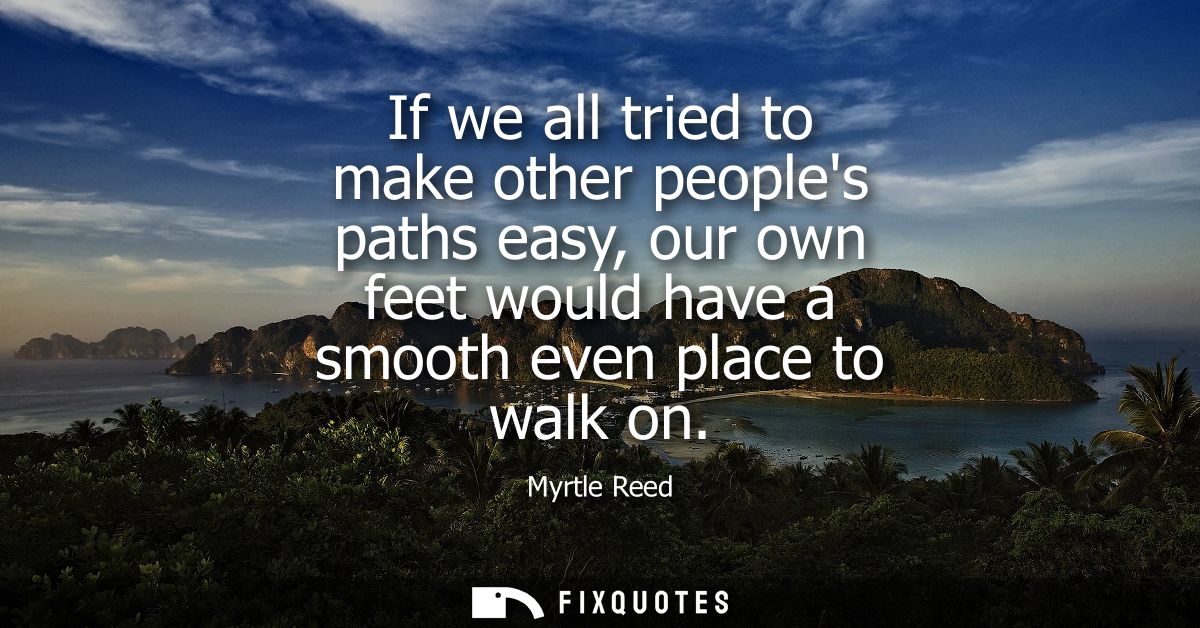
"If we all tried to make other people's paths easy, our own feet would have a smooth, even place to walk on"
About this Quote
The intent is social, even corrective. In an era when American individualism was hardening into a kind of moral sport, Reed reframes kindness as infrastructure. Ease isnt a private luxury; its something a community builds, or fails to. The subtext is a rebuke to the heroic narrative of suffering: if youre constantly navigating obstacles, maybe thats not character-building. Maybe its a design problem, maintained by people who benefit from rough terrain.
Theres also a quiet feminist politics in the metaphor. Reed wrote in a culture that often assigned women the invisible labor of smoothing the world for everyone else. By turning that labor into a collective imperative - we all - she shifts caretaking from duty to shared civic practice. The payoff, "our own feet", makes reciprocity explicit: compassion is not a one-way depletion. It is the closest thing we get to a moral feedback loop, where the kindness you lay down becomes the ground that holds you up later.
Quote Details
| Topic | Kindness |
|---|---|
| Source | Help us find the source |
| Cite |
Citation Formats
APA Style (7th ed.)
Reed, Myrtle. (2026, February 16). If we all tried to make other people's paths easy, our own feet would have a smooth, even place to walk on. FixQuotes. https://fixquotes.com/quotes/if-we-all-tried-to-make-other-peoples-paths-easy-170702/
Chicago Style
Reed, Myrtle. "If we all tried to make other people's paths easy, our own feet would have a smooth, even place to walk on." FixQuotes. February 16, 2026. https://fixquotes.com/quotes/if-we-all-tried-to-make-other-peoples-paths-easy-170702/.
MLA Style (9th ed.)
"If we all tried to make other people's paths easy, our own feet would have a smooth, even place to walk on." FixQuotes, 16 Feb. 2026, https://fixquotes.com/quotes/if-we-all-tried-to-make-other-peoples-paths-easy-170702/. Accessed 4 Apr. 2026.