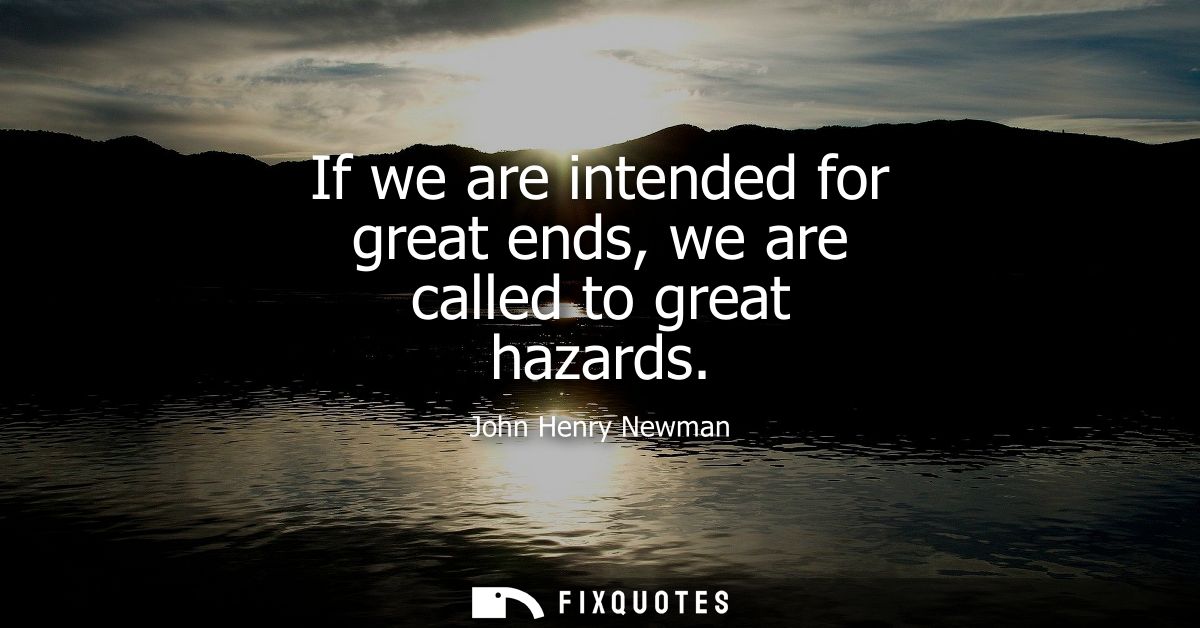
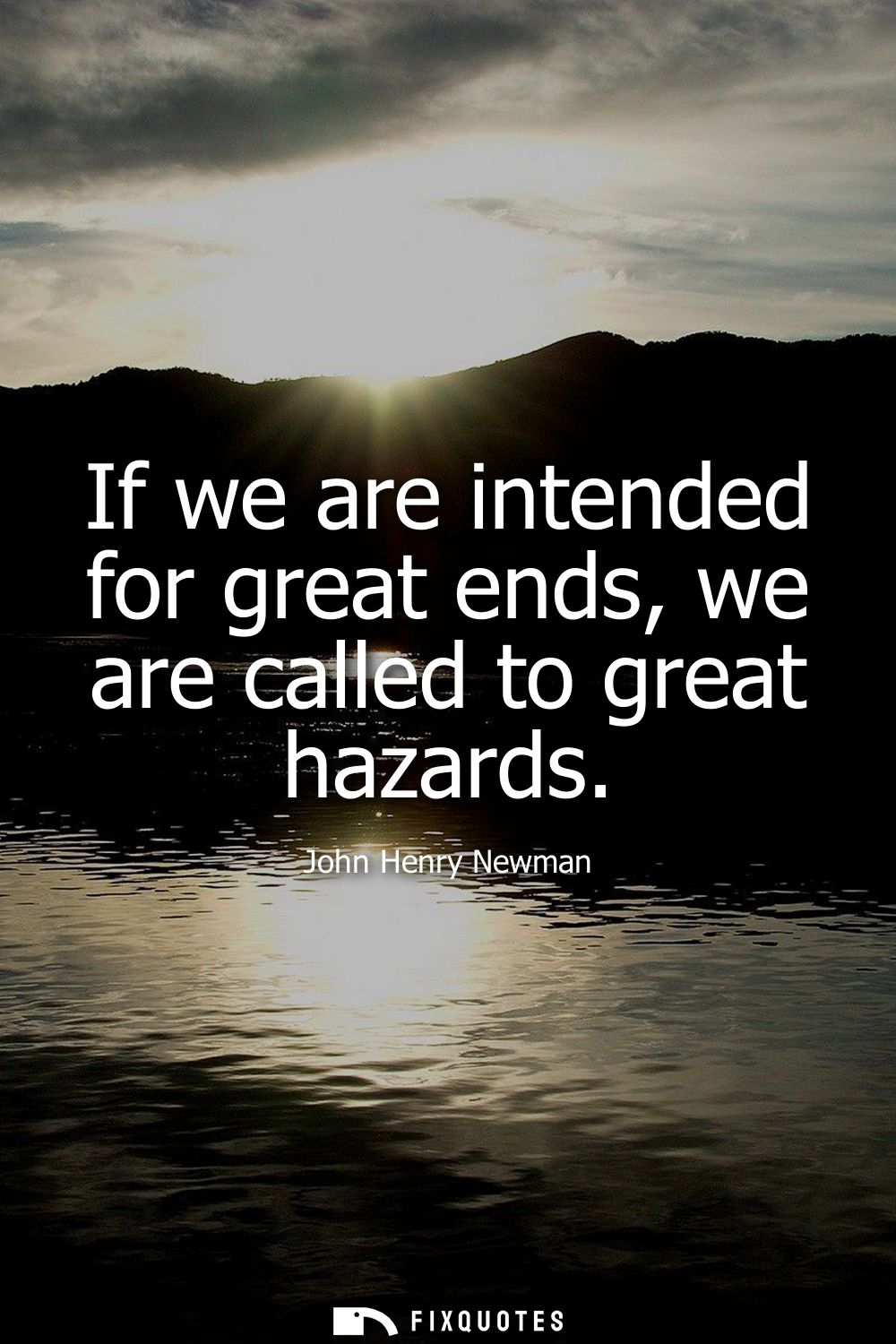
"If we are intended for great ends, we are called to great hazards"
About this Quote
Newman’s line has the bracing calm of someone who thinks comfort is a dubious moral category. “Great ends” is not a motivational poster promise; it’s teleological language, the kind a 19th-century clergyman can use without irony because he assumes history has purpose and souls have assignments. The turn is in “called”: hazard isn’t an accident that befalls the ambitious, it’s a summons. Risk becomes vocation.
The quote works because it refuses the modern bargain that meaning should arrive pre-sanitized. Newman doesn’t romanticize danger as thrill; he frames it as the cost of seriousness. If the goal is genuinely “great,” then hazard is not evidence you’re on the wrong path, but a diagnostic that you’re near something that matters. The subtext is both consoling and disciplinary: stop interpreting resistance as a sign to retreat, and stop seeking “great ends” while bargaining for small inconveniences. It’s an ethic that makes excuses harder.
Context sharpens the edge. Newman lived through religious upheaval and personal consequence, most famously his conversion from Anglicanism to Catholicism and the public suspicion that followed. His era’s hazards weren’t just abstract adversity; they were reputational exile, institutional rupture, social penalties. That background gives the sentence its authority: it’s not a dare from the sidelines, it’s a rule written after the stakes were paid.
In a culture that treats safety as virtue and risk as pathology, Newman’s claim sounds almost impolite. That’s precisely why it still lands. It insists that destiny, if it exists, comes with teeth.
The quote works because it refuses the modern bargain that meaning should arrive pre-sanitized. Newman doesn’t romanticize danger as thrill; he frames it as the cost of seriousness. If the goal is genuinely “great,” then hazard is not evidence you’re on the wrong path, but a diagnostic that you’re near something that matters. The subtext is both consoling and disciplinary: stop interpreting resistance as a sign to retreat, and stop seeking “great ends” while bargaining for small inconveniences. It’s an ethic that makes excuses harder.
Context sharpens the edge. Newman lived through religious upheaval and personal consequence, most famously his conversion from Anglicanism to Catholicism and the public suspicion that followed. His era’s hazards weren’t just abstract adversity; they were reputational exile, institutional rupture, social penalties. That background gives the sentence its authority: it’s not a dare from the sidelines, it’s a rule written after the stakes were paid.
In a culture that treats safety as virtue and risk as pathology, Newman’s claim sounds almost impolite. That’s precisely why it still lands. It insists that destiny, if it exists, comes with teeth.
Quote Details
| Topic | Motivational |
|---|---|
| Source | Help us find the source |
| Cite |
Citation Formats
APA Style (7th ed.)
Newman, John Henry. (2026, January 18). If we are intended for great ends, we are called to great hazards. FixQuotes. https://fixquotes.com/quotes/if-we-are-intended-for-great-ends-we-are-called-5645/
Chicago Style
Newman, John Henry. "If we are intended for great ends, we are called to great hazards." FixQuotes. January 18, 2026. https://fixquotes.com/quotes/if-we-are-intended-for-great-ends-we-are-called-5645/.
MLA Style (9th ed.)
"If we are intended for great ends, we are called to great hazards." FixQuotes, 18 Jan. 2026, https://fixquotes.com/quotes/if-we-are-intended-for-great-ends-we-are-called-5645/. Accessed 22 Mar. 2026.
More Quotes by John
Add to List