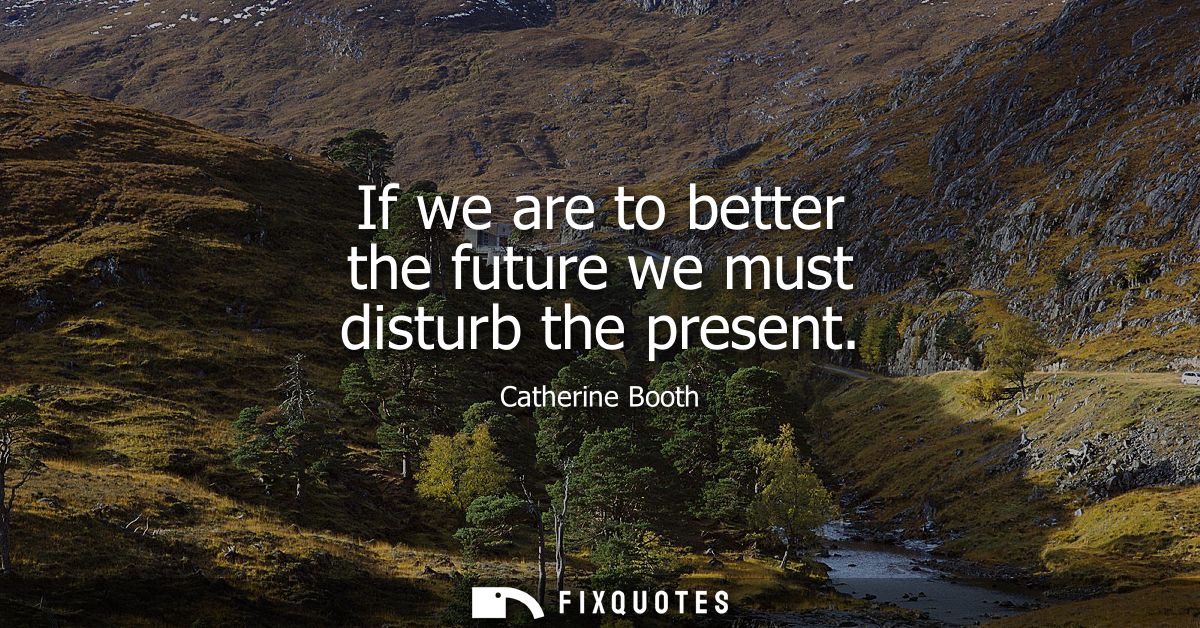
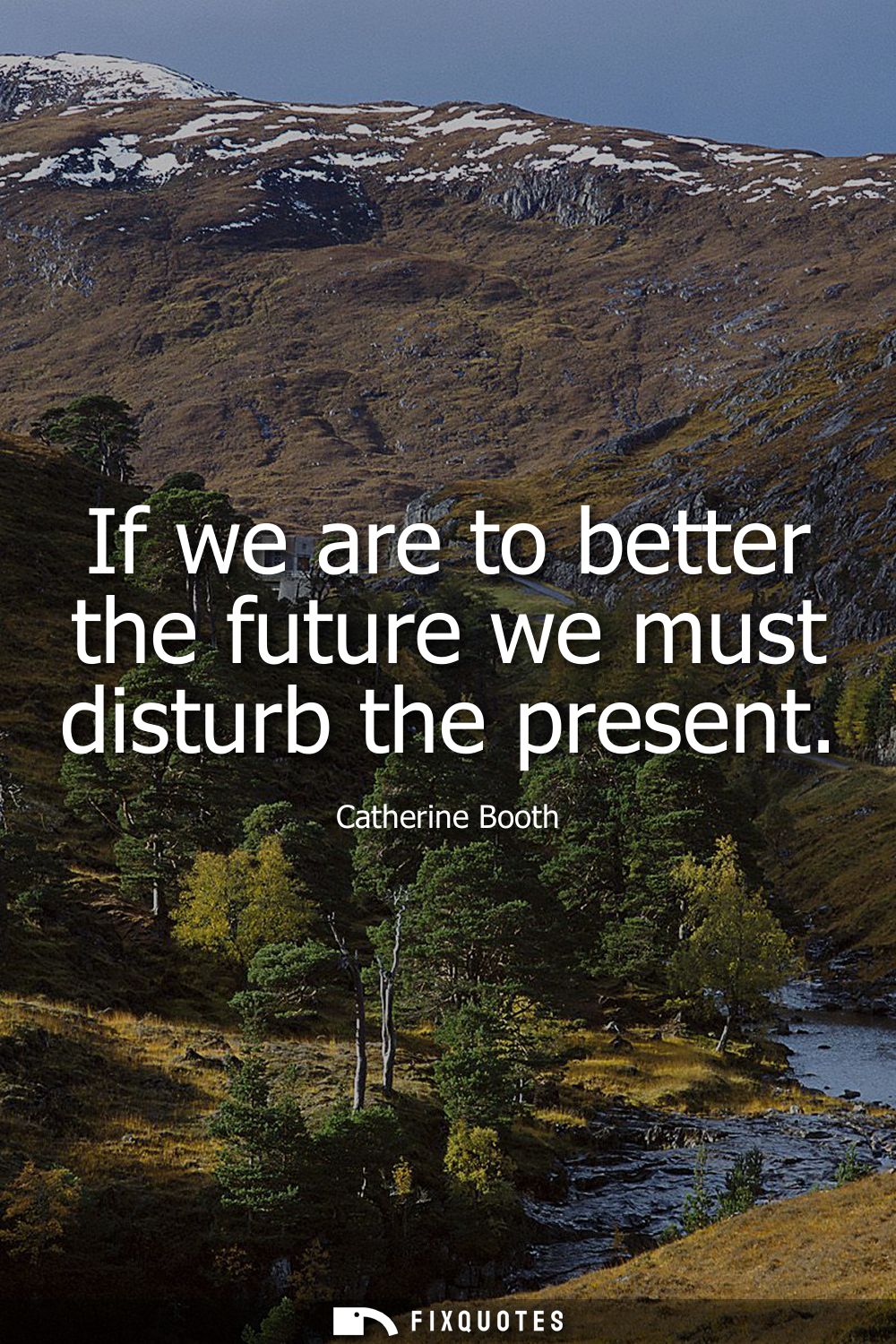
"If we are to better the future, we must disturb the present"
About this Quote
“If we are to better the future we must disturb the present” is activism stripped down to its most inconvenient truth: progress is not a polite request, it’s an interruption. Catherine Booth, co-founder of the Salvation Army, wasn’t speaking from the comfort of abstract reform. She operated in the grind of Victorian Britain, where poverty was treated as personal failure, where “respectability” doubled as social control, and where women were expected to influence the world indirectly, if at all. In that setting, “disturb” is a deliberate provocation. It frames complacency as an active obstacle and makes disruption a moral duty rather than a tactic of last resort.
The line works because it reverses the usual emotional logic of change. People like to imagine the future arriving as a reward for good intentions, with the present left intact. Booth punctures that fantasy: any serious attempt to “better” what comes next will agitate whoever benefits from how things are now. “We” matters, too. She’s not giving permission to a heroic outsider; she’s drafting a collective subject, implicating the listener in the cost of improvement.
There’s also a subtle rebuttal to the era’s favorite critique of reformers: that they were unruly, unseemly, too loud. Booth folds that accusation into her argument. Yes, disturbance is the point. If the present is arranged to keep suffering quiet and contained, then causing a scene isn’t immaturity; it’s strategy.
The line works because it reverses the usual emotional logic of change. People like to imagine the future arriving as a reward for good intentions, with the present left intact. Booth punctures that fantasy: any serious attempt to “better” what comes next will agitate whoever benefits from how things are now. “We” matters, too. She’s not giving permission to a heroic outsider; she’s drafting a collective subject, implicating the listener in the cost of improvement.
There’s also a subtle rebuttal to the era’s favorite critique of reformers: that they were unruly, unseemly, too loud. Booth folds that accusation into her argument. Yes, disturbance is the point. If the present is arranged to keep suffering quiet and contained, then causing a scene isn’t immaturity; it’s strategy.
Quote Details
| Topic | Embrace Change |
|---|---|
| Source | Verified source: Papers on Aggressive Christianity (Catherine Booth, 1880)
Evidence: "There is no improving the future, without disturbing the present," and the difficulty is to get people to be willing to be disturbed! (Chapter 3, “Adaptation of Measures”). This is a primary-source occurrence in Catherine Booth’s own text (in the work titled “Papers on Aggressive Christianity,” dated 1880 on the source page). The commonly-circulated modern paraphrase (“If we are to better the future, we must disturb the present”) appears to be a shortened/modernized rewording of Booth’s sentence. The quote appears in Chapter 3 (“Adaptation of Measures”), in a section beginning with “WHAT IS TO BE DONE?” The web edition does not show the original print pagination, so a page number can’t be verified from this online transcription alone; you’d need to consult a scanned 1880 print edition to extract the exact page. Other candidates (1) The Life of Catherine Booth (Frederick St. George de Latour Booth ..., 1892)95.0% ... If we are to better the future we must disturb the present , which some people very much dislike . They would rat... |
| Cite |
Citation Formats
APA Style (7th ed.)
Booth, Catherine. (2026, February 21). If we are to better the future, we must disturb the present. FixQuotes. https://fixquotes.com/quotes/if-we-are-to-better-the-future-we-must-disturb-123670/
Chicago Style
Booth, Catherine. "If we are to better the future, we must disturb the present." FixQuotes. February 21, 2026. https://fixquotes.com/quotes/if-we-are-to-better-the-future-we-must-disturb-123670/.
MLA Style (9th ed.)
"If we are to better the future, we must disturb the present." FixQuotes, 21 Feb. 2026, https://fixquotes.com/quotes/if-we-are-to-better-the-future-we-must-disturb-123670/. Accessed 31 Mar. 2026.
More Quotes by Catherine
Add to List