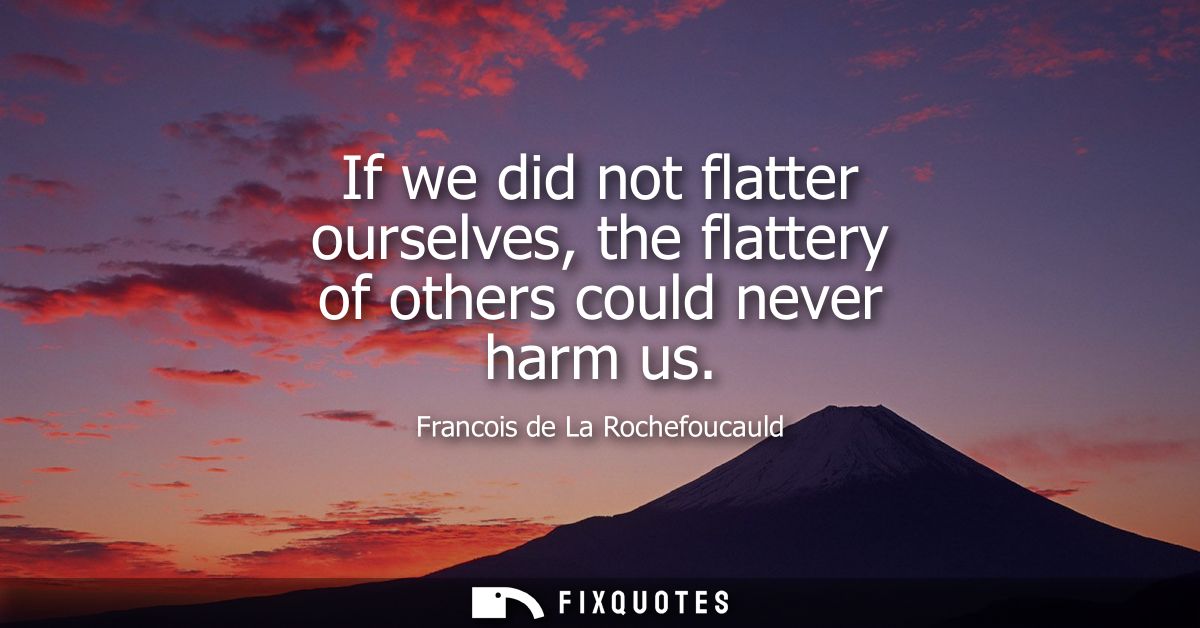
"If we did not flatter ourselves, the flattery of others could never harm us"
About this Quote
The subtext is characteristically Rochefoucauld: moral life is less a battle between good and evil than a constant negotiation with self-love. If you’re genuinely clear-eyed about your motives and limits, praise can’t bribe you into a worse version of yourself. But if you’re already invested in a flattering story about who you are, someone else’s compliment doesn’t just feel good; it confirms an identity you’re eager to protect. That’s how flattery “harms”: it makes you pliable, easier to steer, more willing to trade honesty for the comfort of being admired.
Context matters. Writing in 17th-century France, amid salon culture, court patronage, and a politics lubricated by etiquette, La Rochefoucauld saw flattery as a social technology - a way to win influence without force. His insight still scans: the most manipulative compliments aren’t the grand ones, but the tailored ones that match what we’re already trying to believe. The antidote he offers isn’t cynicism about others. It’s suspicion about the self.
Quote Details
| Topic | Humility |
|---|---|
| Source | La Rochefoucauld, Francois de — Maxims (Maximes). Commonly rendered: "If we did not flatter ourselves, the flattery of others could never harm us." French: "Si nous ne nous flattions pas, la flatterie des autres ne pourrait jamais nous faire de mal." |
| Cite |
Citation Formats
APA Style (7th ed.)
Rochefoucauld, Francois de La. (2026, January 18). If we did not flatter ourselves, the flattery of others could never harm us. FixQuotes. https://fixquotes.com/quotes/if-we-did-not-flatter-ourselves-the-flattery-of-13081/
Chicago Style
Rochefoucauld, Francois de La. "If we did not flatter ourselves, the flattery of others could never harm us." FixQuotes. January 18, 2026. https://fixquotes.com/quotes/if-we-did-not-flatter-ourselves-the-flattery-of-13081/.
MLA Style (9th ed.)
"If we did not flatter ourselves, the flattery of others could never harm us." FixQuotes, 18 Jan. 2026, https://fixquotes.com/quotes/if-we-did-not-flatter-ourselves-the-flattery-of-13081/. Accessed 30 Mar. 2026.