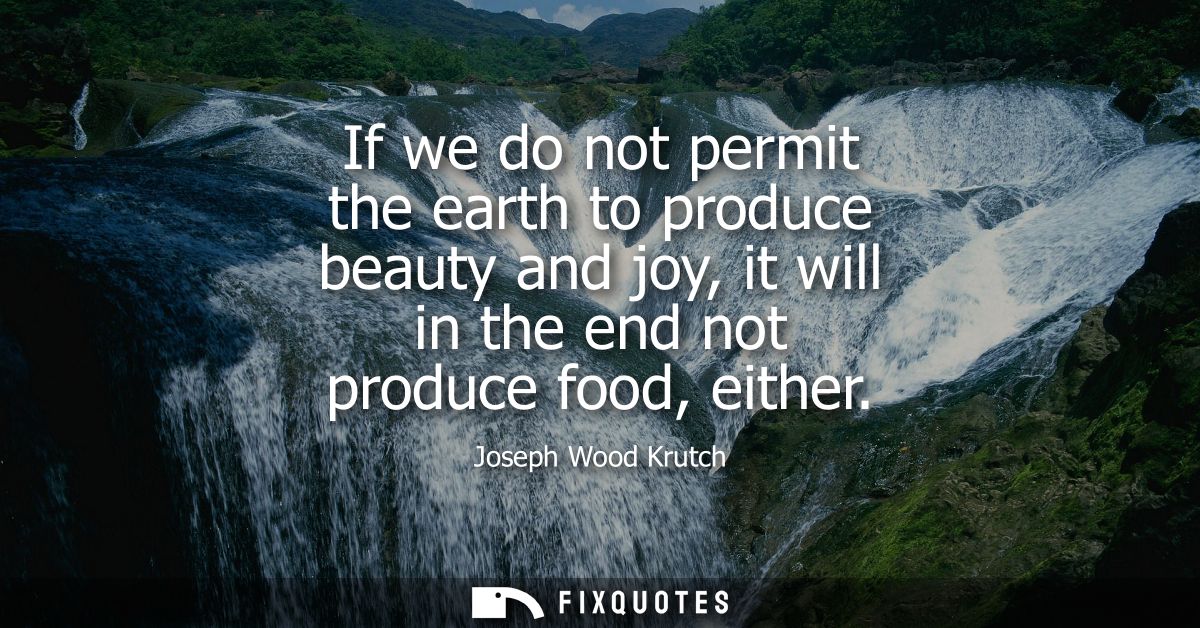
"If we do not permit the earth to produce beauty and joy, it will in the end not produce food, either"
About this Quote
The subtext is aimed at an industrial mindset that sees land as a unit of extraction and success as maximum yield. Krutch treats that as a category error. “Permit” is doing heavy moral work: it implies restraint, humility, and a politics of limits. The earth doesn’t need our innovation as much as it needs us to stop interfering with the basic relationships that keep ecosystems resilient. This is conservation not as sentiment, but as self-preservation.
Context matters: Krutch wrote in the mid-20th century, when pesticides, mechanized monoculture, suburban sprawl, and big dam projects were recasting the American landscape as an engineering problem. His warning anticipates what later science would name explicitly: erosion, pollinator collapse, poisoned waterways, and the brittleness of simplified systems. The sentence lands because it refuses the split between environmentalism and “the economy.” He’s saying the economy is downstream of ecology, whether we like the poetry or not.
Quote Details
| Topic | Nature |
|---|---|
| Source | Help us find the source |
| Cite |
Citation Formats
APA Style (7th ed.)
Krutch, Joseph Wood. (2026, January 18). If we do not permit the earth to produce beauty and joy, it will in the end not produce food, either. FixQuotes. https://fixquotes.com/quotes/if-we-do-not-permit-the-earth-to-produce-beauty-8211/
Chicago Style
Krutch, Joseph Wood. "If we do not permit the earth to produce beauty and joy, it will in the end not produce food, either." FixQuotes. January 18, 2026. https://fixquotes.com/quotes/if-we-do-not-permit-the-earth-to-produce-beauty-8211/.
MLA Style (9th ed.)
"If we do not permit the earth to produce beauty and joy, it will in the end not produce food, either." FixQuotes, 18 Jan. 2026, https://fixquotes.com/quotes/if-we-do-not-permit-the-earth-to-produce-beauty-8211/. Accessed 12 Feb. 2026.