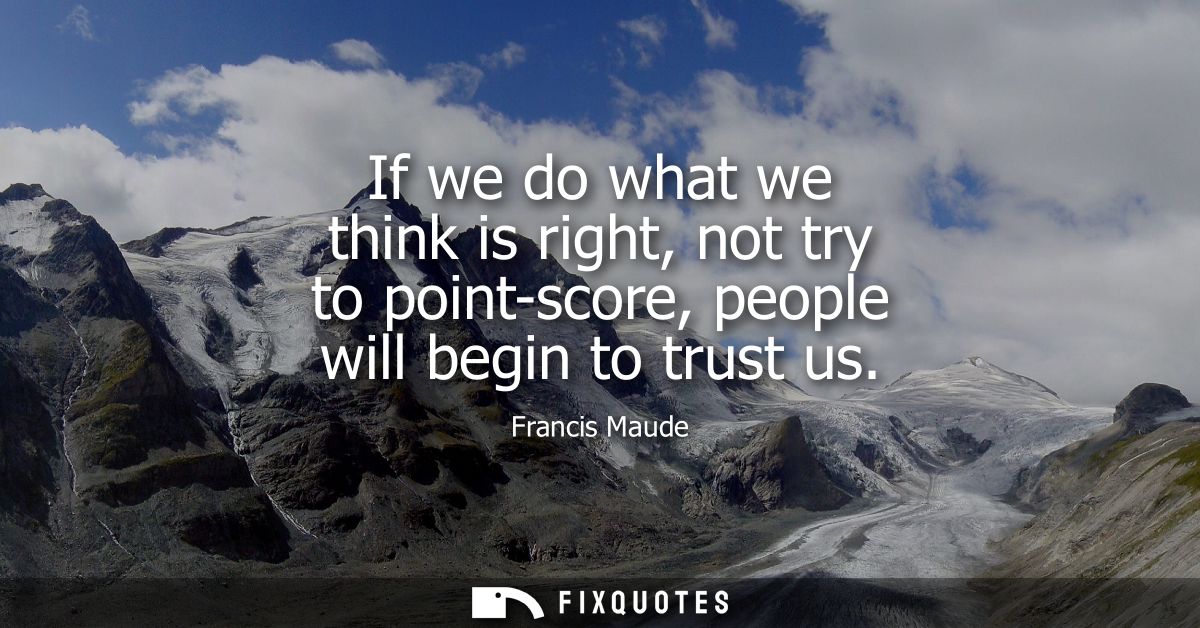
"If we do what we think is right, not try to point-score, people will begin to trust us"
About this Quote
The subtext is that public cynicism isn’t irrational or media-manufactured; it’s earned. By positioning trust as something “people will begin” to grant, Maude admits it’s currently absent and that it returns only gradually. That little “begin” is a tacit concession to scandal fatigue, spin, and the sense that politicians are incentivized to perform rather than decide.
Context matters because Maude isn’t speaking as an outsider scolding the system; he’s a product of it, and that gives the line an almost managerial tone. “If we do” reads like an internal memo to colleagues: stop feeding the short-term cycle, prioritize judgments you can defend when the cameras are gone. It’s also a preemptive defense against accusations of opportunism: the speaker aligns himself with seriousness, implying that opponents are the ones chasing points. The brilliance is that it flatters voters as referees while quietly asking for patience.
Quote Details
| Topic | Honesty & Integrity |
|---|---|
| Source | Help us find the source |
| Cite |
Citation Formats
APA Style (7th ed.)
Maude, Francis. (2026, January 17). If we do what we think is right, not try to point-score, people will begin to trust us. FixQuotes. https://fixquotes.com/quotes/if-we-do-what-we-think-is-right-not-try-to-70752/
Chicago Style
Maude, Francis. "If we do what we think is right, not try to point-score, people will begin to trust us." FixQuotes. January 17, 2026. https://fixquotes.com/quotes/if-we-do-what-we-think-is-right-not-try-to-70752/.
MLA Style (9th ed.)
"If we do what we think is right, not try to point-score, people will begin to trust us." FixQuotes, 17 Jan. 2026, https://fixquotes.com/quotes/if-we-do-what-we-think-is-right-not-try-to-70752/. Accessed 18 Feb. 2026.