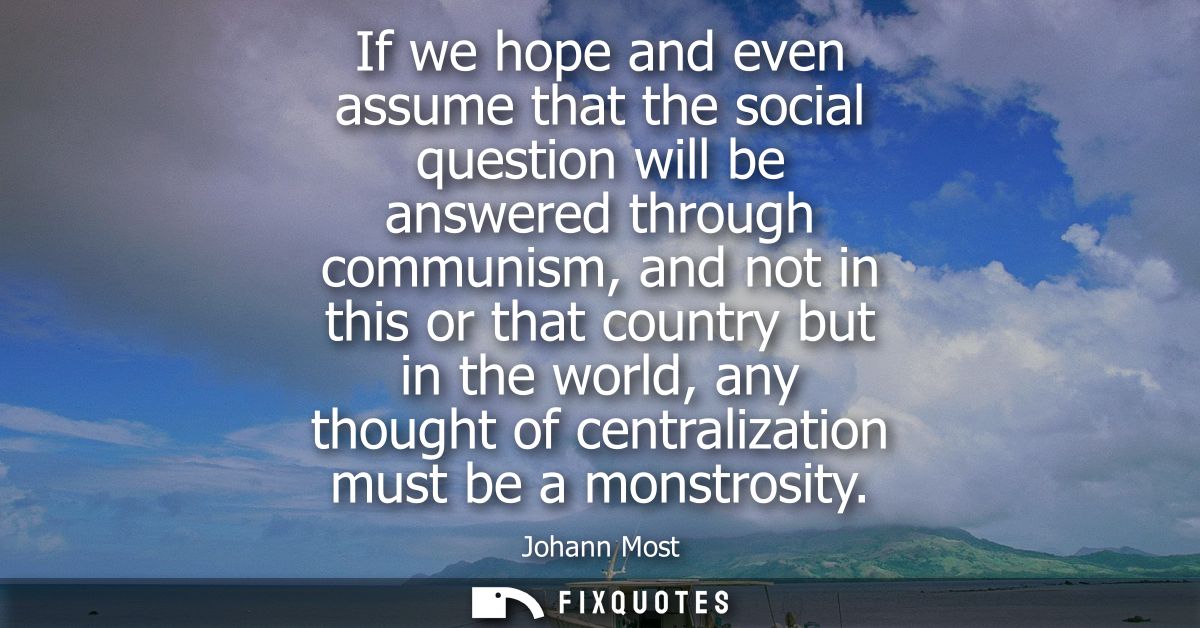
"If we hope and even assume that the social question will be answered through communism, and not in this or that country but in the world, any thought of centralization must be a monstrosity"
About this Quote
“Hope and even assume” is doing sly work. He acknowledges the quasi-religious faith that animates big political movements, then immediately tries to discipline that faith with a hard rule: ends and means have to match. A worldwide emancipation cannot be built on a machine of command. The word “monstrosity” isn’t rhetorical excess; it’s a warning about how revolutions mutate. Centralization doesn’t merely concentrate power, it breeds a new ruling class, reproducing the very hierarchy communism claims to abolish.
Context matters. Most is writing out of the late 19th-century split between authoritarian socialism and anarchist-inflected revolutionary currents, shaped by the Paris Commune’s lessons and the growing shadow of party discipline and state power. His insistence on “in the world” is also a jab at narrow nationalism: a centralized communist state would be forced to compete, police borders, manage scarcity, and suppress dissent. Global liberation, in his view, requires decentralized organization precisely because the state form is designed for control, not freedom.
Quote Details
| Topic | Freedom |
|---|---|
| Source | Help us find the source |
| Cite |
Citation Formats
APA Style (7th ed.)
Most, Johann. (2026, January 18). If we hope and even assume that the social question will be answered through communism, and not in this or that country but in the world, any thought of centralization must be a monstrosity. FixQuotes. https://fixquotes.com/quotes/if-we-hope-and-even-assume-that-the-social-18923/
Chicago Style
Most, Johann. "If we hope and even assume that the social question will be answered through communism, and not in this or that country but in the world, any thought of centralization must be a monstrosity." FixQuotes. January 18, 2026. https://fixquotes.com/quotes/if-we-hope-and-even-assume-that-the-social-18923/.
MLA Style (9th ed.)
"If we hope and even assume that the social question will be answered through communism, and not in this or that country but in the world, any thought of centralization must be a monstrosity." FixQuotes, 18 Jan. 2026, https://fixquotes.com/quotes/if-we-hope-and-even-assume-that-the-social-18923/. Accessed 4 Apr. 2026.