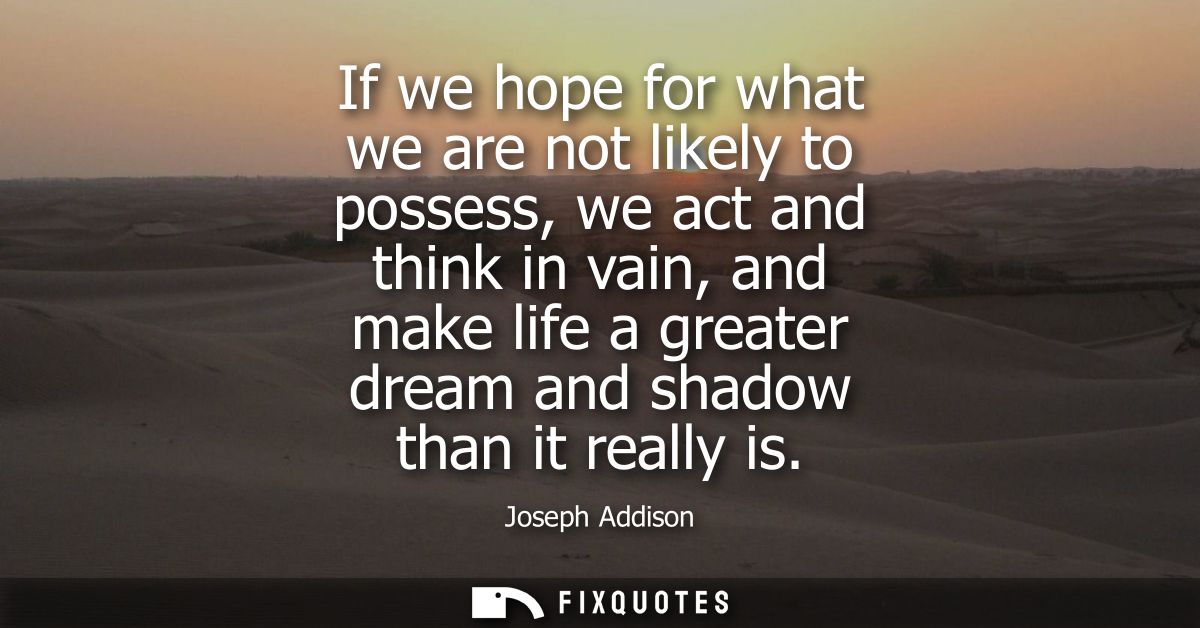
"If we hope for what we are not likely to possess, we act and think in vain, and make life a greater dream and shadow than it really is"
About this Quote
The intent is moral hygiene, the kind that defined early 18th-century essay culture. Addison, the Spectator-era architect of middle-class manners and mental discipline, writes for readers navigating new appetites: commerce, status anxiety, upward mobility, romantic fantasy. In that world, longing is easily marketed, and disappointment becomes a lifestyle. His diction is calibrated to sound reasonable rather than ascetic: “not likely” leaves room for ambition, but demands probabilistic humility.
Subtext: imagination is powerful, but it’s politically and psychologically expensive. When desire outruns reality, it makes you easier to manage - by your own vanity, by social comparison, by the promise of future fulfillment always just out of reach. Addison’s restraint is less about killing dreams than about refusing to let dreams do the living for you.
Quote Details
| Topic | Hope |
|---|---|
| Source | Help us find the source |
| Cite |
Citation Formats
APA Style (7th ed.)
Addison, Joseph. (2026, January 16). If we hope for what we are not likely to possess, we act and think in vain, and make life a greater dream and shadow than it really is. FixQuotes. https://fixquotes.com/quotes/if-we-hope-for-what-we-are-not-likely-to-possess-90939/
Chicago Style
Addison, Joseph. "If we hope for what we are not likely to possess, we act and think in vain, and make life a greater dream and shadow than it really is." FixQuotes. January 16, 2026. https://fixquotes.com/quotes/if-we-hope-for-what-we-are-not-likely-to-possess-90939/.
MLA Style (9th ed.)
"If we hope for what we are not likely to possess, we act and think in vain, and make life a greater dream and shadow than it really is." FixQuotes, 16 Jan. 2026, https://fixquotes.com/quotes/if-we-hope-for-what-we-are-not-likely-to-possess-90939/. Accessed 23 Mar. 2026.