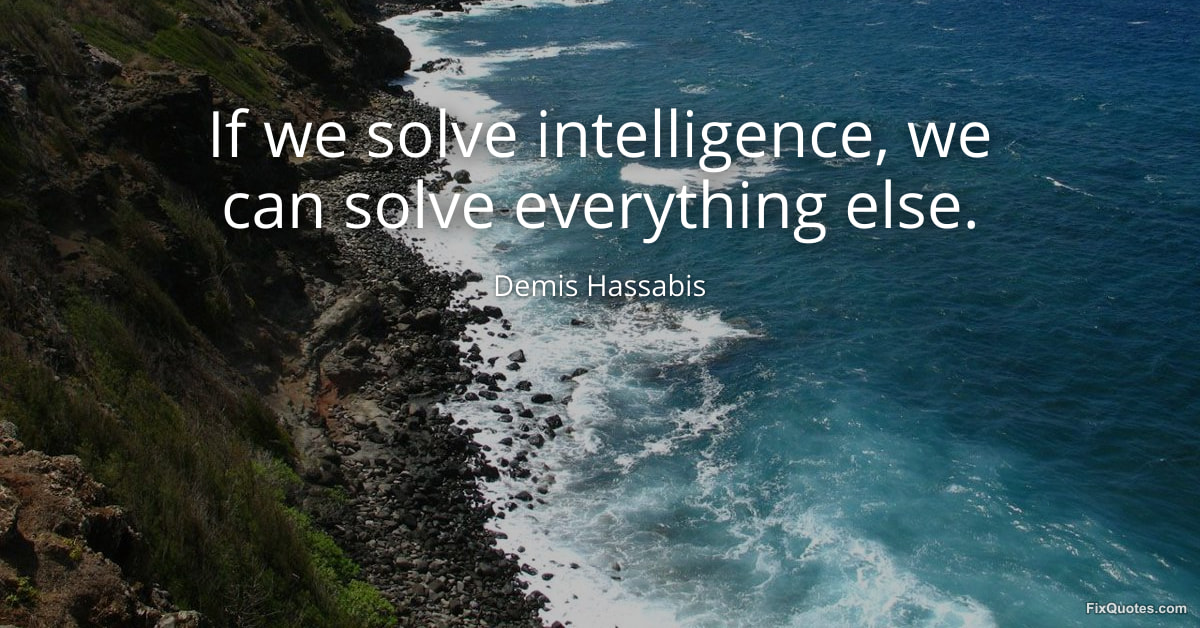
"If we solve intelligence, we can solve everything else"
About this Quote
It’s a thesis statement disguised as a mic-drop: make minds, and the rest becomes engineering. Hassabis is not talking about a clever app or even a better search engine. He’s pitching intelligence as a master key - the one technology that, once cracked, can be turned on every other locked door: protein folding, climate modeling, energy grids, drug discovery, even governance-by-simulation if you follow the logic far enough. That’s why the line works. It compresses a sprawling research agenda into a single, investor-friendly inevitability.
The subtext is bolder, and a little more dangerous: most problems aren’t fundamentally political or moral; they’re computational. Frame intelligence as the bottleneck and you quietly demote institutions, incentives, and power to secondary variables. It’s a worldview common in Silicon Valley and unusually literal in Hassabis’s case, given DeepMind’s mission to build general-purpose learning systems. Coming from someone who has already watched AI outperform humans in bounded domains (games, certain scientific tasks), the statement isn’t naive optimism so much as strategic inevitabilism: if you can build a system that learns anything, you can aim it at anything.
The context matters because “solve intelligence” is doing rhetorical work. It suggests a clean finish line for a messy concept, and it flatters the builder’s role: the people who “solve” intelligence become the stewards of everything else. The quote is inspirational, but it also functions as a justification for scale - more data, more compute, more latitude - because the prize, in this framing, is nothing less than the world.
The subtext is bolder, and a little more dangerous: most problems aren’t fundamentally political or moral; they’re computational. Frame intelligence as the bottleneck and you quietly demote institutions, incentives, and power to secondary variables. It’s a worldview common in Silicon Valley and unusually literal in Hassabis’s case, given DeepMind’s mission to build general-purpose learning systems. Coming from someone who has already watched AI outperform humans in bounded domains (games, certain scientific tasks), the statement isn’t naive optimism so much as strategic inevitabilism: if you can build a system that learns anything, you can aim it at anything.
The context matters because “solve intelligence” is doing rhetorical work. It suggests a clean finish line for a messy concept, and it flatters the builder’s role: the people who “solve” intelligence become the stewards of everything else. The quote is inspirational, but it also functions as a justification for scale - more data, more compute, more latitude - because the prize, in this framing, is nothing less than the world.
Quote Details
| Topic | Artificial Intelligence |
|---|---|
| Source | TED Talk: Demis Hassabis , "The exciting, perilous journey toward AGI" (2024) |
| Cite |
Citation Formats
APA Style (7th ed.)
Hassabis, Demis. (2026, January 26). If we solve intelligence, we can solve everything else. FixQuotes. https://fixquotes.com/quotes/if-we-solve-intelligence-we-can-solve-everything-184480/
Chicago Style
Hassabis, Demis. "If we solve intelligence, we can solve everything else." FixQuotes. January 26, 2026. https://fixquotes.com/quotes/if-we-solve-intelligence-we-can-solve-everything-184480/.
MLA Style (9th ed.)
"If we solve intelligence, we can solve everything else." FixQuotes, 26 Jan. 2026, https://fixquotes.com/quotes/if-we-solve-intelligence-we-can-solve-everything-184480/. Accessed 12 Feb. 2026.
More Quotes by Demis
Add to List