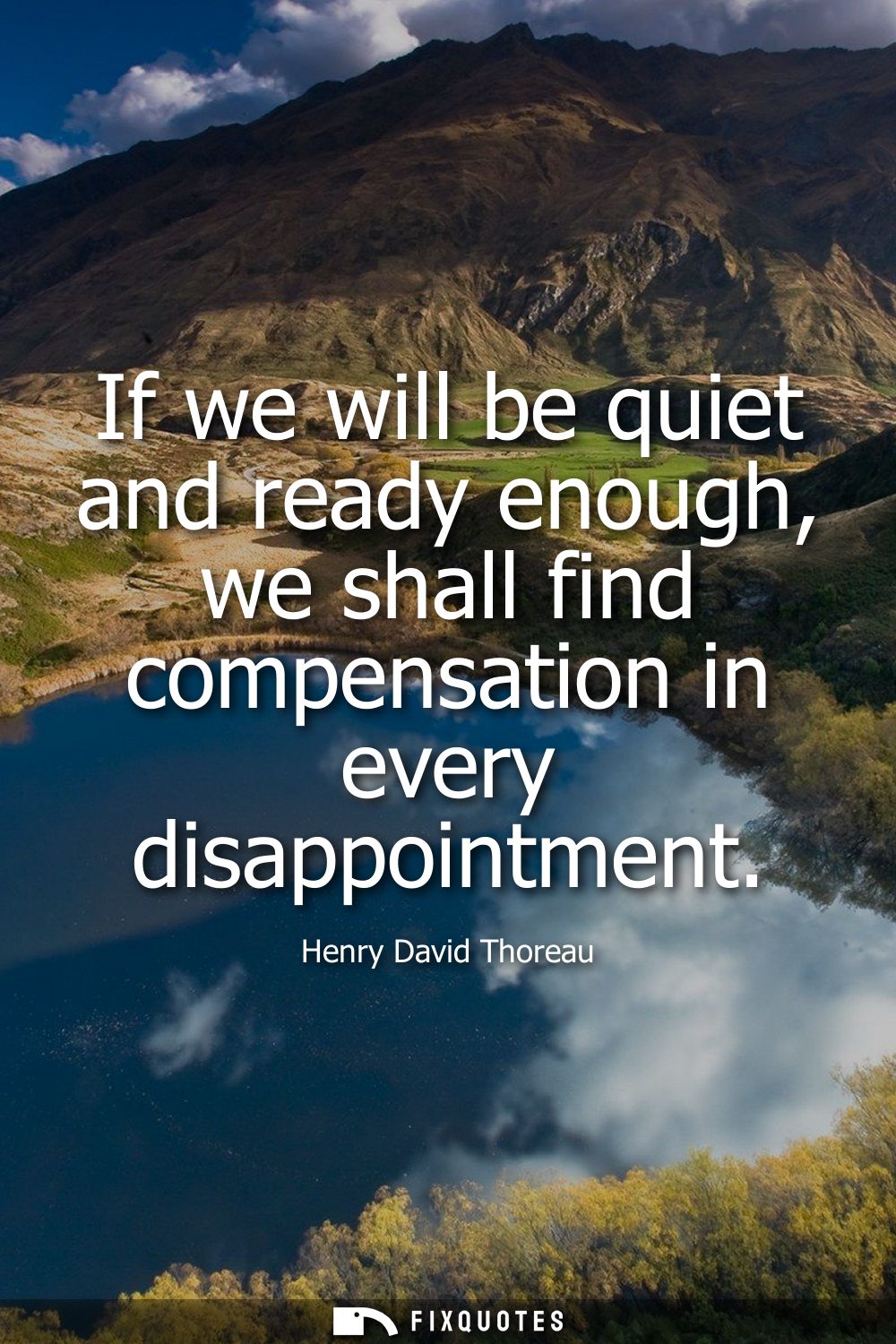
"If we will be quiet and ready enough, we shall find compensation in every disappointment"
About this Quote
Thoreau’s advice lands like a calm rebuke to the American itch for immediate payoff. “Quiet and ready enough” isn’t just a mood; it’s a discipline. He’s arguing that disappointment isn’t primarily an external event but a failure of perception, a moment when the world refuses to match our timetable. If you can lower the noise - social expectations, ambition, self-pity - you become “ready” to notice what the thwarted plan reveals: new routes, truer desires, the limits of your control.
The line smuggles in a kind of moral economics. “Compensation” sounds almost transactional, as if the universe keeps ledgers and refunds. Thoreau borrows that commercial vocabulary to flip it: the real profit comes from refusing the market’s demand that everything validate you right now. Disappointment becomes an instrument, not an injury, but only for the person willing to sit still long enough to hear it.
Context matters. Writing in a 19th-century culture accelerating toward industry, status, and restless acquisition, Thoreau built an identity around opting out - or at least stepping aside to watch the machine more clearly. This is the Walden-era sensibility condensed: nature doesn’t console you with sentiment; it compensates you with perspective. The subtext is quietly radical: if you can train attention, you can make loss less governable by society’s scripts. The disappointment stays real, but it stops being final.
The line smuggles in a kind of moral economics. “Compensation” sounds almost transactional, as if the universe keeps ledgers and refunds. Thoreau borrows that commercial vocabulary to flip it: the real profit comes from refusing the market’s demand that everything validate you right now. Disappointment becomes an instrument, not an injury, but only for the person willing to sit still long enough to hear it.
Context matters. Writing in a 19th-century culture accelerating toward industry, status, and restless acquisition, Thoreau built an identity around opting out - or at least stepping aside to watch the machine more clearly. This is the Walden-era sensibility condensed: nature doesn’t console you with sentiment; it compensates you with perspective. The subtext is quietly radical: if you can train attention, you can make loss less governable by society’s scripts. The disappointment stays real, but it stops being final.
Quote Details
| Topic | Resilience |
|---|
More Quotes by Henry
Add to List