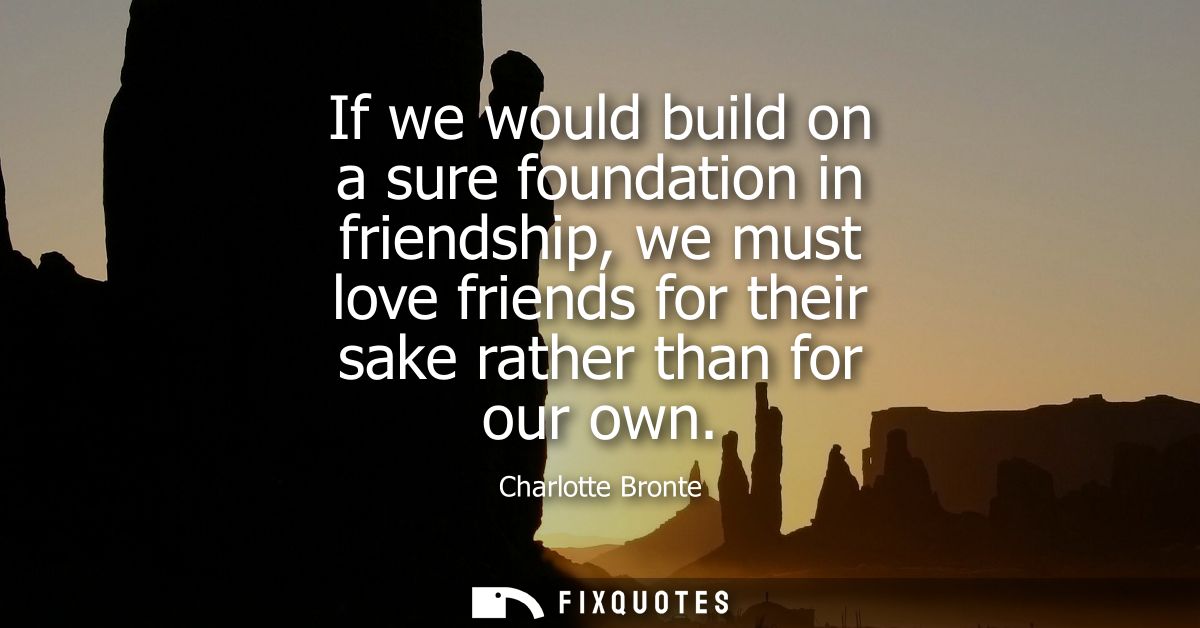
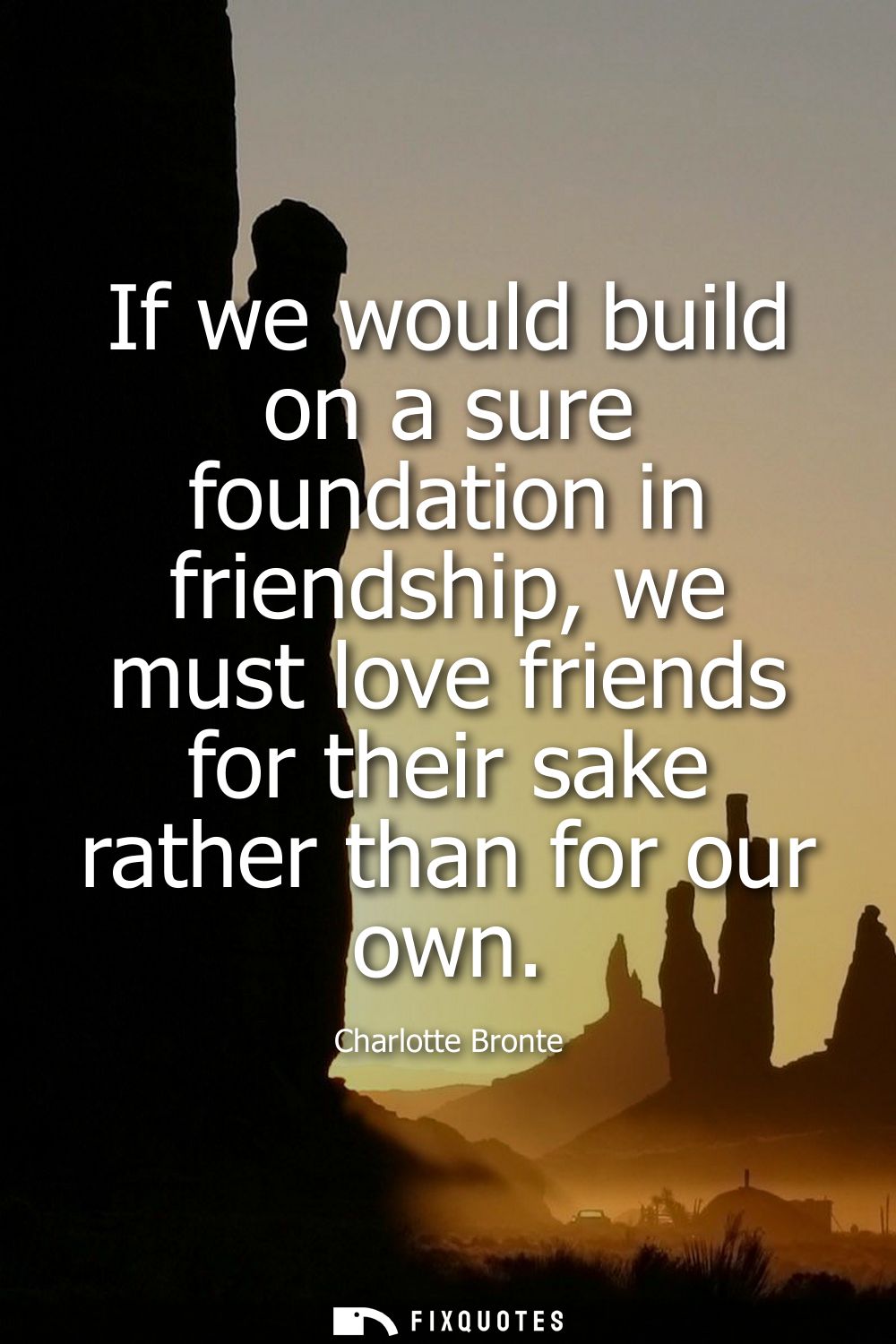
"If we would build on a sure foundation in friendship, we must love friends for their sake rather than for our own"
About this Quote
The hinge is “for their sake rather than for our own,” a distinction that sounds lofty until you notice how often “our own” sneaks in wearing good manners. We love friends for the entertainment they provide, the social capital they confer, the way they steady our self-image. Bronte’s subtext is sharper: affection that’s transactional will eventually demand payment. When a friend’s needs interrupt the role you’ve cast them in, the relationship cracks.
Context matters. Bronte’s fiction is full of characters navigating dependency, class pressure, and the humiliations of needing others. In that world, relationships are rarely “pure”; they’re entangled with survival and status. This sentence reads like an ethical corrective to those realities, insisting on an inner discipline: to see the friend as an end, not a means. It’s also a warning against sentimental narcissism, the habit of calling something love when it’s really appetite.
What makes it work is the austerity. No grand romantic flourish, just a practical principle. Bronte treats friendship not as a vibe, but as a vow: sturdy only when it costs you something.
Quote Details
| Topic | Friendship |
|---|---|
| Source | Help us find the source |
| Cite |
Citation Formats
APA Style (7th ed.)
Bronte, Charlotte. (2026, January 17). If we would build on a sure foundation in friendship, we must love friends for their sake rather than for our own. FixQuotes. https://fixquotes.com/quotes/if-we-would-build-on-a-sure-foundation-in-79702/
Chicago Style
Bronte, Charlotte. "If we would build on a sure foundation in friendship, we must love friends for their sake rather than for our own." FixQuotes. January 17, 2026. https://fixquotes.com/quotes/if-we-would-build-on-a-sure-foundation-in-79702/.
MLA Style (9th ed.)
"If we would build on a sure foundation in friendship, we must love friends for their sake rather than for our own." FixQuotes, 17 Jan. 2026, https://fixquotes.com/quotes/if-we-would-build-on-a-sure-foundation-in-79702/. Accessed 28 Mar. 2026.