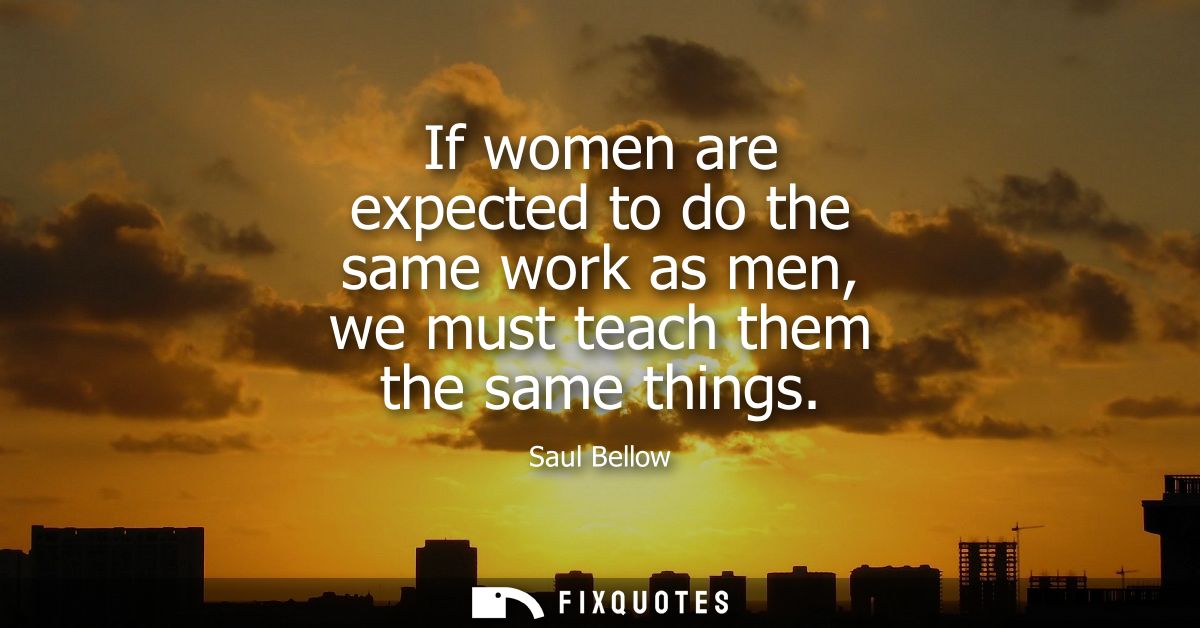
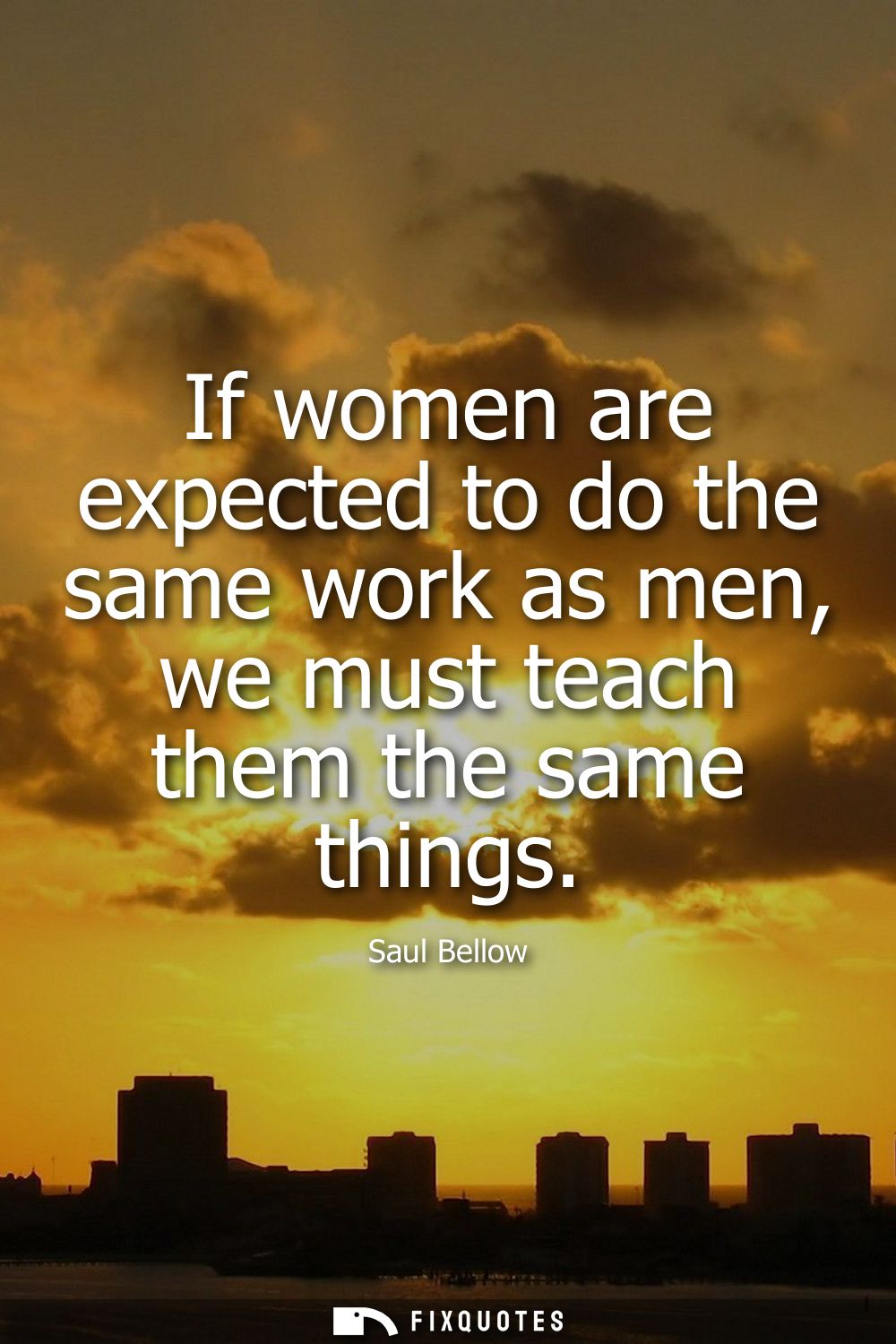
"If women are expected to do the same work as men, we must teach them the same things"
About this Quote
Bellow’s line has the clean, almost bureaucratic logic of a trap: if you’re going to demand identical output, you can’t keep rationing the inputs. The sentence reads like common sense, but it’s a pressure point aimed at a culture that liked equality as a slogan and hierarchy as a habit. By framing the issue as expectation rather than entitlement, Bellow dodges pious language and goes straight for the mechanism that produces inequality: education as gatekeeping.
The subtext is sharper than its civility suggests. “Expected” implies women are already being held to the standard of male competence in public life, while being denied the training, credentials, and informal mentoring that make that competence legible. “Teach” isn’t only about classrooms; it’s about access to networks, apprenticeships, and the kinds of confidence that get coded as talent. The line exposes how discrimination often survives not through outright bans but through unequal preparation and the convenient myth that outcomes reflect “natural” differences.
Context matters: Bellow wrote in a century when women’s labor participation surged, yet professional authority and intellectual prestige remained aggressively gendered. His fiction is famously alert to status games and cultural hypocrisy; here he compresses that sensibility into a maxim. It’s not a sentimental defense of women so much as a rebuke to institutions that want women’s productivity without surrendering male monopoly over training and expertise. The quote works because it’s an argument you can’t easily heckle: if you believe in merit, you have to fund it.
The subtext is sharper than its civility suggests. “Expected” implies women are already being held to the standard of male competence in public life, while being denied the training, credentials, and informal mentoring that make that competence legible. “Teach” isn’t only about classrooms; it’s about access to networks, apprenticeships, and the kinds of confidence that get coded as talent. The line exposes how discrimination often survives not through outright bans but through unequal preparation and the convenient myth that outcomes reflect “natural” differences.
Context matters: Bellow wrote in a century when women’s labor participation surged, yet professional authority and intellectual prestige remained aggressively gendered. His fiction is famously alert to status games and cultural hypocrisy; here he compresses that sensibility into a maxim. It’s not a sentimental defense of women so much as a rebuke to institutions that want women’s productivity without surrendering male monopoly over training and expertise. The quote works because it’s an argument you can’t easily heckle: if you believe in merit, you have to fund it.
Quote Details
| Topic | Equality |
|---|
More Quotes by Saul
Add to List