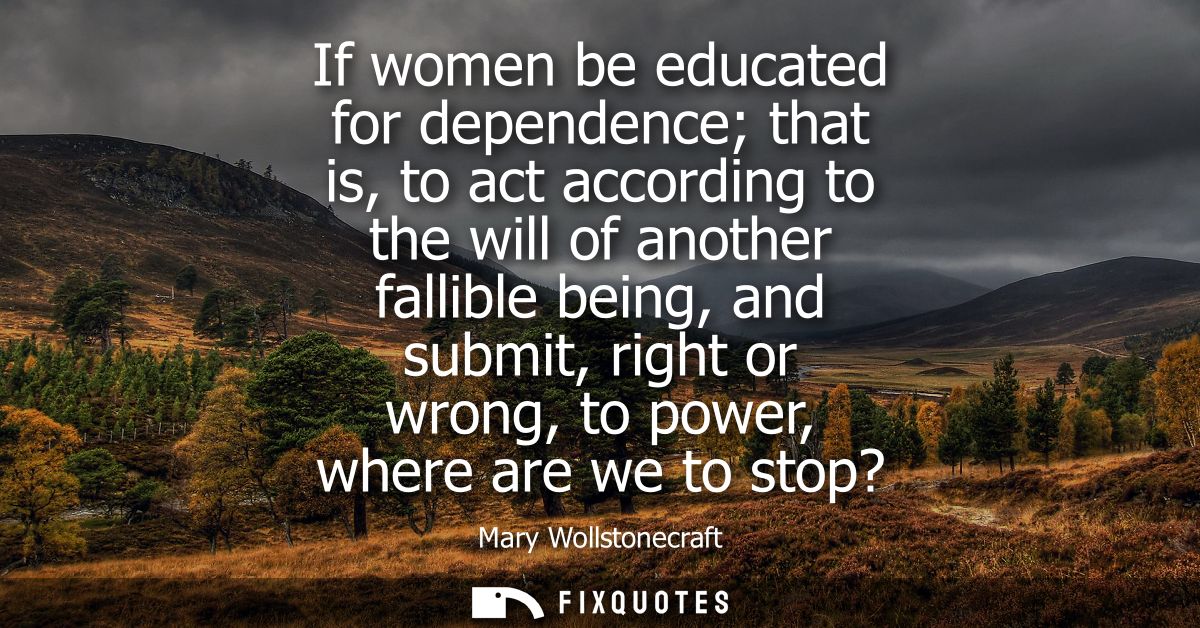
"If women be educated for dependence; that is, to act according to the will of another fallible being, and submit, right or wrong, to power, where are we to stop?"
About this Quote
The subtext is that obedience is not neutral. “Submit, right or wrong, to power” names the scandal: deference becomes a habit that can sanctify cruelty and stupidity alike. Wollstonecraft is writing in the wake of Enlightenment promises and revolutionary rhetoric, when “reason” and “rights” were circulating as universal ideals that somehow kept stopping at the parlor door. She’s exposing that contradiction with a slippery-slope question: once you teach submission as virtue, what principle limits it? If “right or wrong” doesn’t matter, then neither does conscience, nor justice, nor even the stability of the society that relies on women as moral educators of children.
Contextually, this is the argument of A Vindication of the Rights of Woman sharpened into a single sentence: education is destiny disguised as etiquette. Wollstonecraft’s intent is not simply to elevate women; it’s to deny tyranny its favorite alibi, the idea that dependence is “natural” when it has been carefully manufactured.
Quote Details
| Topic | Equality |
|---|---|
| Source | Mary Wollstonecraft, A Vindication of the Rights of Woman (1792). Passage arguing against educating women for dependence (commonly cited from Wollstonecraft's Vindication). |
| Cite |
Citation Formats
APA Style (7th ed.)
Wollstonecraft, Mary. (2026, January 18). If women be educated for dependence; that is, to act according to the will of another fallible being, and submit, right or wrong, to power, where are we to stop? FixQuotes. https://fixquotes.com/quotes/if-women-be-educated-for-dependence-that-is-to-7491/
Chicago Style
Wollstonecraft, Mary. "If women be educated for dependence; that is, to act according to the will of another fallible being, and submit, right or wrong, to power, where are we to stop?" FixQuotes. January 18, 2026. https://fixquotes.com/quotes/if-women-be-educated-for-dependence-that-is-to-7491/.
MLA Style (9th ed.)
"If women be educated for dependence; that is, to act according to the will of another fallible being, and submit, right or wrong, to power, where are we to stop?" FixQuotes, 18 Jan. 2026, https://fixquotes.com/quotes/if-women-be-educated-for-dependence-that-is-to-7491/. Accessed 4 Apr. 2026.