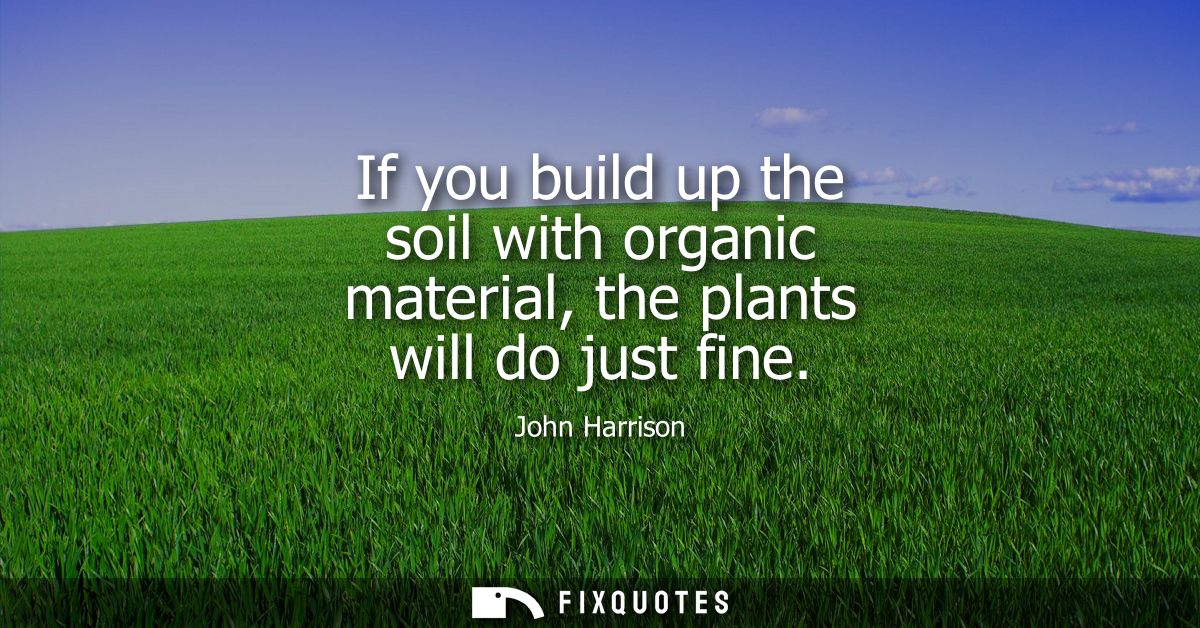
"If you build up the soil with organic material, the plants will do just fine"
About this Quote
The intent is corrective. It pushes back against the impulse to micromanage results - to fuss over leaves and blame the plant when growth stalls - when the real lever is the soil. “Build up” implies labor and patience, the slow accumulation of compost, not a quick fix. “Organic material” is telling, too. It’s not an additive in the modern, branded sense; it’s the leftover, broken-down matter of life, reused. Waste becomes infrastructure. That’s a quiet rebuke to extractive thinking: you don’t force productivity, you cultivate conditions.
The subtext fits the 18th century’s pragmatic Enlightenment better than its more swaggering rhetoric. Britain was refining agriculture, instrumentation, and industry by trial, iteration, and craft knowledge. Harrison’s genius came from obsessing over what most people ignore - temperature shifts, lubrication, wood movement. The line’s modest confidence (“will do just fine”) is almost procedural: attend to fundamentals, and nature - or a well-designed mechanism - will cooperate. It’s an engineer’s faith, not in control, but in good foundations.
Quote Details
| Topic | Nature |
|---|---|
| Source | Help us find the source |
| Cite |
Citation Formats
APA Style (7th ed.)
Harrison, John. (2026, January 15). If you build up the soil with organic material, the plants will do just fine. FixQuotes. https://fixquotes.com/quotes/if-you-build-up-the-soil-with-organic-material-11511/
Chicago Style
Harrison, John. "If you build up the soil with organic material, the plants will do just fine." FixQuotes. January 15, 2026. https://fixquotes.com/quotes/if-you-build-up-the-soil-with-organic-material-11511/.
MLA Style (9th ed.)
"If you build up the soil with organic material, the plants will do just fine." FixQuotes, 15 Jan. 2026, https://fixquotes.com/quotes/if-you-build-up-the-soil-with-organic-material-11511/. Accessed 31 Mar. 2026.