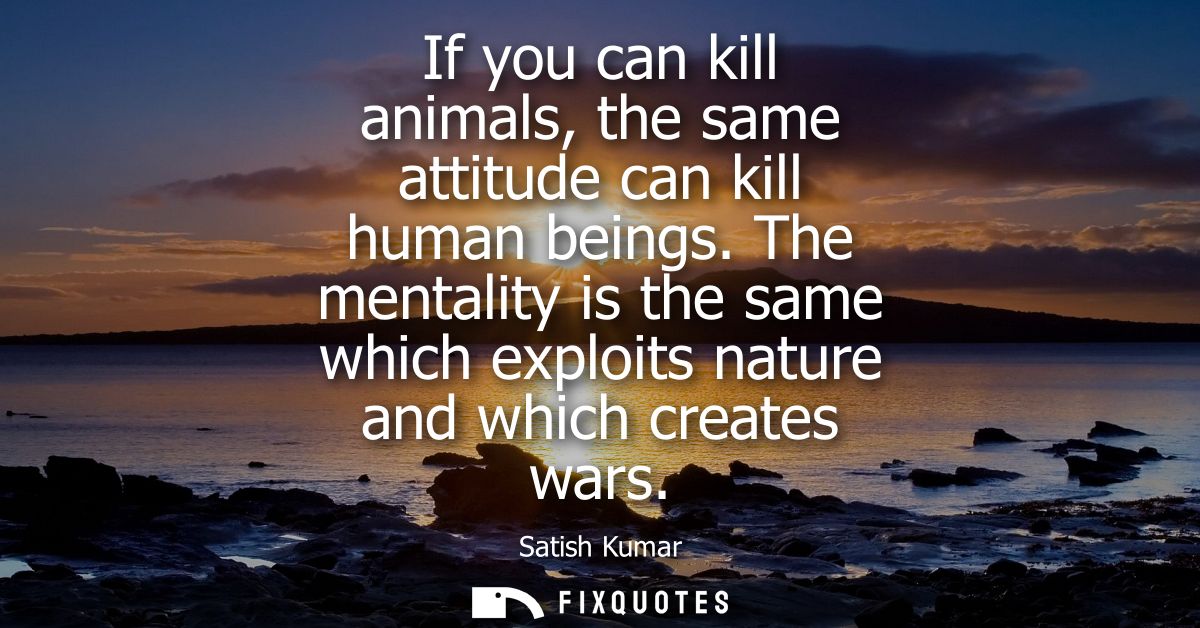
"If you can kill animals, the same attitude can kill human beings. The mentality is the same which exploits nature and which creates wars"
About this Quote
The quote works because it collapses categories modern life works hard to keep separate. We compartmentalize: animals are “food,” forests are “timber,” wars are “geopolitics.” Kumar refuses the compartments and names the common denominator: exploitation. The syntax does a lot of the moral work. “The same attitude” implies continuity; “the mentality is the same” doubles down, insisting this is not a freak exception but a pattern.
Context matters: Kumar comes out of a lineage of Gandhian and ecological activism where nonviolence isn’t only interpersonal ethics but a total stance toward the world. In that tradition, war isn’t an aberration; it’s the loudest expression of a quieter everyday creed: that power justifies taking. The subtext is a challenge to liberal comfort: if you oppose war but live casually inside systems that normalize harm to the vulnerable, your politics may be more aesthetic than structural.
Quote Details
| Topic | Ethics & Morality |
|---|---|
| Source | Help us find the source |
| Cite |
Citation Formats
APA Style (7th ed.)
Kumar, Satish. (2026, January 15). If you can kill animals, the same attitude can kill human beings. The mentality is the same which exploits nature and which creates wars. FixQuotes. https://fixquotes.com/quotes/if-you-can-kill-animals-the-same-attitude-can-116975/
Chicago Style
Kumar, Satish. "If you can kill animals, the same attitude can kill human beings. The mentality is the same which exploits nature and which creates wars." FixQuotes. January 15, 2026. https://fixquotes.com/quotes/if-you-can-kill-animals-the-same-attitude-can-116975/.
MLA Style (9th ed.)
"If you can kill animals, the same attitude can kill human beings. The mentality is the same which exploits nature and which creates wars." FixQuotes, 15 Jan. 2026, https://fixquotes.com/quotes/if-you-can-kill-animals-the-same-attitude-can-116975/. Accessed 5 Apr. 2026.