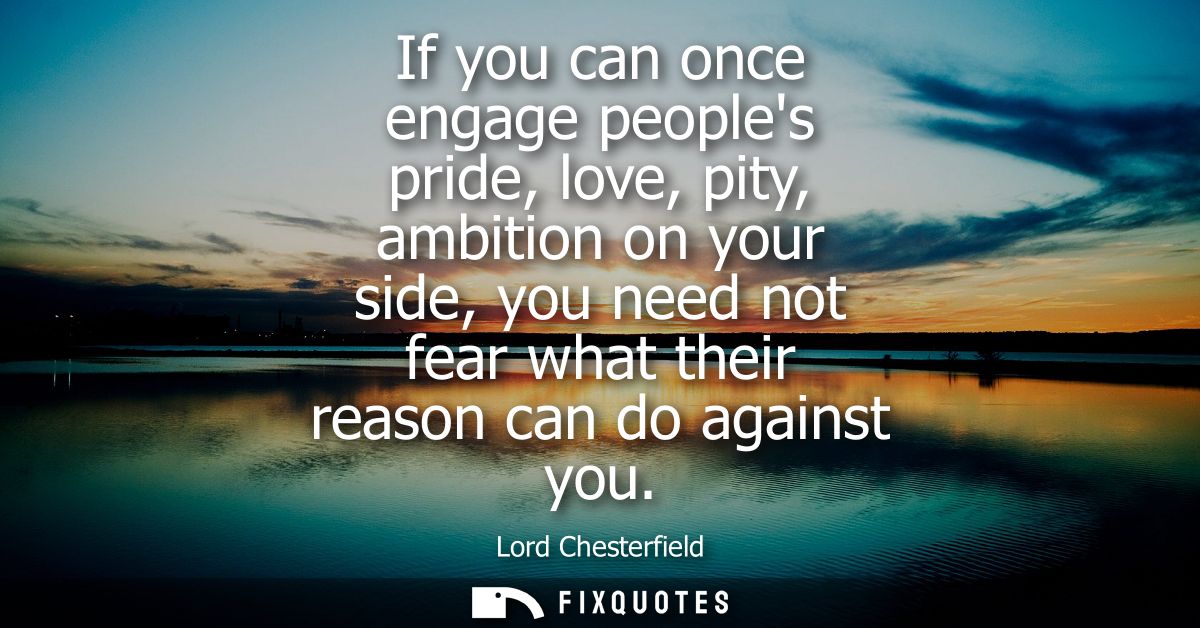
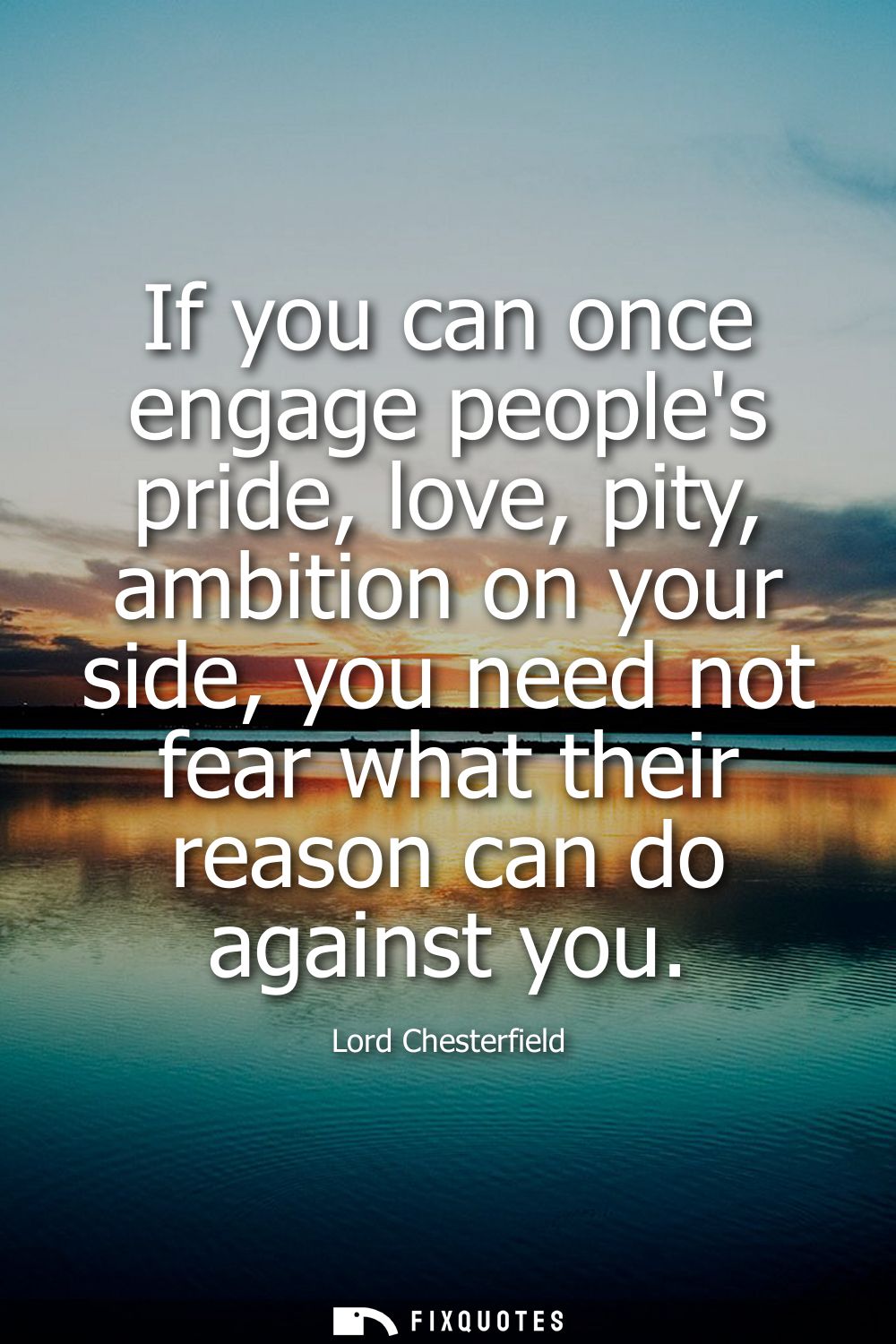
"If you can once engage people's pride, love, pity, ambition on your side, you need not fear what their reason can do against you"
About this Quote
The subtext is almost brutish in its candor: people defend what flatters them. Pride is the master key because it makes persuasion feel like self-respect. Pity offers moral permission to suspend skepticism. Ambition creates buy-in: if your ascent is tied to mine, your reasoning will conveniently align. Love is the softest word here, but in Chesterfield’s hands it’s still a lever, a way to bind loyalty beyond evidence.
Context matters. Chesterfield was a statesman and a famed author of letters on social advancement - a world where patronage, reputation, and courtly performance mattered as much as policy. In that environment, “reason” was rarely a neutral referee; it was the brief filed after alliances were formed. The quote’s intent is less inspirational than diagnostic: if you want to move people, stop arguing like a philosopher and start thinking like a strategist.
Quote Details
| Topic | Leadership |
|---|---|
| Source | Help us find the source |
| Cite |
Citation Formats
APA Style (7th ed.)
Chesterfield, Lord. (2026, January 18). If you can once engage people's pride, love, pity, ambition on your side, you need not fear what their reason can do against you. FixQuotes. https://fixquotes.com/quotes/if-you-can-once-engage-peoples-pride-love-pity-16140/
Chicago Style
Chesterfield, Lord. "If you can once engage people's pride, love, pity, ambition on your side, you need not fear what their reason can do against you." FixQuotes. January 18, 2026. https://fixquotes.com/quotes/if-you-can-once-engage-peoples-pride-love-pity-16140/.
MLA Style (9th ed.)
"If you can once engage people's pride, love, pity, ambition on your side, you need not fear what their reason can do against you." FixQuotes, 18 Jan. 2026, https://fixquotes.com/quotes/if-you-can-once-engage-peoples-pride-love-pity-16140/. Accessed 3 Apr. 2026.