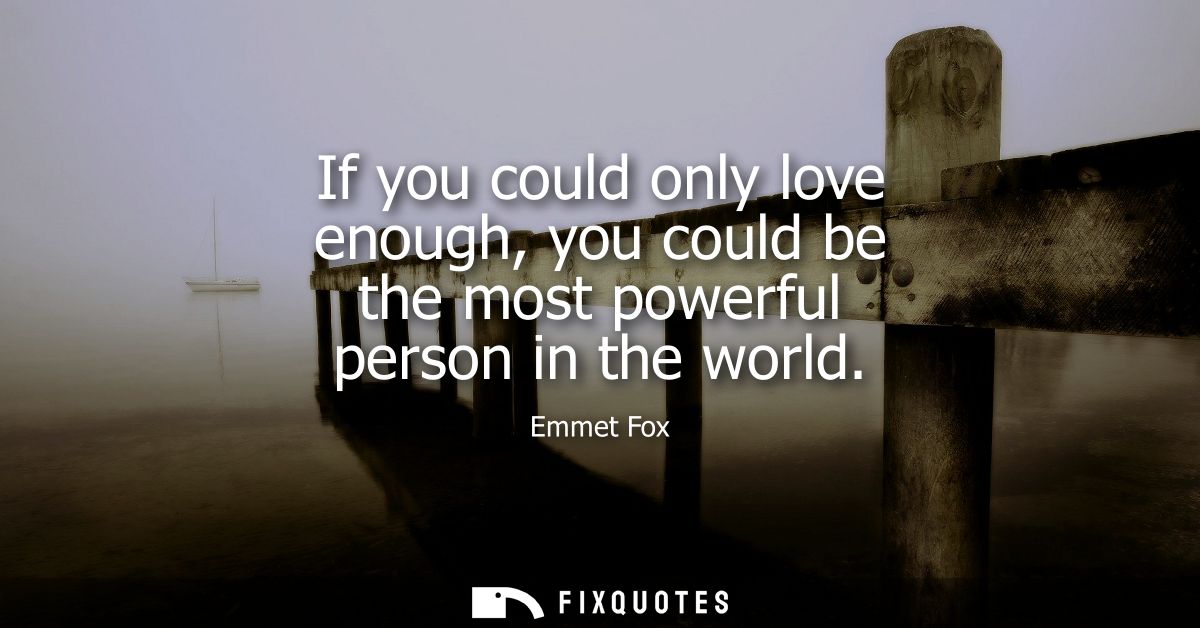
"If you could only love enough, you could be the most powerful person in the world"
About this Quote
The subtext is both consoling and quietly radical. Consoling, because it relocates agency inside the self; you don’t need money, beauty, or status to matter. Radical, because it redefines power as noncoercive influence: the capacity to disarm hostility, to break cycles of resentment, to make generosity feel less like self-sacrifice and more like strategy. Fox is selling a moral technology.
There’s also a sly safeguard built in. “If you could” admits the difficulty; it’s aspirational enough to dodge falsification. When love fails to “make you powerful,” the problem isn’t the claim, it’s your dosage. That’s the New Thought move: promise transformation while keeping the burden of proof internal.
Read generously, the sentence is an argument for emotional sovereignty. Read skeptically, it’s a spiritualized version of hustle culture: limitless results, provided you optimize the self.
Quote Details
| Topic | Love |
|---|---|
| Source | Help us find the source |
| Cite |
Citation Formats
APA Style (7th ed.)
Fox, Emmet. (2026, January 17). If you could only love enough, you could be the most powerful person in the world. FixQuotes. https://fixquotes.com/quotes/if-you-could-only-love-enough-you-could-be-the-51076/
Chicago Style
Fox, Emmet. "If you could only love enough, you could be the most powerful person in the world." FixQuotes. January 17, 2026. https://fixquotes.com/quotes/if-you-could-only-love-enough-you-could-be-the-51076/.
MLA Style (9th ed.)
"If you could only love enough, you could be the most powerful person in the world." FixQuotes, 17 Jan. 2026, https://fixquotes.com/quotes/if-you-could-only-love-enough-you-could-be-the-51076/. Accessed 18 Feb. 2026.