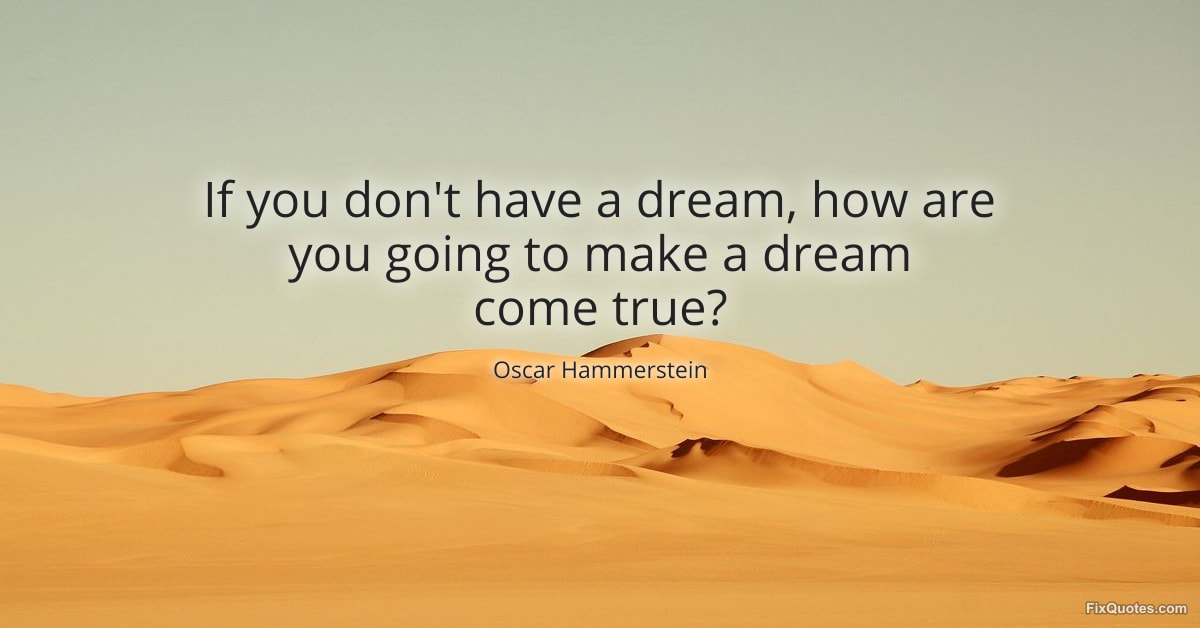
"If you don't have a dream, how are you going to make a dream come true?"
About this Quote
The intent is pragmatic. Hammerstein, a Broadway writer steeped in narrative mechanics, understands that “dream” isn’t just fantasy; it’s the plot engine. In musicals, characters sing when speech can’t hold the pressure of desire. That’s the subtext here: without a named want, you drift, and drift doesn’t produce story, community, or change. The quote flatters agency while quietly assigning responsibility. If your life stalls, it’s not only bad luck; it might be that you never articulated the thing you were chasing.
Context matters. Hammerstein wrote during decades defined by economic collapse, war, and the postwar scramble for meaning. Broadway sold hope, but the best of it sold hope with structure: goals, sacrifices, rewrites. His “dream” isn’t a hazy wish; it’s a decision to want something specific enough that reality can push back. That friction is where a “come true” becomes earned rather than imagined.
Quote Details
| Topic | Goal Setting |
|---|---|
| Source | Verified source: Happy Talk (South Pacific) – first-edition vocal score sh... (Oscar Hammerstein, 1949)
Evidence: You gotta have a dream; If you don't have a dream How you gonna have a dream come true? (Music pp. 2–7 (title page [1])). This line is not originally a standalone aphorism; it is a lyric from the song “Happy Talk” in Rodgers & Hammerstein’s musical South Pacific (original Broadway production opened 1949). A primary, contemporaneous publication of the lyric is the first-edition sheet music/vocal score for “Happy Talk,” cataloged by The Morgan Library & Museum as published in New York by Williamson Music, Inc., copyright 1949 (with Chappell & Co., Inc. also listed as another publisher). The frequently-circulated wording “If you don't have a dream, how are you going to make a dream come true?” is a paraphrase/modernized variant (“make” vs. “have,” and “are you going to” vs. “how you gonna”). Other candidates (1) Let Go of Whatever Makes You Stop (John L. Mason, 1994) compilation95.0% ... If you don't have a dream , how are you going to make a dream come true ? " ( Oscar Hammerstein ) Do you look at ... |
| Cite |
Citation Formats
APA Style (7th ed.)
Hammerstein, Oscar. (2026, February 8). If you don't have a dream, how are you going to make a dream come true? FixQuotes. https://fixquotes.com/quotes/if-you-dont-have-a-dream-how-are-you-going-to-119802/
Chicago Style
Hammerstein, Oscar. "If you don't have a dream, how are you going to make a dream come true?" FixQuotes. February 8, 2026. https://fixquotes.com/quotes/if-you-dont-have-a-dream-how-are-you-going-to-119802/.
MLA Style (9th ed.)
"If you don't have a dream, how are you going to make a dream come true?" FixQuotes, 8 Feb. 2026, https://fixquotes.com/quotes/if-you-dont-have-a-dream-how-are-you-going-to-119802/. Accessed 12 Feb. 2026.