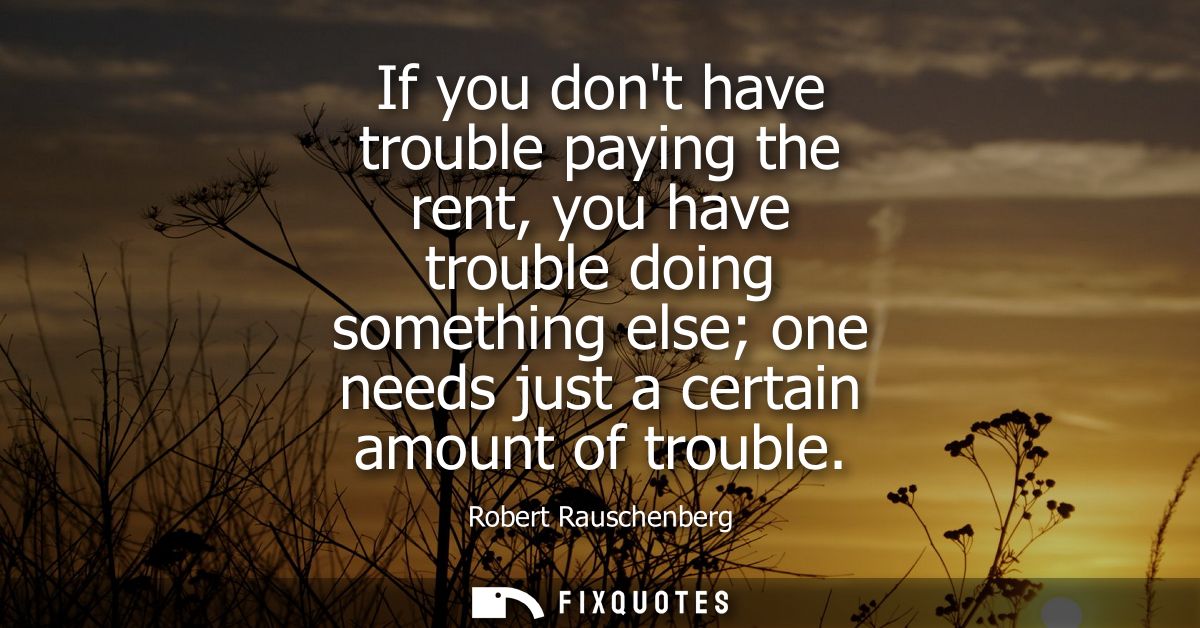
"If you don't have trouble paying the rent, you have trouble doing something else; one needs just a certain amount of trouble"
About this Quote
The intent is bracingly unsentimental. Rauschenberg isn’t asking for sympathy; he’s disarming the myth that a stable life will finally deliver peace and therefore better art. It won’t. The subtext is almost therapeutic in its realism: stop imagining a trouble-free future as a destination. Trouble is the baseline condition, and the work is learning which troubles you can live with - or even use.
Context matters here. Rauschenberg came up in the postwar American art world, when the market was beginning to professionalize “the avant-garde” even as artists still lived with real material insecurity. His own practice - scavenged materials, combines, an embrace of the everyday - turns scarcity into method. The quote reads like the ethos behind that aesthetic: you don’t wait for life to get easier; you metabolize the difficulty, because difficulty is never leaving.
Quote Details
| Topic | Wisdom |
|---|---|
| Source | Help us find the source |
| Cite |
Citation Formats
APA Style (7th ed.)
Rauschenberg, Robert. (2026, January 17). If you don't have trouble paying the rent, you have trouble doing something else; one needs just a certain amount of trouble. FixQuotes. https://fixquotes.com/quotes/if-you-dont-have-trouble-paying-the-rent-you-have-65382/
Chicago Style
Rauschenberg, Robert. "If you don't have trouble paying the rent, you have trouble doing something else; one needs just a certain amount of trouble." FixQuotes. January 17, 2026. https://fixquotes.com/quotes/if-you-dont-have-trouble-paying-the-rent-you-have-65382/.
MLA Style (9th ed.)
"If you don't have trouble paying the rent, you have trouble doing something else; one needs just a certain amount of trouble." FixQuotes, 17 Jan. 2026, https://fixquotes.com/quotes/if-you-dont-have-trouble-paying-the-rent-you-have-65382/. Accessed 12 Feb. 2026.