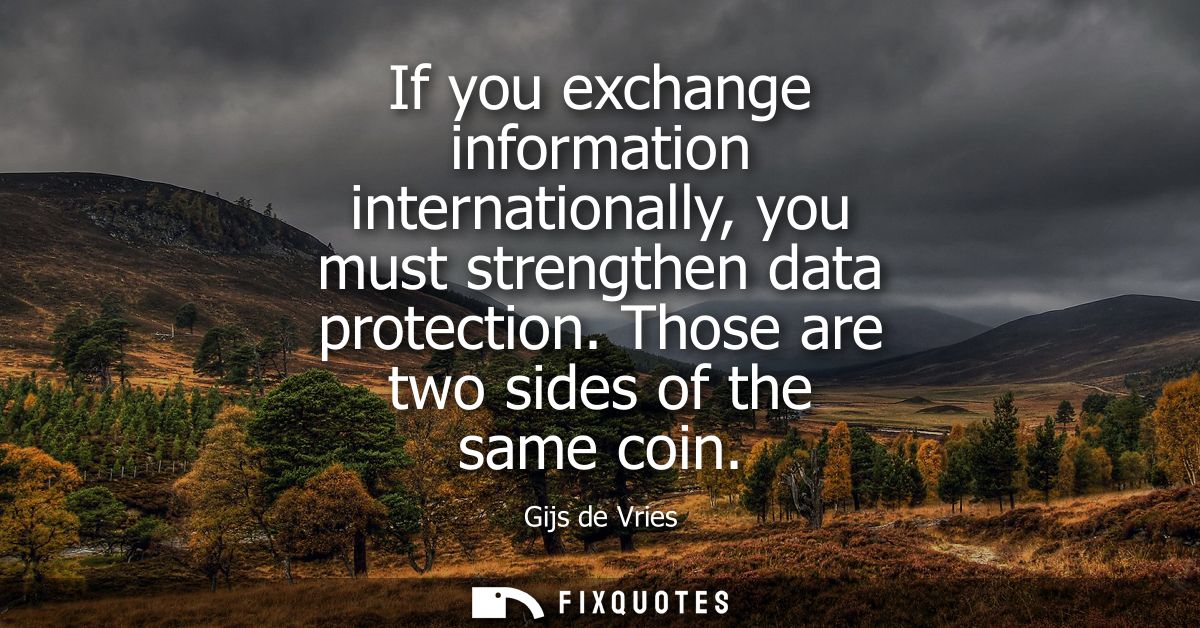
"If you exchange information internationally, you must strengthen data protection. Those are two sides of the same coin"
About this Quote
The coin metaphor does quiet work. It makes “exchange” and “protection” feel inseparable and value-neutral, as if privacy safeguards are simply the natural shadow cast by connectivity. That’s strategic, because the real debate in international politics is rarely about whether data should move; it’s about whose rules govern that movement. By insisting these are two sides of the same coin, De Vries pre-empts the familiar argument that security, innovation, or commerce require loosening constraints. He reframes protection as the price of legitimacy: without it, cross-border exchange becomes extraction.
The subtext is European and post-9/11: the tension between counterterrorism cooperation, corporate data appetite, and civil liberties. A Dutch/EU politician speaking in this register is also gesturing toward the EU’s preferred model of “rights-compatible” globalization, where trust is an infrastructure, not a vibe. Strengthening data protection is less about moral purity than about maintaining consent in democracies. If citizens think international sharing equals surveillance or misuse, the political mandate for sharing collapses. The coin isn’t just rhetorical; it’s a warning about what happens when one side is minted and the other gets shaved off.
Quote Details
| Topic | Privacy & Cybersecurity |
|---|---|
| Source | Help us find the source |
| Cite |
Citation Formats
APA Style (7th ed.)
Vries, Gijs de. (2026, January 17). If you exchange information internationally, you must strengthen data protection. Those are two sides of the same coin. FixQuotes. https://fixquotes.com/quotes/if-you-exchange-information-internationally-you-53483/
Chicago Style
Vries, Gijs de. "If you exchange information internationally, you must strengthen data protection. Those are two sides of the same coin." FixQuotes. January 17, 2026. https://fixquotes.com/quotes/if-you-exchange-information-internationally-you-53483/.
MLA Style (9th ed.)
"If you exchange information internationally, you must strengthen data protection. Those are two sides of the same coin." FixQuotes, 17 Jan. 2026, https://fixquotes.com/quotes/if-you-exchange-information-internationally-you-53483/. Accessed 12 Feb. 2026.