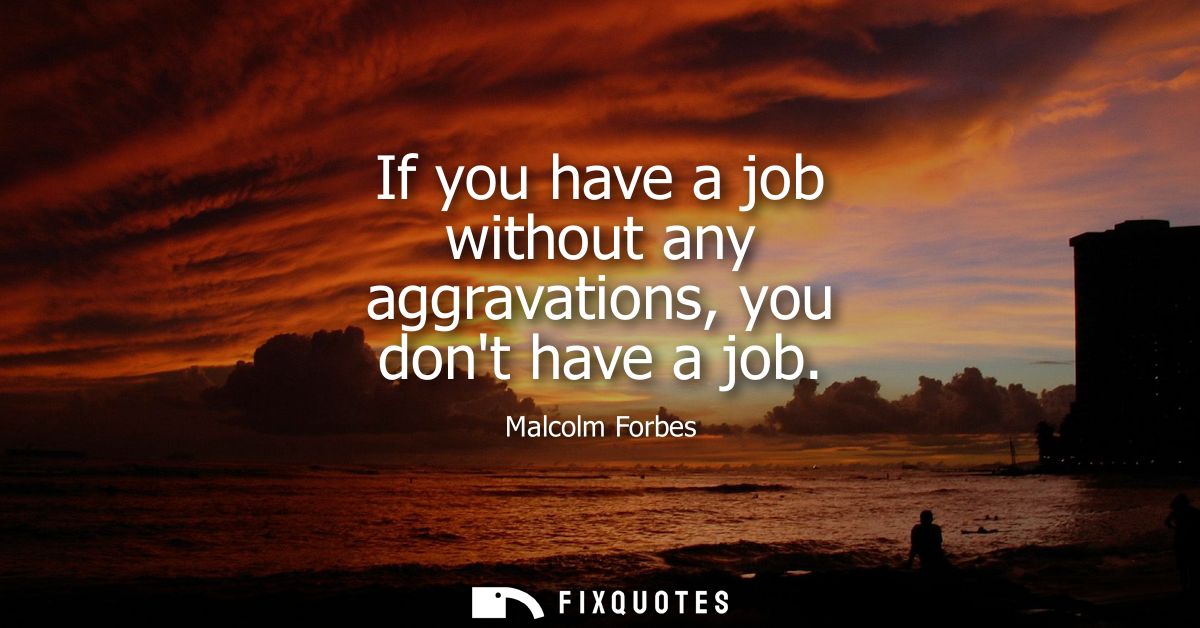
"If you have a job without any aggravations, you don't have a job"
About this Quote
Work, in Forbes's telling, isn’t defined by dignity or purpose so much as by friction. “If you have a job without any aggravations, you don’t have a job” is a brisk little rebrand of annoyance: not a defect in the system, but proof the system is real. Coming from Malcolm Forbes - the glossy prophet of capitalism-as-lifestyle - the line carries the self-assured logic of a publisher who sold ambition as both a moral virtue and a consumer product.
The intent is almost managerial. Aggravation becomes a loyalty test: if you’re irritated, good, you’re engaged; if you’re not, you’re either idle, sheltered, or unnecessary. It’s a neat inversion that flatters the overworked and preemptively disarms complaints. The subtext is tougher: suffering is not merely expected, it’s legitimizing. That’s a powerful story for an era when corporate identity and personal identity were increasingly fused, when “career” stopped being a role and started acting like a personality.
The quote also smuggles in a class perspective. Forbes had the kind of work where aggravations are meetings, egos, deadlines - problems that still presume autonomy and status. For many workers, “aggravations” aren’t motivational grit; they’re structural precarity: wages, safety, burnout, disrespect. Read that way, the line exposes a cultural habit: turning stress into a badge so the machine doesn’t have to change.
It works because it’s punchy, a little smug, and just true enough to be reusable - the perfect aphorism for people who want hardship to feel like choice.
The intent is almost managerial. Aggravation becomes a loyalty test: if you’re irritated, good, you’re engaged; if you’re not, you’re either idle, sheltered, or unnecessary. It’s a neat inversion that flatters the overworked and preemptively disarms complaints. The subtext is tougher: suffering is not merely expected, it’s legitimizing. That’s a powerful story for an era when corporate identity and personal identity were increasingly fused, when “career” stopped being a role and started acting like a personality.
The quote also smuggles in a class perspective. Forbes had the kind of work where aggravations are meetings, egos, deadlines - problems that still presume autonomy and status. For many workers, “aggravations” aren’t motivational grit; they’re structural precarity: wages, safety, burnout, disrespect. Read that way, the line exposes a cultural habit: turning stress into a badge so the machine doesn’t have to change.
It works because it’s punchy, a little smug, and just true enough to be reusable - the perfect aphorism for people who want hardship to feel like choice.
Quote Details
| Topic | Work |
|---|---|
| Source | Later attribution: Don't Just Do Something, Sit There: A Manifesto for Livin... (Wallace Chapman, 2013) modern compilationISBN: 9781742539102 · ID: l_KcDwAAQBAJ
Evidence:
... if you have a job without any aggravations, you don't have a job,' said Malcolm S. Forbes, owner of Forbes magazine. It's scary taking that first step , and according to. |
| Cite |
Citation Formats
APA Style (7th ed.)
Forbes, Malcolm. (2026, February 8). If you have a job without any aggravations, you don't have a job. FixQuotes. https://fixquotes.com/quotes/if-you-have-a-job-without-any-aggravations-you-8899/
Chicago Style
Forbes, Malcolm. "If you have a job without any aggravations, you don't have a job." FixQuotes. February 8, 2026. https://fixquotes.com/quotes/if-you-have-a-job-without-any-aggravations-you-8899/.
MLA Style (9th ed.)
"If you have a job without any aggravations, you don't have a job." FixQuotes, 8 Feb. 2026, https://fixquotes.com/quotes/if-you-have-a-job-without-any-aggravations-you-8899/. Accessed 7 Apr. 2026.
More Quotes by Malcolm
Add to List