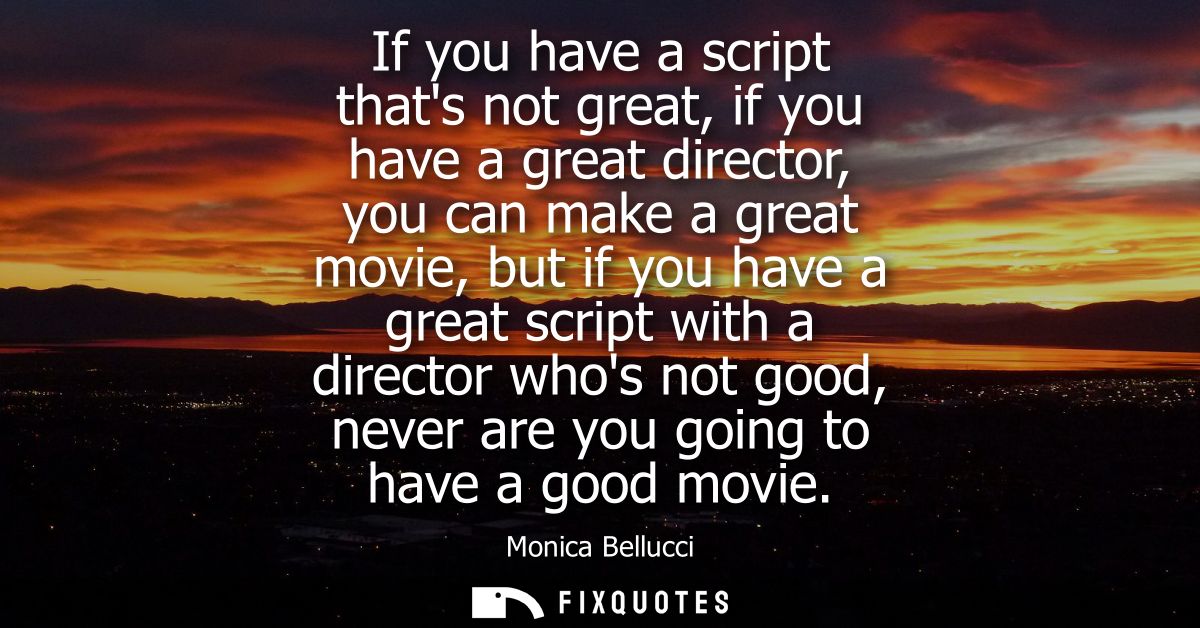
"If you have a script that's not great, if you have a great director, you can make a great movie, but if you have a great script with a director who's not good, never are you going to have a good movie"
About this Quote
The sting is in the second clause. A great script paired with a bad director doesn’t merely underperform; it “never” becomes a good movie. That absolutism is doing work. It’s an actor’s truth, born on sets where a scene’s meaning is made - or killed - by choices that aren’t on the page: blocking that flattens power dynamics, coverage that drains tension, a tempo that turns comedy into dead air. Bellucci is also defending actors, implicitly arguing that performances aren’t plug-and-play. A strong director creates conditions for risk, coherence, and trust; a weak one produces anxiety, inconsistency, and a movie that feels like stitched footage.
Context matters: Bellucci’s career spans auteur cinema and mainstream production, across countries and working cultures. From that vantage point, the director isn’t just a creative leader but the translator between script, actor, and audience. Her quote is less romantic than practical: scripts matter, but cinema is execution, and execution is governance.
Quote Details
| Topic | Movie |
|---|---|
| Source | Help us find the source |
| Cite |
Citation Formats
APA Style (7th ed.)
Bellucci, Monica. (2026, January 18). If you have a script that's not great, if you have a great director, you can make a great movie, but if you have a great script with a director who's not good, never are you going to have a good movie. FixQuotes. https://fixquotes.com/quotes/if-you-have-a-script-thats-not-great-if-you-have-23903/
Chicago Style
Bellucci, Monica. "If you have a script that's not great, if you have a great director, you can make a great movie, but if you have a great script with a director who's not good, never are you going to have a good movie." FixQuotes. January 18, 2026. https://fixquotes.com/quotes/if-you-have-a-script-thats-not-great-if-you-have-23903/.
MLA Style (9th ed.)
"If you have a script that's not great, if you have a great director, you can make a great movie, but if you have a great script with a director who's not good, never are you going to have a good movie." FixQuotes, 18 Jan. 2026, https://fixquotes.com/quotes/if-you-have-a-script-thats-not-great-if-you-have-23903/. Accessed 26 Mar. 2026.