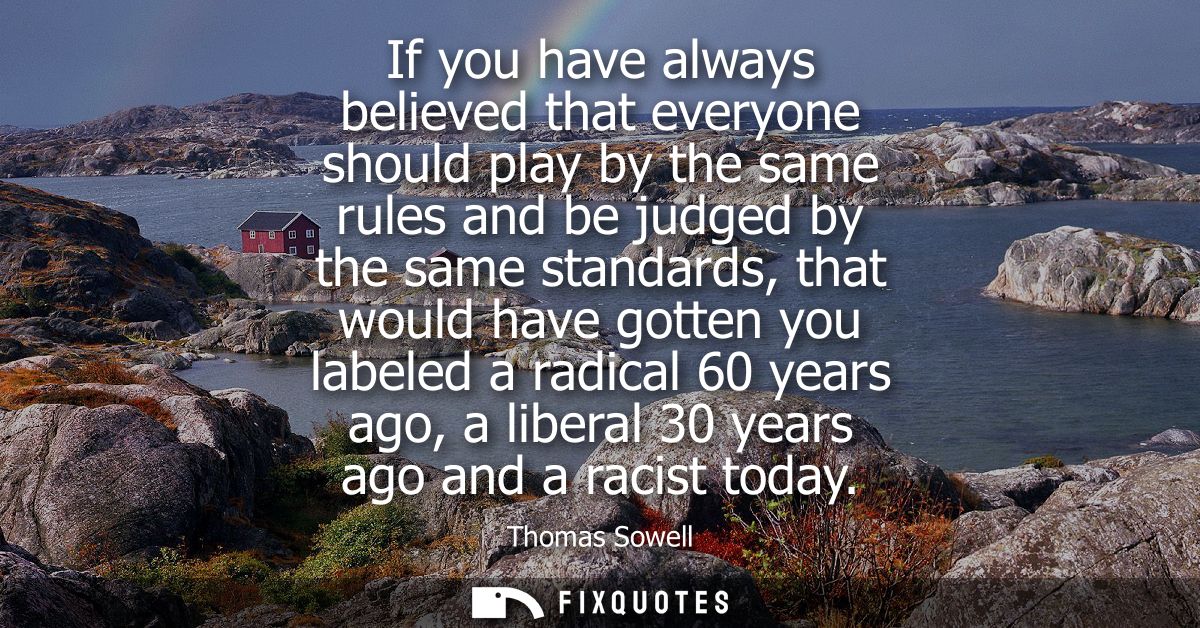
"If you have always believed that everyone should play by the same rules and be judged by the same standards, that would have gotten you labeled a radical 60 years ago, a liberal 30 years ago and a racist today"
About this Quote
The subtext is doing heavier lifting than the surface claim. "Same standards" isn’t just about fairness; it’s a rebuke to policies and norms that treat outcomes as evidence of injustice and justify unequal treatment to correct it. Read in context of late-20th-century debates over affirmative action, hiring, admissions, and disparate impact doctrine, the line defends color-blind individualism while implying that today’s anti-racism rhetoric has become a pretext for new forms of discrimination. The rhetorical move is to make accusations of racism sound like mere semantic escalation: if yesterday’s liberal becomes today’s racist, then the accusation loses moral force and becomes a tool of social control.
Why it works is its elegance: it flatters the reader as principled, suggests persecution without saying so, and frames opponents as fickle label-makers rather than arguers. What it leaves out is the central dispute: whether equal rules in an unequal society produce equal justice, or just equal procedure. That omission is the point; it shifts the battleground from policy outcomes to legitimacy of the conversation itself.
Quote Details
| Topic | Equality |
|---|---|
| Source | Later attribution: Fighting the Last War (Jeffrey M. Bale, Tamir Bar-On, 2024) modern compilationISBN: 9781978792296 · ID: 60eAEQAAQBAJ
Evidence:
... If You Have Always Believed That Everyone Should Play by the Same Rules and be Judged by the Same Standards , That Would Have Gotten You Labeled a Radical 60 Years Ago , a Liberal 30 Years Ago and a Racist Today . " Twitter , June 4 ... |
| Cite |
Citation Formats
APA Style (7th ed.)
Sowell, Thomas. (2026, February 18). If you have always believed that everyone should play by the same rules and be judged by the same standards, that would have gotten you labeled a radical 60 years ago, a liberal 30 years ago and a racist today. FixQuotes. https://fixquotes.com/quotes/if-you-have-always-believed-that-everyone-should-2122/
Chicago Style
Sowell, Thomas. "If you have always believed that everyone should play by the same rules and be judged by the same standards, that would have gotten you labeled a radical 60 years ago, a liberal 30 years ago and a racist today." FixQuotes. February 18, 2026. https://fixquotes.com/quotes/if-you-have-always-believed-that-everyone-should-2122/.
MLA Style (9th ed.)
"If you have always believed that everyone should play by the same rules and be judged by the same standards, that would have gotten you labeled a radical 60 years ago, a liberal 30 years ago and a racist today." FixQuotes, 18 Feb. 2026, https://fixquotes.com/quotes/if-you-have-always-believed-that-everyone-should-2122/. Accessed 15 Mar. 2026.