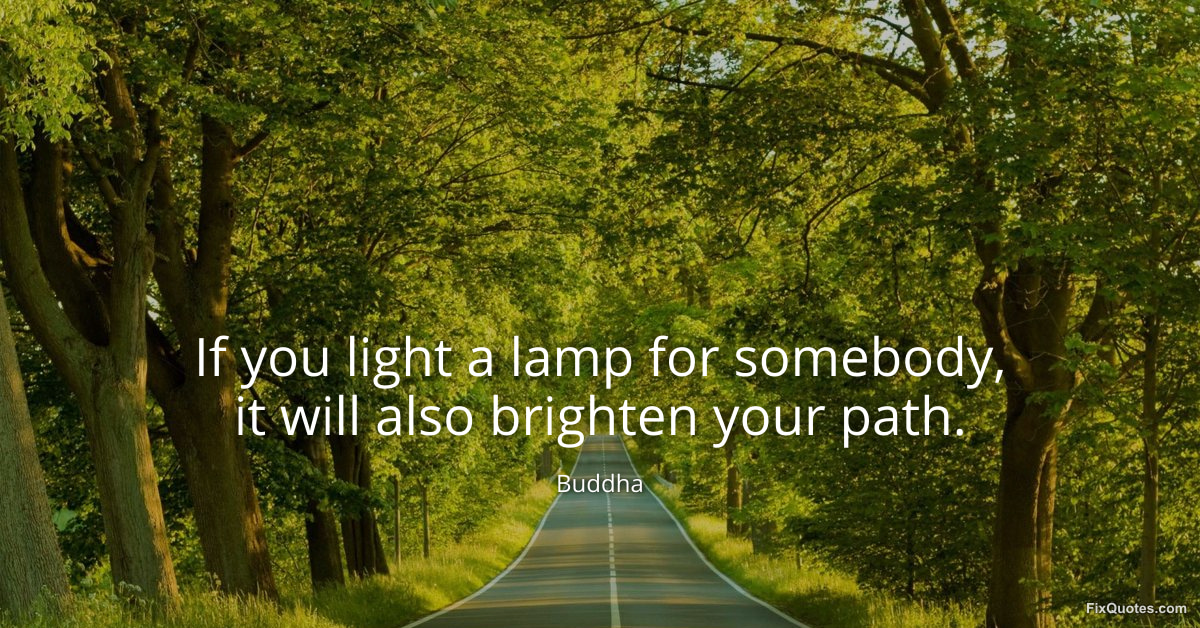
"If you light a lamp for somebody, it will also brighten your path"
About this Quote
A line like this survives because it does two jobs at once: it sounds gentle, and it quietly overturns the usual math of self-interest. The image is domestic, almost disarmingly simple. A lamp lit for another person does not diminish the flame; it enlarges the field of vision for everyone nearby, including the one holding it. That is the moral architecture of the saying. Compassion is not framed as sacrifice in the punitive sense, but as a practice that transforms the giver.
That matters in the Buddhist context, where intention is never merely private. Actions shape consciousness. To help another person is not just to improve their circumstances; it also disciplines your own mind away from greed, ego, and isolation. The "path" here carries extra weight. In Buddhist thought, the path is the route toward awakening, clarity, release from suffering. So the quote is not offering a Hallmark version of kindness. It is making a deeper claim: generosity is spiritually practical.
Its rhetorical power comes from sidestepping commandment language. Rather than "you should help others", it offers a small revelation about how reality works. That makes the ethic feel less like obedience and more like insight. It also answers a perennial anxiety: if I give too much, what happens to me? The response is elegant and strategic. You are not outside the circle of your own mercy.
For a historical religious leader, that is classic durable teaching: memorable image, moral reciprocity, and a promise that ethical action is not loss, but illumination.
That matters in the Buddhist context, where intention is never merely private. Actions shape consciousness. To help another person is not just to improve their circumstances; it also disciplines your own mind away from greed, ego, and isolation. The "path" here carries extra weight. In Buddhist thought, the path is the route toward awakening, clarity, release from suffering. So the quote is not offering a Hallmark version of kindness. It is making a deeper claim: generosity is spiritually practical.
Its rhetorical power comes from sidestepping commandment language. Rather than "you should help others", it offers a small revelation about how reality works. That makes the ethic feel less like obedience and more like insight. It also answers a perennial anxiety: if I give too much, what happens to me? The response is elegant and strategic. You are not outside the circle of your own mercy.
For a historical religious leader, that is classic durable teaching: memorable image, moral reciprocity, and a promise that ethical action is not loss, but illumination.
Quote Details
| Topic | Kindness |
|---|---|
| Source | Later attribution: Mysticism in Newburyport (Peter James Ford, 2023) modern compilationISBN: 9798765238981 · ID: euawEAAAQBAJ
Evidence:
... If you light a lamp for somebody , it will also brighten your path . -Buddha -Buddha FORGIVE OTHERS Not because they deserve forgiveness ... But because you deserve. YOUR MIND WILL BECOME LIKE A LAMP SET IN A WINDLESS PLACE . " The ... |
| Cite |
Citation Formats
APA Style (7th ed.)
Buddha. (2026, March 27). If you light a lamp for somebody, it will also brighten your path. FixQuotes. https://fixquotes.com/quotes/if-you-light-a-lamp-for-somebody-it-will-also-185800/
Chicago Style
Buddha. "If you light a lamp for somebody, it will also brighten your path." FixQuotes. March 27, 2026. https://fixquotes.com/quotes/if-you-light-a-lamp-for-somebody-it-will-also-185800/.
MLA Style (9th ed.)
"If you light a lamp for somebody, it will also brighten your path." FixQuotes, 27 Mar. 2026, https://fixquotes.com/quotes/if-you-light-a-lamp-for-somebody-it-will-also-185800/. Accessed 30 Mar. 2026.
More Quotes by Buddha
Add to List