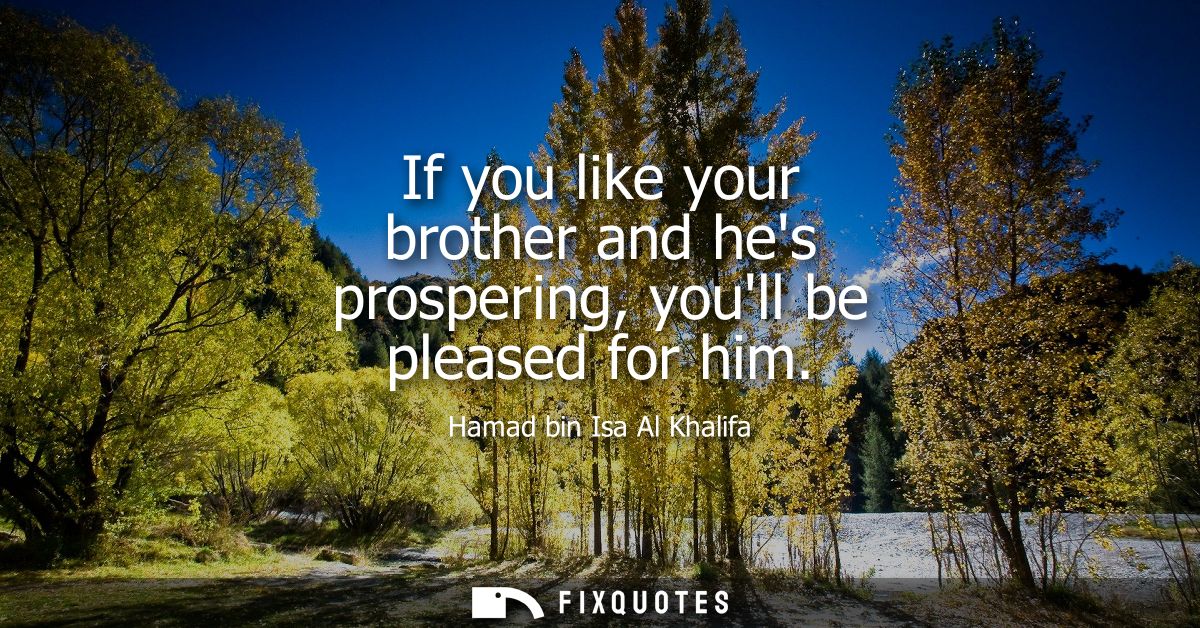
"If you like your brother and he's prospering, you'll be pleased for him"
About this Quote
The word "brother" is the key lever. In Gulf political culture, it can mean literal kin, a fellow citizen, a neighboring ruler, a partner in an alliance, or a member of the wider Arab or Muslim community. That ambiguity is useful. It softens hierarchy into intimacy and reframes power relations as family relations, where dissent can be cast as betrayal rather than disagreement. If you are displeased with "your brother's" success, the problem isn't policy; it's your character.
The conditional "If you like" also quietly narrows the moral circle. It's not an abstract call for justice or equality; it's an appeal to personal bonds as the basis for political stability. Prosperity becomes proof of virtue, and approval becomes a test of loyalty. The subtext is the familiar authoritarian bargain, rendered in the language of domestic harmony: stop resenting the distribution of gains, celebrate them, and the household stays intact.
As a piece of rhetoric, it works because it is too ordinary to argue with directly. Who wants to be the person admitting, publicly, that they don't feel pleased?
Quote Details
| Topic | Brother |
|---|---|
| Source | Help us find the source |
| Cite |
Citation Formats
APA Style (7th ed.)
Khalifa, Hamad bin Isa Al. (2026, January 15). If you like your brother and he's prospering, you'll be pleased for him. FixQuotes. https://fixquotes.com/quotes/if-you-like-your-brother-and-hes-prospering-youll-167552/
Chicago Style
Khalifa, Hamad bin Isa Al. "If you like your brother and he's prospering, you'll be pleased for him." FixQuotes. January 15, 2026. https://fixquotes.com/quotes/if-you-like-your-brother-and-hes-prospering-youll-167552/.
MLA Style (9th ed.)
"If you like your brother and he's prospering, you'll be pleased for him." FixQuotes, 15 Jan. 2026, https://fixquotes.com/quotes/if-you-like-your-brother-and-hes-prospering-youll-167552/. Accessed 9 Mar. 2026.