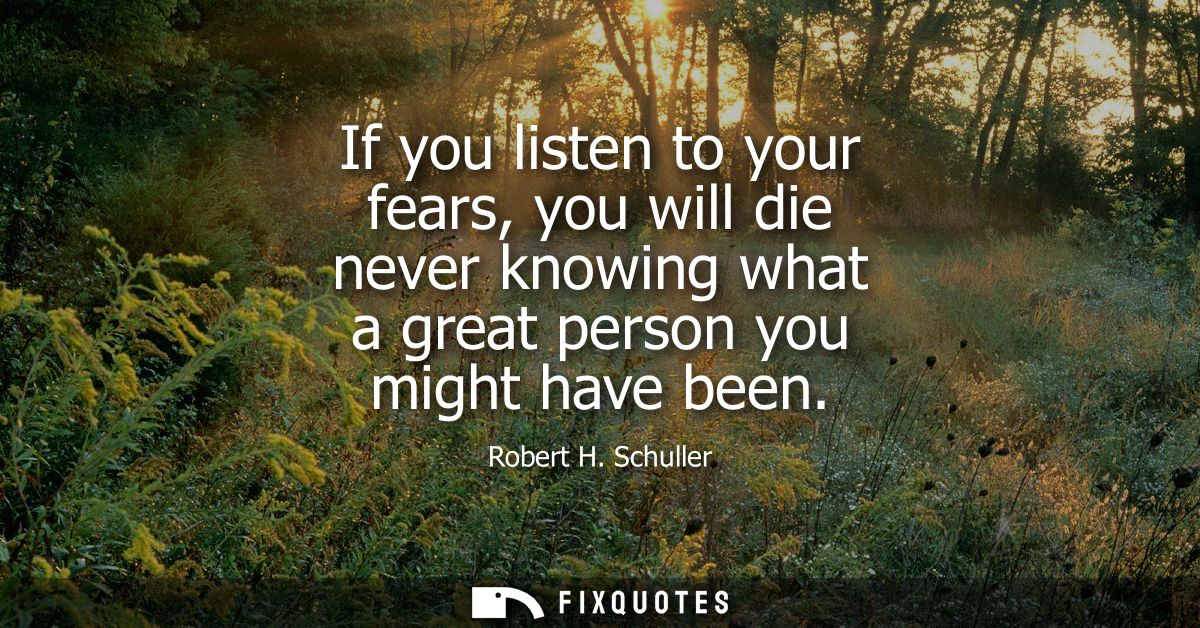
"If you listen to your fears, you will die, never knowing what a great person you might have been"
About this Quote
The subtext is classic Schuller-era positive-thinking Christianity, shaped by late-20th-century American prosperity theology and therapeutic culture. For a televangelist speaking to an audience steeped in anxiety about status, work, and personal failure, fear becomes the devilish saboteur you can choose not to obey. "Great person" is intentionally vague, a projection screen. It doesn’t demand sainthood; it offers upward mobility of the soul, a spiritually sanctioned ambition.
There’s also an implicit individualism that cuts both ways. The quote treats fear as an internal radio you can switch off, not a rational response to real constraints - poverty, discrimination, trauma, illness. That omission is part of its power and its risk: it converts structural problems into a private spiritual test. Still, as a piece of persuasion, it works because it weaponizes regret. It doesn’t just sell courage; it makes cowardice feel expensive.
Quote Details
| Topic | Motivational |
|---|---|
| Source | Help us find the source |
| Cite |
Citation Formats
APA Style (7th ed.)
Schuller, Robert H. (2026, February 20). If you listen to your fears, you will die, never knowing what a great person you might have been. FixQuotes. https://fixquotes.com/quotes/if-you-listen-to-your-fears-you-will-die-never-16397/
Chicago Style
Schuller, Robert H. "If you listen to your fears, you will die, never knowing what a great person you might have been." FixQuotes. February 20, 2026. https://fixquotes.com/quotes/if-you-listen-to-your-fears-you-will-die-never-16397/.
MLA Style (9th ed.)
"If you listen to your fears, you will die, never knowing what a great person you might have been." FixQuotes, 20 Feb. 2026, https://fixquotes.com/quotes/if-you-listen-to-your-fears-you-will-die-never-16397/. Accessed 7 Apr. 2026.