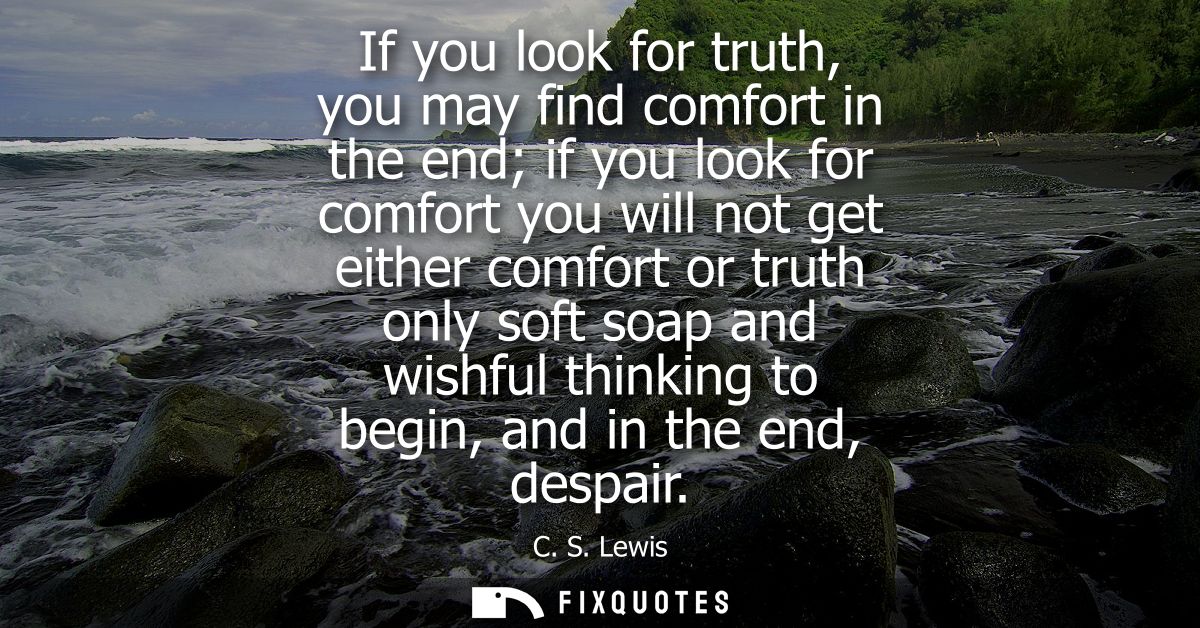
"If you look for truth, you may find comfort in the end; if you look for comfort, you will not get either comfort or truth, only soft soap and wishful thinking to begin, and in the end, despair"
About this Quote
The rhetoric is slyly pastoral. “May find comfort” is deliberately modest, almost legalistic, refusing to guarantee emotional payoff. That restraint is the hook: truth doesn’t promise to soothe you, which is precisely why it can be trusted. By comparison, “soft soap” lands like a slap. It’s old-fashioned slang for flattery and lubricant, suggesting comfort-as-a-goal turns thinking into self-massage: you pre-soothe the conclusion, then call it conviction. “Wishful thinking to begin” implies the rot starts early, at the moment you pick the question you’re willing to ask.
Context matters: Lewis, an Oxford don and Christian apologist writing in a century scarred by world wars and ideological salesmanship, had watched “comfort” become a public virtue marketed by politics and consumer culture alike. His warning is less about stoicism for its own sake than about spiritual and intellectual hygiene. If you demand that reality feel nice, you don’t get a gentler reality; you get a thinner one. The final word, “despair,” isn’t melodrama. It’s the logical endpoint of a life built on anesthesia: when pain finally breaks through, you have neither truth to stand on nor comfort that can carry weight.
Quote Details
| Topic | Truth |
|---|---|
| Source | Unverified source: Mere Christianity (C. S. Lewis, 1952)
Evidence: Book I, Chapter 5 (“We Have Cause to Be Uneasy”); page varies by edition (e.g., p. 39 is reported in at least one modern edition). The wording matches Lewis’s text in *Mere Christianity*, Book I, Ch. 5 (“We Have Cause to Be Uneasy”). This collected volume was first published in 1952 (UK: Geoffrey... Other candidates (1) C. S. Lewis (C. S. Lewis) compilation34.9% end your soul after the good you had expected instead of turning it to the good you had got you could refuse the real... |
| Cite |
Citation Formats
APA Style (7th ed.)
Lewis, C. S. (2026, February 16). If you look for truth, you may find comfort in the end; if you look for comfort, you will not get either comfort or truth, only soft soap and wishful thinking to begin, and in the end, despair. FixQuotes. https://fixquotes.com/quotes/if-you-look-for-truth-you-may-find-comfort-in-the-18352/
Chicago Style
Lewis, C. S. "If you look for truth, you may find comfort in the end; if you look for comfort, you will not get either comfort or truth, only soft soap and wishful thinking to begin, and in the end, despair." FixQuotes. February 16, 2026. https://fixquotes.com/quotes/if-you-look-for-truth-you-may-find-comfort-in-the-18352/.
MLA Style (9th ed.)
"If you look for truth, you may find comfort in the end; if you look for comfort, you will not get either comfort or truth, only soft soap and wishful thinking to begin, and in the end, despair." FixQuotes, 16 Feb. 2026, https://fixquotes.com/quotes/if-you-look-for-truth-you-may-find-comfort-in-the-18352/. Accessed 2 Apr. 2026.