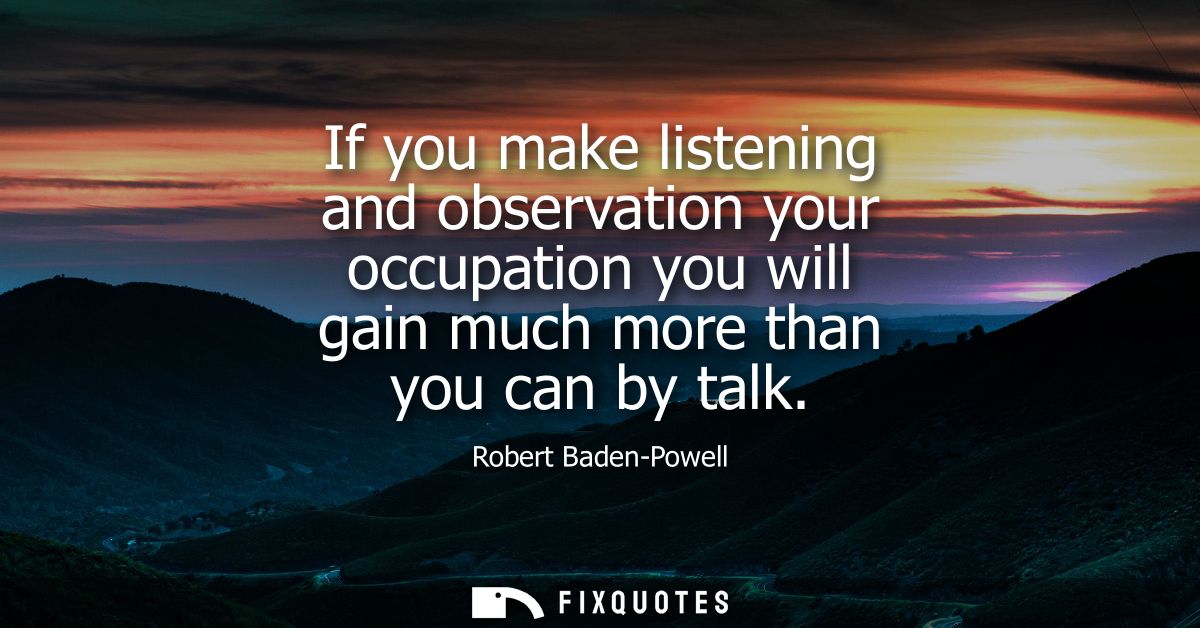
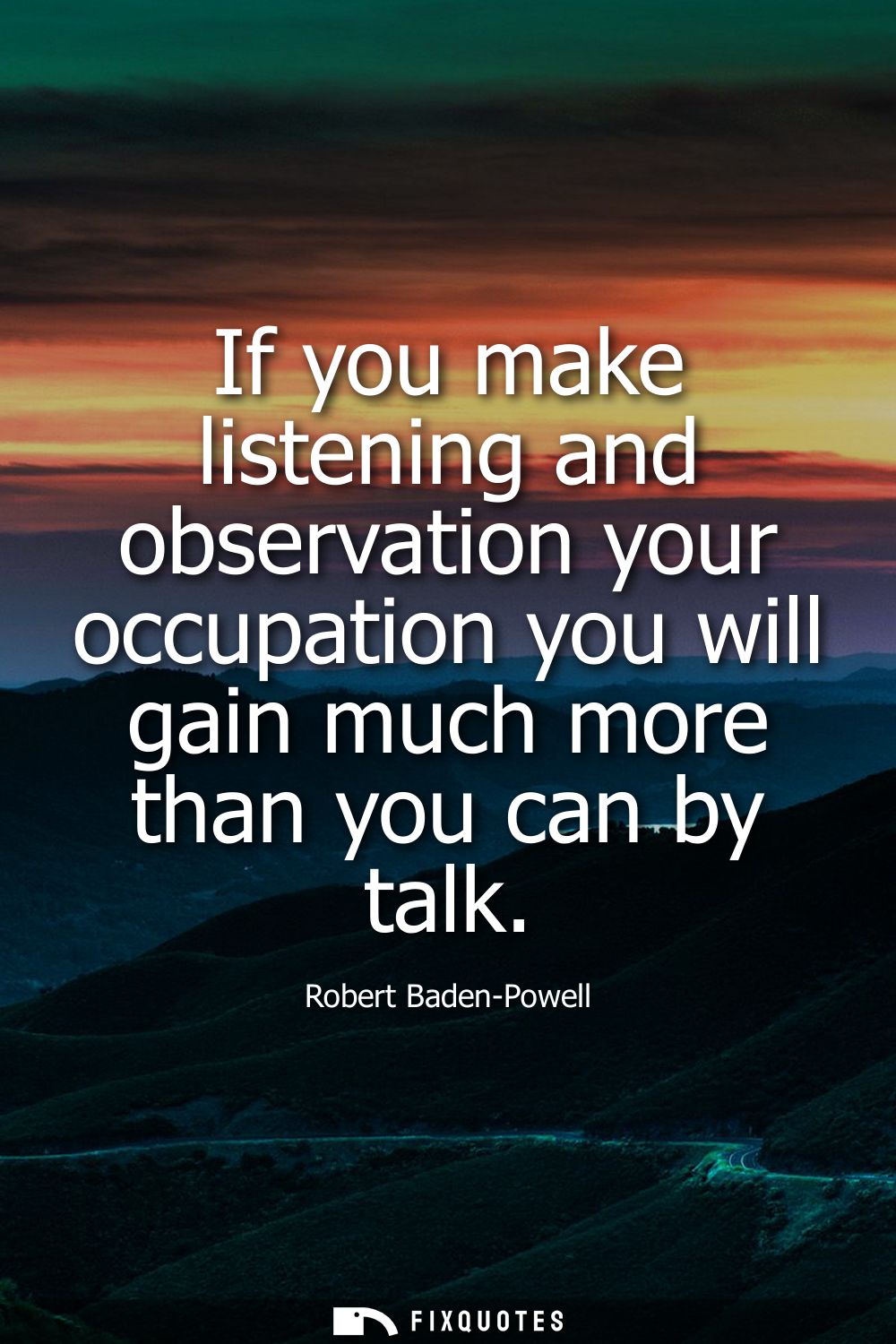
"If you make listening and observation your occupation, you will gain much more than you can by talk"
About this Quote
The phrasing does a lot of covert work. “Occupation” turns listening from a passive virtue into a job with outputs. He’s not praising silence for its own sake; he’s recommending a method of acquiring asymmetric advantage. Talk is framed as inefficient, even self-indulgent: it spends social energy without necessarily producing information. Observation, by contrast, is a kind of quiet extraction. You take in the world on its own terms, rather than trying to bend it through rhetoric.
There’s also a moral subtext that fits Baden-Powell’s era and institution. Military culture prizes restraint and self-control; “gain much more” implies that the disciplined listener accrues competence and authority, while the talker performs. It’s a rebuke to bluster, a warning against confusing confidence with knowledge. Read today, it lands as an antidote to the modern compulsion to broadcast: attention as a competitive skill, humility as a tactic, silence as a form of power.
Quote Details
| Topic | Wisdom |
|---|---|
| Source | Help us find the source |
| Cite |
Citation Formats
APA Style (7th ed.)
Baden-Powell, Robert. (2026, February 20). If you make listening and observation your occupation, you will gain much more than you can by talk. FixQuotes. https://fixquotes.com/quotes/if-you-make-listening-and-observation-your-17053/
Chicago Style
Baden-Powell, Robert. "If you make listening and observation your occupation, you will gain much more than you can by talk." FixQuotes. February 20, 2026. https://fixquotes.com/quotes/if-you-make-listening-and-observation-your-17053/.
MLA Style (9th ed.)
"If you make listening and observation your occupation, you will gain much more than you can by talk." FixQuotes, 20 Feb. 2026, https://fixquotes.com/quotes/if-you-make-listening-and-observation-your-17053/. Accessed 2 Apr. 2026.