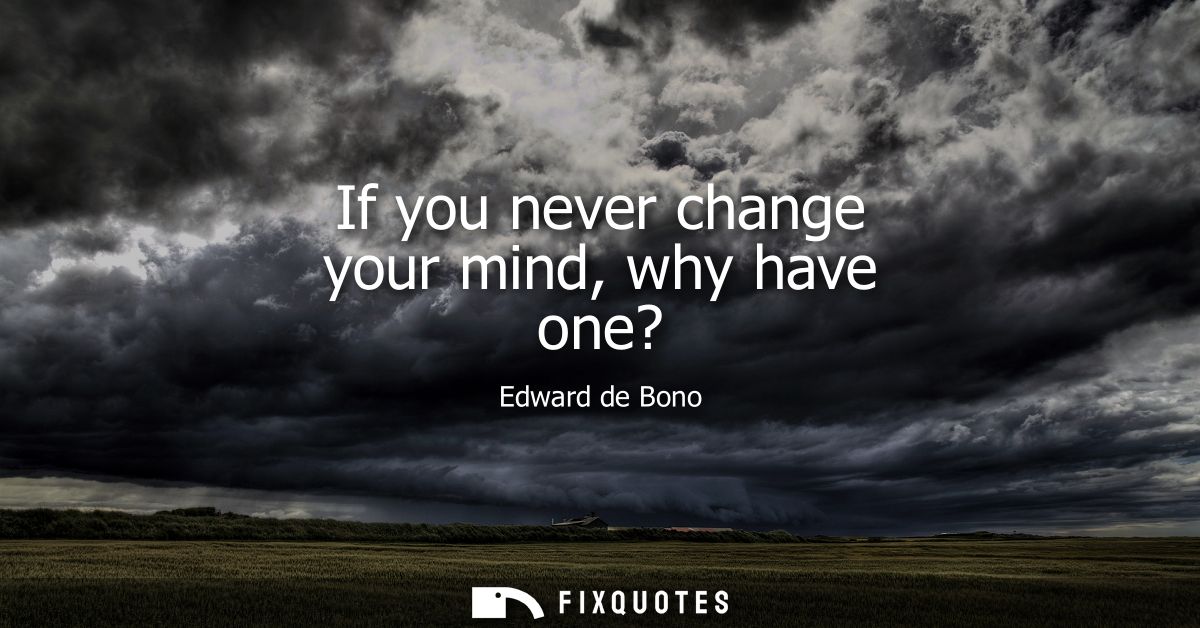
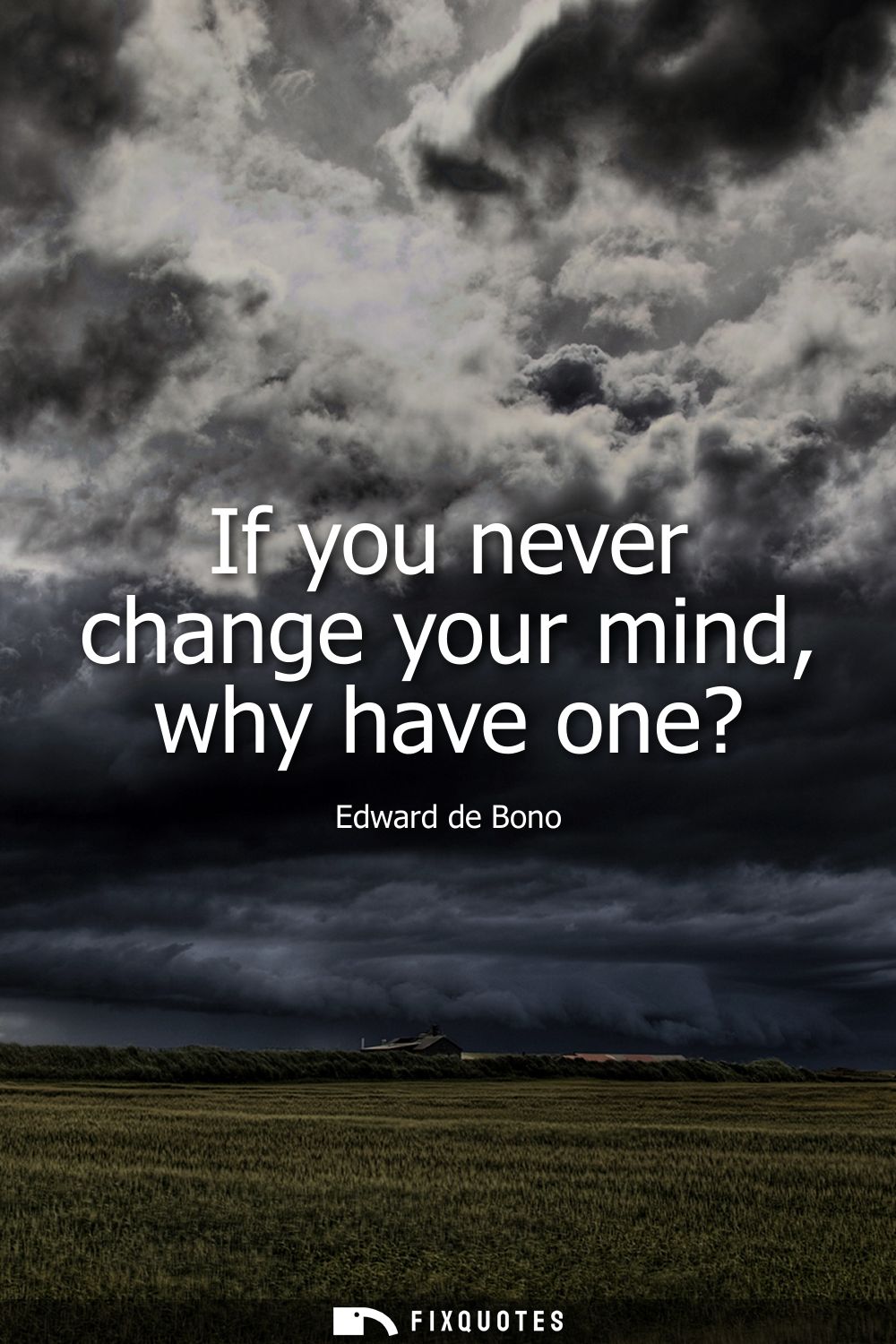
"If you never change your mind, why have one?"
About this Quote
A mind that refuses to budge isn’t a mind so much as a badge. De Bono’s line lands like a polite insult: if your opinions are permanently laminated, you’re not thinking, you’re displaying. The punch comes from the sly inversion of what we tend to celebrate. “Having a mind” is usually treated as an identity marker, proof of seriousness. De Bono treats it as a tool with a job description: it’s for updating, not posturing.
The specific intent is pragmatic, almost engineer-like. De Bono spent a career arguing that thinking can be designed - that creativity isn’t a mystical gift but a set of habits, prompts, and reframings. In that context, “change your mind” isn’t fickleness; it’s the expected output of a functioning cognitive system encountering new information. The question form is doing work, too. It refuses the reader the comfort of agreement and instead forces a self-audit: when was the last time you revised a belief for reasons other than social pressure?
Subtext: our culture confuses consistency with integrity. We reward people for “standing firm,” even when firmness is just stubbornness dressed up as principle. De Bono needles that moral vanity, suggesting that the fear of appearing wrong often beats the desire to be accurate. The quote also preemptively rescues mind-changing from its PR problem. It reframes revision not as weakness, but as evidence that the mind is alive, responsive, and actually being used.
The specific intent is pragmatic, almost engineer-like. De Bono spent a career arguing that thinking can be designed - that creativity isn’t a mystical gift but a set of habits, prompts, and reframings. In that context, “change your mind” isn’t fickleness; it’s the expected output of a functioning cognitive system encountering new information. The question form is doing work, too. It refuses the reader the comfort of agreement and instead forces a self-audit: when was the last time you revised a belief for reasons other than social pressure?
Subtext: our culture confuses consistency with integrity. We reward people for “standing firm,” even when firmness is just stubbornness dressed up as principle. De Bono needles that moral vanity, suggesting that the fear of appearing wrong often beats the desire to be accurate. The quote also preemptively rescues mind-changing from its PR problem. It reframes revision not as weakness, but as evidence that the mind is alive, responsive, and actually being used.
Quote Details
| Topic | Embrace Change |
|---|---|
| Source | Help us find the source |
| Cite |
Citation Formats
APA Style (7th ed.)
Bono, Edward de. (2026, January 15). If you never change your mind, why have one? FixQuotes. https://fixquotes.com/quotes/if-you-never-change-your-mind-why-have-one-82127/
Chicago Style
Bono, Edward de. "If you never change your mind, why have one?" FixQuotes. January 15, 2026. https://fixquotes.com/quotes/if-you-never-change-your-mind-why-have-one-82127/.
MLA Style (9th ed.)
"If you never change your mind, why have one?" FixQuotes, 15 Jan. 2026, https://fixquotes.com/quotes/if-you-never-change-your-mind-why-have-one-82127/. Accessed 29 Mar. 2026.
More Quotes by Edward
Add to List