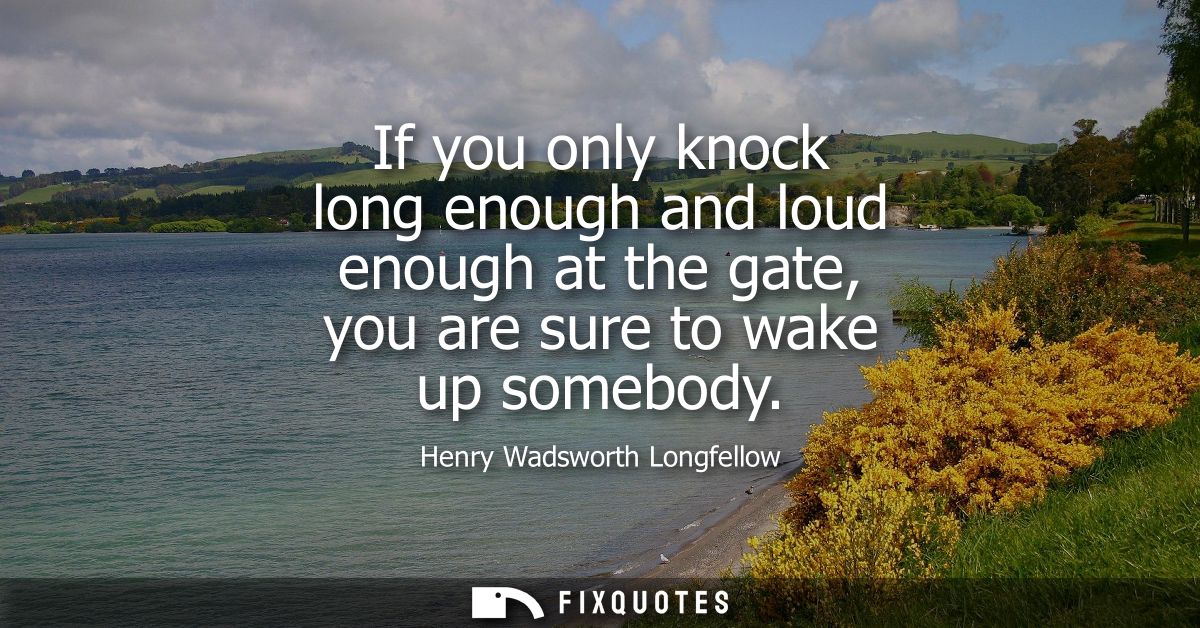
"If you only knock long enough and loud enough at the gate, you are sure to wake up somebody"
About this Quote
That’s the subtext that gives the sentence its bite. A gate implies exclusion, hierarchy, and rules you didn’t write. Knocking is the sanctioned act of the outsider: you can’t stroll in, but you can demand to be heard without technically trespassing. Longfellow frames agency as insistence rather than force, volume rather than violence. In an era that prized self-improvement and Protestant-inflected industriousness, this is optimism with calluses: progress comes from repetition, from refusing to let institutions rest.
Context matters. Longfellow wrote amid 19th-century America’s churn of reform movements, new media, and widening (if uneven) access to education and public discourse. The “gate” reads as everything from literary gatekeeping to political and social barriers; “waking” hints at conscience as much as attention. The phrase works because it demystifies opportunity. It isn’t luck; it’s pressure applied over time, the unglamorous persistence that turns private denial into public inconvenience.
Quote Details
| Topic | Never Give Up |
|---|---|
| Source | Help us find the source |
| Cite |
Citation Formats
APA Style (7th ed.)
Longfellow, Henry Wadsworth. (2026, January 14). If you only knock long enough and loud enough at the gate, you are sure to wake up somebody. FixQuotes. https://fixquotes.com/quotes/if-you-only-knock-long-enough-and-loud-enough-at-19956/
Chicago Style
Longfellow, Henry Wadsworth. "If you only knock long enough and loud enough at the gate, you are sure to wake up somebody." FixQuotes. January 14, 2026. https://fixquotes.com/quotes/if-you-only-knock-long-enough-and-loud-enough-at-19956/.
MLA Style (9th ed.)
"If you only knock long enough and loud enough at the gate, you are sure to wake up somebody." FixQuotes, 14 Jan. 2026, https://fixquotes.com/quotes/if-you-only-knock-long-enough-and-loud-enough-at-19956/. Accessed 5 Apr. 2026.