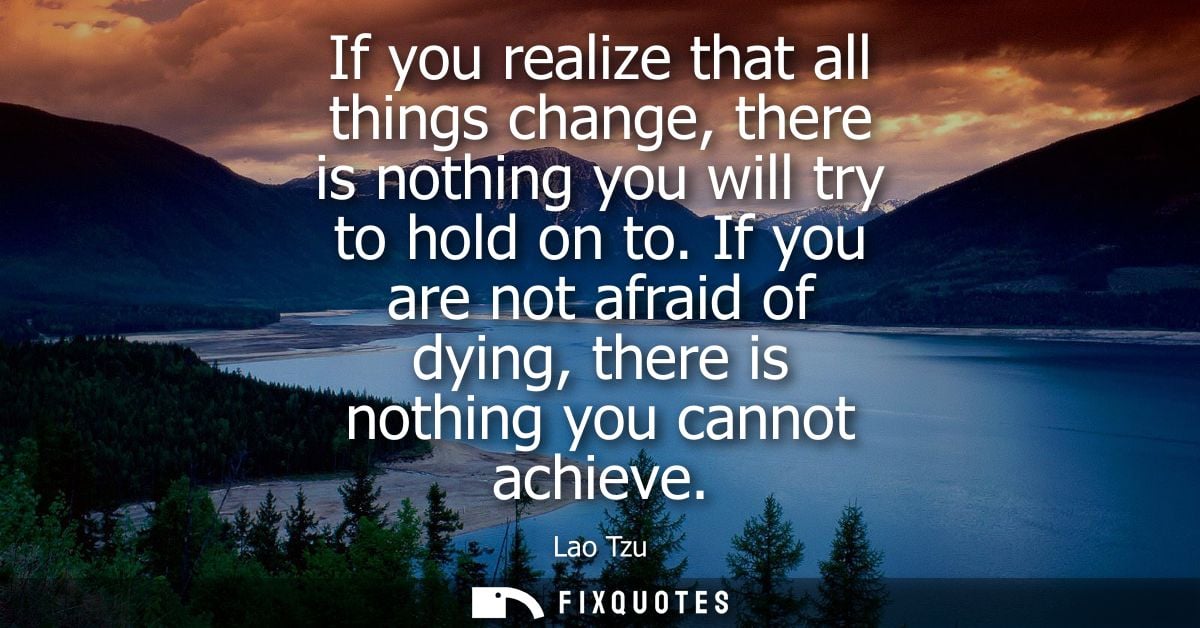
"If you realize that all things change, there is nothing you will try to hold on to. If you are not afraid of dying, there is nothing you cannot achieve"
About this Quote
Impermanence is Lao Tzu's wedge into the human panic reflex: the instinct to clutch, control, and convert life into property. The first line isn’t soothing; it’s surgical. “All things change” sounds like a gentle truism until you notice what it’s trying to dismantle: attachment as a default operating system. Lao Tzu’s move is to frame grasping not as love or commitment but as a category error, like trying to nail down a river. The implied critique is political and psychological at once: a person who must possess is a person who can be managed, provoked, and frightened.
Then the quote pivots from release to power. “If you are not afraid of dying” reads like an ascetic dare, but it’s really a theory of leverage. Fear of death is the ultimate handle; remove it and the usual tools of coercion stop working. In the Warring States-era atmosphere that fed early Daoist thought, that idea carries real consequence. When rulers govern through threats and ambition feeds on insecurity, a citizen who doesn’t flinch at loss becomes harder to manipulate. The line isn’t a call to reckless heroism so much as an argument that freedom begins where terror ends.
The subtext is classic Daoism: the strongest stance is non-grasping. Letting go isn’t passivity; it’s a refusal to be yanked around by the world’s bait-and-switch. The paradox is the point: the less you cling, the more agency you have.
Then the quote pivots from release to power. “If you are not afraid of dying” reads like an ascetic dare, but it’s really a theory of leverage. Fear of death is the ultimate handle; remove it and the usual tools of coercion stop working. In the Warring States-era atmosphere that fed early Daoist thought, that idea carries real consequence. When rulers govern through threats and ambition feeds on insecurity, a citizen who doesn’t flinch at loss becomes harder to manipulate. The line isn’t a call to reckless heroism so much as an argument that freedom begins where terror ends.
The subtext is classic Daoism: the strongest stance is non-grasping. Letting go isn’t passivity; it’s a refusal to be yanked around by the world’s bait-and-switch. The paradox is the point: the less you cling, the more agency you have.
Quote Details
| Topic | Wisdom |
|---|
More Quotes by Lao
Add to List