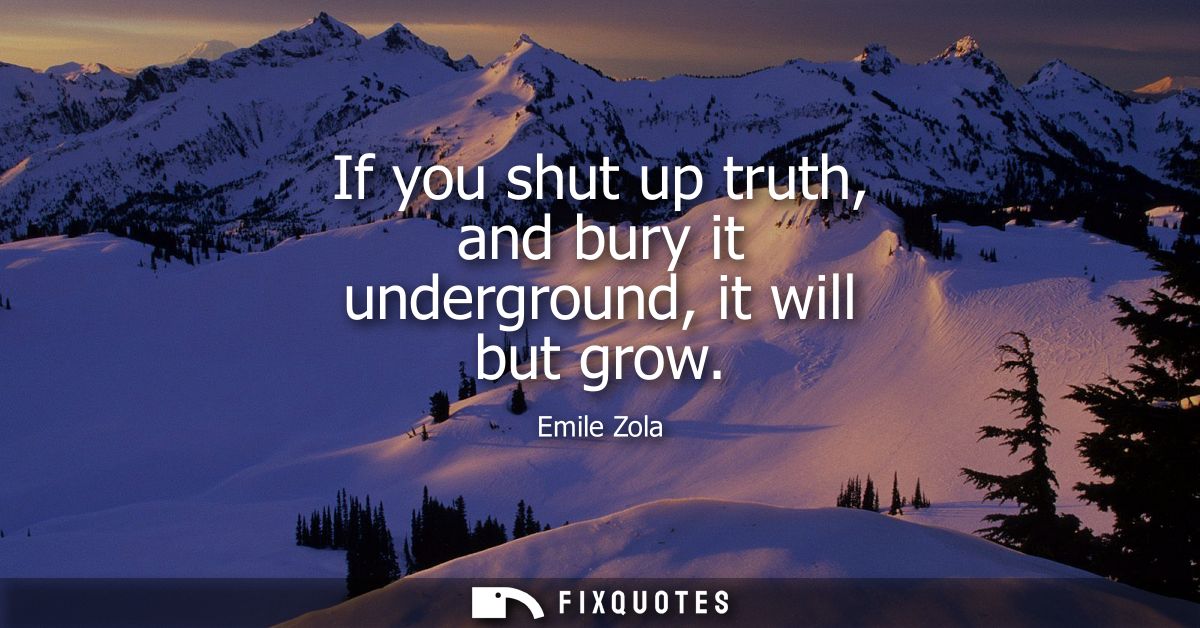
"If you shut up truth, and bury it underground, it will but grow"
About this Quote
Zola’s line has the blunt confidence of a man who’s watched institutions try to “manage” reality with paperwork and force, only to have reality come back louder. “Shut up truth” frames truth as something living, unruly, and vocal - not an abstract principle but a speaker you can gag. Then he pivots to the most telling image: burying it “underground.” That’s not just censorship; it’s concealment with intent, the kind of official burial that pretends the problem is solved because it’s no longer visible. Zola’s genius is the reversal: burial doesn’t kill truth, it fertilizes it.
The subtext is a warning to power: suppression is not neutral; it creates pressure. The more aggressively a state, church, or press apparatus clamps down, the more it turns truth into contraband, and contraband gains allure. Silence becomes evidence. Absence becomes a clue. The forbidden acquires a mythology, recruiting allies who might not have cared if the facts were simply spoken aloud.
Context matters because Zola wasn’t writing from a safe balcony. His career intersected with the Dreyfus Affair, where a modern bureaucracy tried to bury an inconvenient miscarriage of justice under secrecy, forged documents, and nationalistic hysteria. “J’accuse” wasn’t just moral theater; it was a bet on this very dynamic: expose the cover-up and the cover-up becomes the scandal.
The line works because it refuses the comforting fantasy that censorship is efficient. It’s inefficient, self-defeating, and oddly biological: truth, once pushed beneath the surface, doesn’t disappear. It sends roots. It waits. Then it breaks ground.
The subtext is a warning to power: suppression is not neutral; it creates pressure. The more aggressively a state, church, or press apparatus clamps down, the more it turns truth into contraband, and contraband gains allure. Silence becomes evidence. Absence becomes a clue. The forbidden acquires a mythology, recruiting allies who might not have cared if the facts were simply spoken aloud.
Context matters because Zola wasn’t writing from a safe balcony. His career intersected with the Dreyfus Affair, where a modern bureaucracy tried to bury an inconvenient miscarriage of justice under secrecy, forged documents, and nationalistic hysteria. “J’accuse” wasn’t just moral theater; it was a bet on this very dynamic: expose the cover-up and the cover-up becomes the scandal.
The line works because it refuses the comforting fantasy that censorship is efficient. It’s inefficient, self-defeating, and oddly biological: truth, once pushed beneath the surface, doesn’t disappear. It sends roots. It waits. Then it breaks ground.
Quote Details
| Topic | Truth |
|---|---|
| Source | Help us find the source |
| Cite |
Citation Formats
APA Style (7th ed.)
Zola, Emile. (2026, January 18). If you shut up truth, and bury it underground, it will but grow. FixQuotes. https://fixquotes.com/quotes/if-you-shut-up-truth-and-bury-it-underground-it-4209/
Chicago Style
Zola, Emile. "If you shut up truth, and bury it underground, it will but grow." FixQuotes. January 18, 2026. https://fixquotes.com/quotes/if-you-shut-up-truth-and-bury-it-underground-it-4209/.
MLA Style (9th ed.)
"If you shut up truth, and bury it underground, it will but grow." FixQuotes, 18 Jan. 2026, https://fixquotes.com/quotes/if-you-shut-up-truth-and-bury-it-underground-it-4209/. Accessed 1 Apr. 2026.
More Quotes by Emile
Add to List