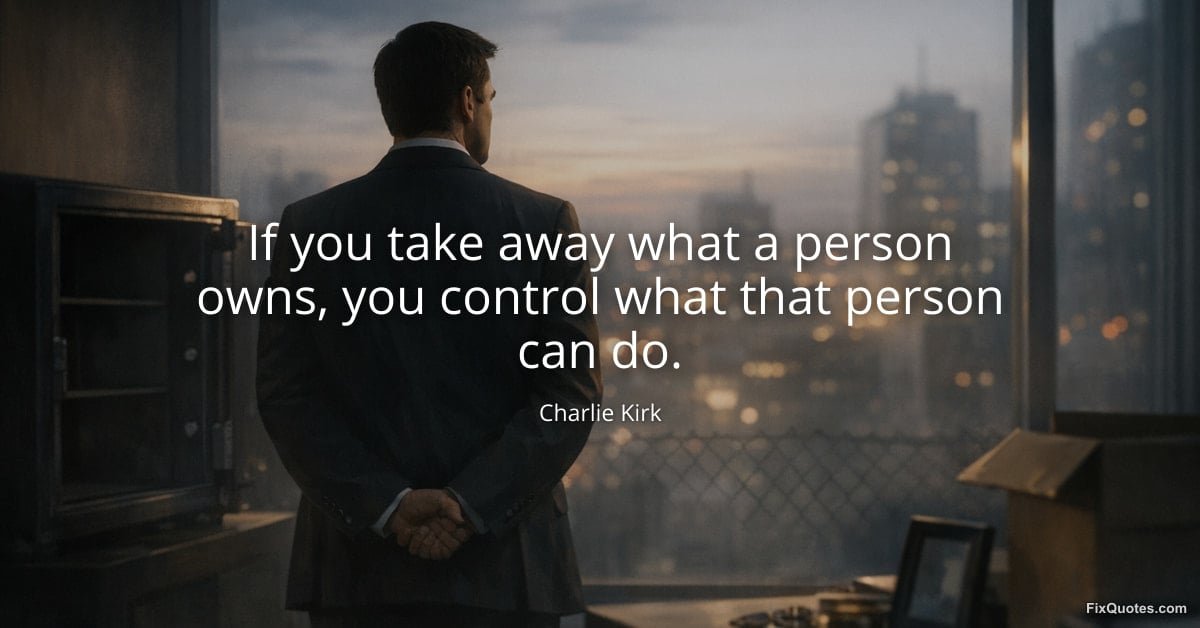
"If you take away what a person owns, you control what that person can do"
About this Quote
The intent is diagnostic and accusatory at the same time. “Take away” implies force and illegitimacy, skipping over the messy reality that modern states constantly redistribute, regulate, and define property rights in the first place. The sentence preloads the villain: whoever questions your ownership is trying to “control” you. That rhetorical move is classic movement politics - turn policy debates into existential stakes, and you don’t have to argue the details.
The subtext is a particular brand of American libertarianism with populist edges: ordinary people are one confiscation away from servitude, while government (or “elites”) is the natural suspect. It also quietly elevates owners as the default citizen, making non-owners - renters, the precariously employed, people with little wealth - almost invisible, as if freedom is something you purchase and then defend.
Context matters: this fits a post-2008, post-pandemic conservative ecosystem where distrust in institutions is a renewable resource and “control” is the master keyword. The brilliance, and the danger, is that it converts economic anxiety into a single, ready-made explanation.
Quote Details
| Topic | Freedom |
|---|---|
| Source | Notes: Quote is displayed on the official Turning Point USA website and attributed to Charlie Kirk. No primary source (speech, book, or dated publication) is provided on the site, and no independently verifiable first occurrence has been identified. Evidence: If you take away what a person owns, you control what that person can do. Other candidates (1) Charlie Kirk (Charlie Kirk) compilation37.5% adside books 2020 i am here tonight to tell you to warn you that this election is a deci |
| Video | Watch Video Quote |
| Featured | This quote was our Quote of the Day on March 18, 2026 |
| Cite |
Citation Formats
APA Style (7th ed.)
Kirk, Charlie. (2026, March 18). If you take away what a person owns, you control what that person can do. FixQuotes. https://fixquotes.com/quotes/if-you-take-away-what-a-person-owns-you-control-173226/
Chicago Style
Kirk, Charlie. "If you take away what a person owns, you control what that person can do." FixQuotes. March 18, 2026. https://fixquotes.com/quotes/if-you-take-away-what-a-person-owns-you-control-173226/.
MLA Style (9th ed.)
"If you take away what a person owns, you control what that person can do." FixQuotes, 18 Mar. 2026, https://fixquotes.com/quotes/if-you-take-away-what-a-person-owns-you-control-173226/. Accessed 5 Apr. 2026.