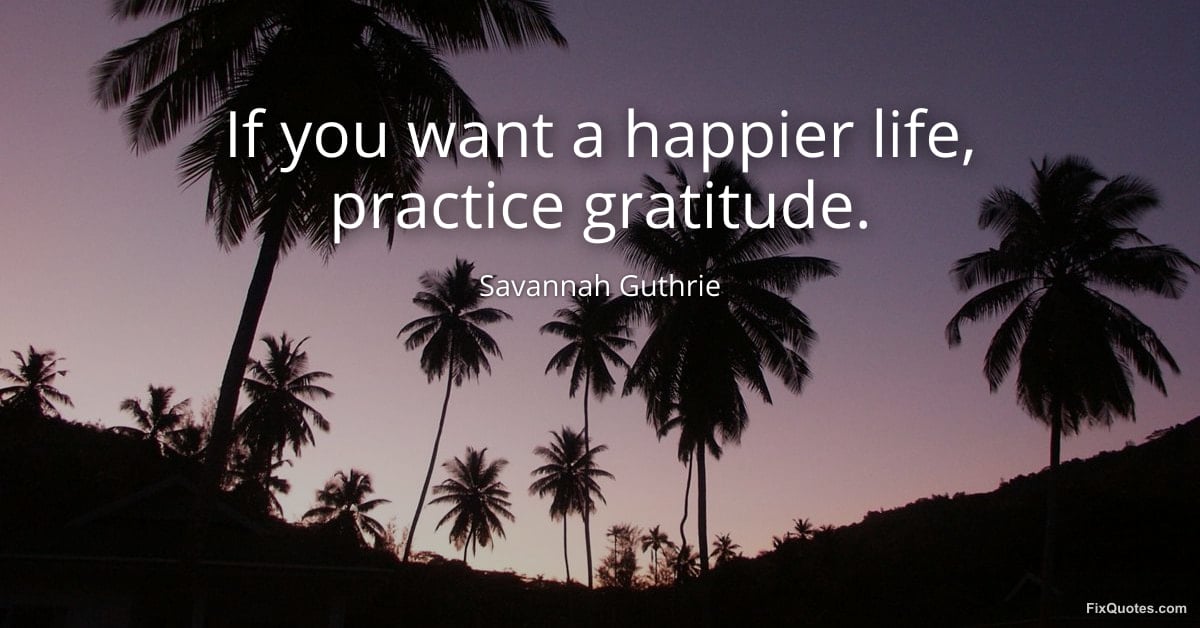
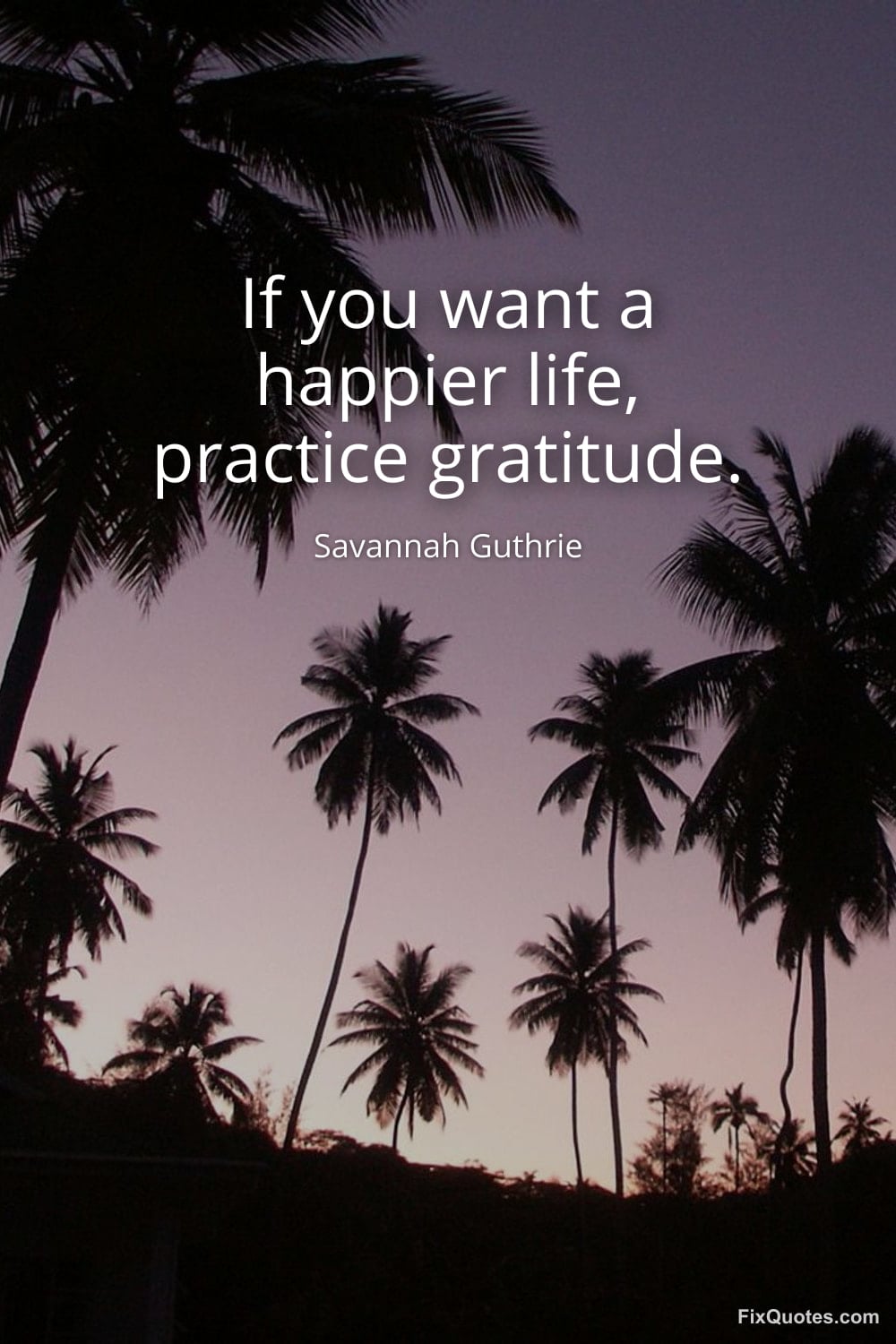
"If you want a happier life, practice gratitude"
About this Quote
Self-help slogans usually land like wallpaper, but Guthrie’s line works because it smuggles a challenge inside a comfort. “If you want” frames happiness as a choice, not a prize bestowed by luck or status. It’s an invitation and a subtle rebuke: if you’re miserable, maybe it’s not only the world’s fault. That’s bracing coming from a journalist, a profession trained to spot what’s broken and urgent. In that context, gratitude isn’t naive cheerfulness; it’s a counter-discipline to the newsroom’s default posture of critique.
The verb “practice” is doing the heavy lifting. Gratitude here isn’t a personality trait or a spontaneous feeling you either have or don’t. It’s closer to training: repeated, sometimes artificial at first, designed to change what you notice. The subtext is behavioral, even pragmatic: you can’t always control outcomes, but you can influence attention. And attention, over time, becomes mood. Guthrie is essentially arguing that happiness is less about upgrading your circumstances than upgrading your mental habits.
There’s also an implicit cultural critique. Modern life markets discontent as fuel: the next purchase, the next achievement, the next outrage. Gratitude interrupts that cycle by making “enough” briefly visible. Coming from a morning-show anchor, it’s calibrated for mass use: short, portable, non-ideological. The intent isn’t philosophical precision; it’s a usable intervention, pitched at people who feel overrun by the day and need a lever they can actually pull.
The verb “practice” is doing the heavy lifting. Gratitude here isn’t a personality trait or a spontaneous feeling you either have or don’t. It’s closer to training: repeated, sometimes artificial at first, designed to change what you notice. The subtext is behavioral, even pragmatic: you can’t always control outcomes, but you can influence attention. And attention, over time, becomes mood. Guthrie is essentially arguing that happiness is less about upgrading your circumstances than upgrading your mental habits.
There’s also an implicit cultural critique. Modern life markets discontent as fuel: the next purchase, the next achievement, the next outrage. Gratitude interrupts that cycle by making “enough” briefly visible. Coming from a morning-show anchor, it’s calibrated for mass use: short, portable, non-ideological. The intent isn’t philosophical precision; it’s a usable intervention, pitched at people who feel overrun by the day and need a lever they can actually pull.
Quote Details
| Topic | Gratitude |
|---|---|
| Source | Mostly What God Does: Reflections on Seeking and Finding His Love Everywhere (2024), Savannah Guthrie |
| Cite |
Citation Formats
APA Style (7th ed.)
Guthrie, Savannah. (2026, February 11). If you want a happier life, practice gratitude. FixQuotes. https://fixquotes.com/quotes/if-you-want-a-happier-life-practice-gratitude-185264/
Chicago Style
Guthrie, Savannah. "If you want a happier life, practice gratitude." FixQuotes. February 11, 2026. https://fixquotes.com/quotes/if-you-want-a-happier-life-practice-gratitude-185264/.
MLA Style (9th ed.)
"If you want a happier life, practice gratitude." FixQuotes, 11 Feb. 2026, https://fixquotes.com/quotes/if-you-want-a-happier-life-practice-gratitude-185264/. Accessed 13 Feb. 2026.
More Quotes by Savannah
Add to List