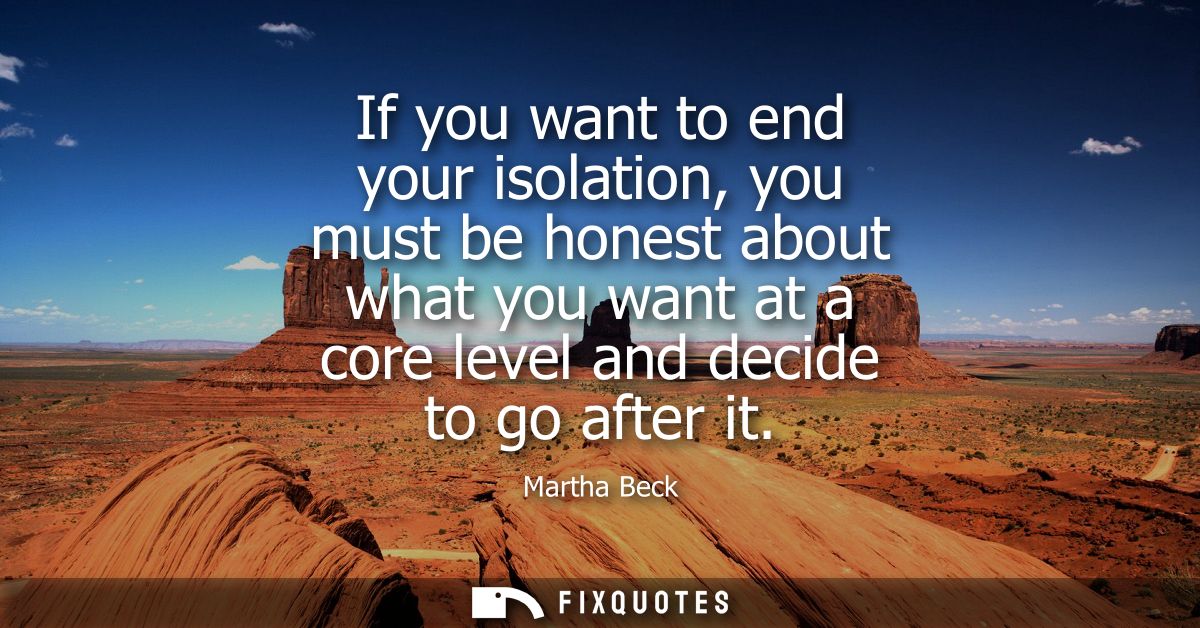
"If you want to end your isolation, you must be honest about what you want at a core level and decide to go after it"
About this Quote
The quote also smuggles in a critique of contemporary self-help culture’s gentler evasions. There’s no permission slip here to “honor your introversion” and call it a day. She’s asking for specificity and risk: “decide” and “go after it” are verbs of agency, not vibes. The subtext is that connection isn’t primarily won through likability hacks; it’s won through aligned behavior. You don’t end isolation by becoming more palatable. You end it by becoming more legible.
Context matters: Beck’s work often sits at the intersection of coaching, psychology, and personal reinvention, where candor is treated as a tool rather than a confession. In that ecosystem, honesty isn’t moral virtue; it’s strategy. The line lands because it flips the usual story. Isolation isn’t fate. It’s feedback: you’re not pursuing the life - and the people - you actually want.
Quote Details
| Topic | Self-Improvement |
|---|---|
| Source | Help us find the source |
| Cite |
Citation Formats
APA Style (7th ed.)
Beck, Martha. (2026, January 17). If you want to end your isolation, you must be honest about what you want at a core level and decide to go after it. FixQuotes. https://fixquotes.com/quotes/if-you-want-to-end-your-isolation-you-must-be-51599/
Chicago Style
Beck, Martha. "If you want to end your isolation, you must be honest about what you want at a core level and decide to go after it." FixQuotes. January 17, 2026. https://fixquotes.com/quotes/if-you-want-to-end-your-isolation-you-must-be-51599/.
MLA Style (9th ed.)
"If you want to end your isolation, you must be honest about what you want at a core level and decide to go after it." FixQuotes, 17 Jan. 2026, https://fixquotes.com/quotes/if-you-want-to-end-your-isolation-you-must-be-51599/. Accessed 27 Mar. 2026.